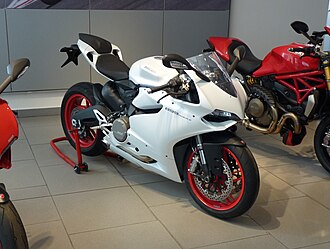
Ducati 899 Panigale: The Middleweight Superbike That Redefined Performance
The Ducati 899 Panigale occupies a special place in the history of modern superbikes. Introduced as a more accessible companion to the sensational 1199 Panigale, the 899 was designed to offer much of Ducati’s flagship superbike character in a package that was slightly smaller, more manageable, and particularly well suited to both enthusiastic road riding and track use. It combined Ducati’s unmistakable Italian styling with a compact Superquadro V-twin engine, sophisticated electronics, a lightweight chassis, Brembo brakes, and the radical Panigale design language that had replaced the traditional Ducati superbike formula.
Although it was produced for only a relatively short period, the Ducati 899 became an important model in the Panigale family. It represented a middle ground between conventional middleweight sportbikes and the increasingly extreme liter-class superbikes of its era. With approximately 148 horsepower, a 898cc L-twin engine, and a dry weight of around 169 kilograms, the 899 offered serious performance without requiring the rider to constantly manage the overwhelming output of a larger superbike. Its combination of compact dimensions, strong midrange torque, responsive handling, and sophisticated electronic assistance made it one of the most interesting performance motorcycles of the 2010s.
The Birth of the Ducati 899 Panigale
A Smaller Panigale With a Serious Mission
The Ducati 899 Panigale arrived in 2013 as the smaller sibling to the 1199 Panigale. The 1199 had already established itself as a radically different Ducati superbike, replacing the company’s traditional trellis-frame architecture with a compact monocoque-style front structure and introducing the highly advanced Superquadro engine. Ducati’s challenge with the 899 was to preserve that identity while creating a motorcycle with a more approachable balance of power and weight.
Rather than simply reducing the displacement of the 1199 engine, Ducati developed an 898cc version of the Superquadro V-twin. The engine retained the 90-degree L-twin configuration and desmodromic valve actuation that had become synonymous with Ducati, while adopting dimensions suited to its smaller displacement. Ducati claimed approximately 148 horsepower at 10,750 rpm and 99 Nm of torque at 9,000 rpm, giving the 899 enough performance to qualify as a genuine superbike while remaining considerably less intimidating than some of the larger machines in the class.
The motorcycle also benefited from the visual identity established by the 1199. Its narrow fairing, aggressive front end, compact tail, single-sided rear styling, and exposed mechanical elements created a motorcycle that looked unmistakably like a member of the Panigale family.
Why the 899 Was Different
The importance of the 899 was that Ducati did not treat it simply as an entry-level Panigale. It was a carefully engineered motorcycle in its own right. The smaller engine altered the character of the bike, while the chassis and electronics were designed to complement the available performance.
This created an interesting proposition. The 1199 and later 1299 were designed to deliver extraordinary outright performance, whereas the 899 could often be ridden closer to its limits on the road and on many racetracks. The rider had access to substantial power without the same level of intimidation associated with a 200-horsepower-class superbike.
That balance ultimately became one of the 899’s greatest strengths.
The 898cc Superquadro Engine
Ducati’s Compact V-Twin
The heart of the Ducati 899 is its 898cc Superquadro engine. The name “Superquadro” refers to the engine’s highly oversquare design, with a large bore relative to stroke. This configuration allows the engine to operate at high rotational speeds while supporting strong airflow through the cylinder head.
The 90-degree V-twin uses liquid cooling, four valves per cylinder, electronic fuel injection, and Ducati’s desmodromic valve system. The engine is compact and relatively light, helping Ducati achieve the mass centralization required for sharp sportbike handling.
With a claimed 148 horsepower, the 899 was significantly more powerful than many traditional middleweight motorcycles. Yet the engine’s personality was not defined solely by its peak output. The V-twin layout produced strong acceleration throughout the usable rev range, allowing the rider to drive hard out of corners without constantly chasing maximum engine speed.
The engine also provided the distinctive character that Ducati enthusiasts expected. Throttle response, intake noise, exhaust note, and the mechanical feel of the L-twin all contributed to a riding experience that felt very different from the inline-four engines commonly found in Japanese supersport motorcycles.
Superquadro and Desmodromic Technology
The desmodromic valve system is one of Ducati’s most recognizable engineering features. Conventional engines generally rely on valve springs to close the valves after they have been opened by the camshaft. Ducati’s desmodromic system mechanically controls both the opening and closing of the valves.
In the 899, this technology helped Ducati maintain precise valve control at high engine speeds while supporting the engine’s performance-oriented character. It was part of a broader engineering philosophy in which the engine was designed not merely to provide transportation but to become a major part of the motorcycle’s personality.
For enthusiasts, this mechanical sophistication is part of the attraction of owning an 899. It also means that maintenance history is particularly important when purchasing a used example.
The Panigale Chassis
A Radical Departure From Ducati’s Traditional Trellis Frame
One of the most important characteristics of the 899 Panigale is its chassis architecture. Ducati moved away from the large tubular trellis frame associated with earlier superbikes and instead used a compact monocoque-style front structure.
The engine itself became an important structural component of the motorcycle. This allowed Ducati to reduce the amount of separate frame material and create a compact chassis around the engine.
The approach contributed to the Panigale’s distinctive appearance. Instead of a visually dominant frame surrounding the engine, the motorcycle appears much more tightly packaged. The fairing, engine, airbox, and chassis all seem to occupy a single compact space.
This architecture also helped Ducati pursue its goals of low weight and centralized mass. A sportbike responds more quickly when unnecessary mass is removed and major components are positioned close to the motorcycle’s center.
Lightweight Construction
The 899’s dry weight was approximately 169 kilograms, although ready-to-ride weight is naturally higher once fuel, oil, and other operating fluids are included. For a motorcycle producing around 148 horsepower, this represented an impressive power-to-weight ratio.
Weight reduction is particularly valuable on a motorcycle intended for both road and track use. A lighter motorcycle requires less braking force to slow down, changes direction more easily, and places less demand on tires and suspension.
The 899 therefore demonstrated that performance is not simply about engine output. Its relatively low mass was just as important to its overall character.
Suspension and Braking
Sportbike Hardware
The Ducati 899 was equipped with high-performance suspension designed to complement its powerful engine and lightweight chassis. At the front was a fully adjustable upside-down fork, while the rear used a fully adjustable monoshock arrangement.
Suspension setup is especially important on a motorcycle like the 899 because the machine can be used in very different environments. A road-oriented setting can prioritize compliance and stability over imperfect surfaces, while a track setup can be considerably firmer and more controlled.
Braking performance was equally important. The 899 used Brembo radial-mount front brake calipers operating on large dual discs. The braking system provided the stopping power expected from a genuine superbike and worked with Ducati’s electronic ABS system.
Strong brakes are essential on a motorcycle capable of reaching high speeds quickly. On a racetrack, the ability to brake late and repeatedly is one of the biggest determinants of lap time, while on public roads powerful and predictable braking provides an important safety margin.
Ducati 899 Electronics
Riding Modes and Traction Control
The 899 Panigale arrived during a period when electronic rider aids were becoming increasingly sophisticated on production motorcycles. Ducati equipped the motorcycle with multiple riding modes, traction control, ABS, and other electronic systems designed to manage its performance.
Riding modes allowed the character of the motorcycle to be adapted to different situations. The rider could select a setting that modified throttle response and electronic intervention, creating a more manageable motorcycle for everyday riding or a more aggressive setup for performance use.
Ducati’s traction control system was particularly useful when exploiting the engine’s torque. Rather than simply limiting power whenever wheelspin was detected, the system was designed to provide different levels of intervention according to the selected mode.
Quickshifter and Engine Braking
The 899 also offered Ducati’s electronic quickshift technology, allowing rapid upshifts without requiring the rider to close the throttle or operate the clutch in the conventional manner. This became especially valuable on a racetrack, where minimizing interruptions in acceleration can improve lap times.
Engine-braking management was another important aspect of the motorcycle’s electronics. Aggressive downshifting on a powerful V-twin can generate substantial rear-wheel deceleration, so electronic management helps maintain stability during hard braking and corner entry.
Together, these systems transformed the 899 from a purely mechanical superbike into a sophisticated electronic performance platform.
Riding the Ducati 899 Panigale
On the Street
Despite its racetrack-oriented appearance, the 899 can be used effectively on public roads. Its relatively compact dimensions and manageable weight make it easier to maneuver than many larger superbikes.
The riding position is nevertheless committed. The rider leans forward over the tank, the footpegs are positioned relatively high, and the motorcycle is clearly designed around sporty riding rather than relaxed touring.
At moderate speeds, the 899’s engine provides strong acceleration without requiring the rider to explore its highest rpm range. This makes it possible to enjoy the motorcycle’s performance on winding roads without constantly reaching extreme speeds.
The downside is that the aggressive ergonomics and firm suspension can become tiring on long journeys. The 899 is fundamentally a sportbike, and its comfort is secondary to handling and performance.
On the Racetrack
The racetrack is where the 899 makes the most sense. Its lightweight construction, strong brakes, responsive engine, advanced electronics, and precise chassis combine into a very capable track platform.
The engine’s output is substantial enough to provide rapid acceleration without overwhelming the rider as easily as a larger superbike can. This can make the 899 particularly rewarding for riders developing their track skills.
Instead of constantly managing excessive horsepower, the rider can concentrate on braking points, corner speed, body position, throttle control, and smooth transitions. The motorcycle therefore encourages technique.
The Ducati 899 vs. the 1199 Panigale
Two Different Approaches to Performance
The 899 and 1199 share much of their visual identity and basic engineering philosophy, but they offer distinctly different experiences. The 1199’s larger 1,198cc Superquadro engine produces considerably more power and torque, making it a much more extreme machine.
The 899 sacrifices some outright performance in exchange for greater accessibility. Its smaller engine can be easier to exploit, particularly on tighter circuits where maximum horsepower is not always the decisive factor.
For a rider choosing between the two used motorcycles, the decision often comes down to priorities. Someone who wants maximum acceleration and superbike performance may prefer the 1199, while a rider looking for a motorcycle that offers an engaging balance of power and handling may find the 899 more attractive.
The 899 also occupies an interesting place between the traditional 600–750cc supersport category and the liter-class superbike segment. It offers significantly more performance than a conventional middleweight while retaining a relatively manageable overall character.
Special Versions and the 899 Panigale
The 899 was offered in different finishes and specifications during its production run, although it did not develop the enormous range of derivatives associated with some other Ducati models. Its role was primarily to provide a more approachable Panigale rather than to become a separate family of increasingly extreme variants.
That simplicity is now part of the model’s appeal. The 899 represents a very specific point in Ducati’s development: the company had embraced the Panigale architecture, advanced electronic rider aids were becoming standard, and the Superquadro V-twin remained at the center of the superbike range.
Buying a Used Ducati 899
Service History Is Essential
Because the 899 is now an older performance motorcycle, maintenance history should be one of the first things a prospective buyer investigates. Ducati engines require proper servicing, and the desmodromic valve system means valve-clearance inspections are particularly important.
The timing-belt system should also be maintained according to Ducati’s recommended schedule for the relevant model and market. Brake fluid, coolant, engine oil, filters, chain condition, suspension seals, tires, and battery condition should all be checked.
A clean motorcycle with documented maintenance is generally a much better proposition than an apparently inexpensive example with an uncertain history.
Inspecting a Former Track Bike
The 899’s capabilities mean that some examples will have spent significant time on racetracks. Track use is not automatically a reason to reject a motorcycle. A well-maintained track machine can be mechanically healthier than a neglected street bike.
However, buyers should inspect for crash damage, replacement fairings, scratched engine covers, altered wiring, aftermarket electronics, worn steering-head bearings, suspension wear, and excessive brake or clutch use.
It is also worth checking that the motorcycle’s electronic systems operate correctly and that any modifications can be returned to an appropriate road specification if necessary.
The Legacy of the Ducati 899
The Ducati 899 Panigale was eventually succeeded by the Panigale V2, which continued the idea of a smaller Ducati superbike but introduced a 955cc Superquadro engine and further technical development.
The 899 therefore represents a transitional point in Ducati’s history. It was one of the final Ducati superbikes to combine the revolutionary Panigale chassis concept with the company’s compact V-twin superbike philosophy before the four-cylinder V4 became the centerpiece of Ducati’s flagship racing-derived machines.
Its legacy is not based on being the most powerful Ducati ever built. Instead, it is remembered for its balance. The motorcycle had enough power to feel genuinely exotic, but its output was still manageable enough for skilled riders to exploit more frequently than the enormous power of larger superbikes.
Final Thoughts on the Ducati 899
The Ducati 899 Panigale remains one of the most compelling middleweight superbikes of its generation. It combined Ducati’s unmistakable design language with a high-revving 898cc Superquadro V-twin, lightweight construction, sophisticated electronics, powerful Brembo brakes, and a chassis designed around performance.
Its greatest strength was balance. The 899 was fast enough to deliver genuine superbike excitement but not so powerful that the rider could rarely use the engine’s capabilities. On the road, it offered thrilling acceleration and responsive handling, while on a racetrack it provided an excellent platform for learning and refining performance-riding technique.
The motorcycle also represents an important moment in Ducati’s evolution. It belonged to the Panigale generation that abandoned the traditional trellis-frame architecture, embraced a more integrated chassis, and increasingly relied on electronics to manage high levels of performance. At the same time, it retained the distinctive character of Ducati’s 90-degree V-twin engine and desmodromic valve technology.
Today, the 899 Panigale remains attractive to riders who want a motorcycle with genuine Italian superbike character without necessarily stepping into the extreme performance territory of larger Panigale models. Its combination of compact dimensions, relatively low weight, strong engine performance, and unmistakable styling gives it a personality that remains highly desirable.
The Ducati 899 was never simply a smaller 1199. It was a carefully balanced interpretation of the Panigale concept, and that is exactly what makes it memorable. It delivered the drama, sound, technology, and visual presence associated with Ducati while offering a level of performance that could be used more fully by a skilled rider. For enthusiasts looking for a modern classic from Ducati’s V-twin superbike era, the 899 Panigale remains a particularly compelling choice.
Ducati 899 Panigale Technical Specifications
The following figures summarize the commonly published specifications for the Ducati 899 Panigale. Exact figures can vary slightly by market, model year, and measurement method.
| Specification | Ducati 899 Panigale |
|---|---|
| Motorcycle type | Supersport / superbike |
| Production period | 2013–2015 |
| Engine | Liquid-cooled 90° L-twin |
| Displacement | 898 cc |
| Bore × stroke | 100 × 57.2 mm |
| Compression ratio | Approx. 12.5:1 |
| Valve system | Desmodromic, 4 valves per cylinder |
| Cooling | Liquid-cooled |
| Fuel system | Electronic fuel injection |
| Maximum power | Approx. 148 hp @ 10,750 rpm |
| Maximum torque | Approx. 99 Nm @ 9,000 rpm |
| Transmission | 6-speed |
| Final drive | Chain |
| Frame/chassis | Monocoque-style aluminum front structure |
| Front suspension | Fully adjustable upside-down fork |
| Rear suspension | Adjustable monoshock |
| Front brakes | Twin Brembo radial-mount discs |
| Rear brake | Single disc |
| Front wheel | 17-inch |
| Rear wheel | 17-inch |
| Front tire | 120/70 ZR17 |
| Rear tire | 180/60 ZR17 |
| Wheelbase | Approx. 1,426 mm |
| Seat height | Approx. 830 mm |
| Dry weight | Approx. 169 kg |
| Fuel capacity | Approx. 17 L |
| Electronics | Riding modes, traction control, ABS, engine-brake management |
| Quickshifter | Ducati Quick Shift |
| Instrumentation | Digital/LCD racing-style display |
| Exhaust configuration | Under-engine exhaust system |
| Main character | Lightweight, high-performance V-twin superbike |
