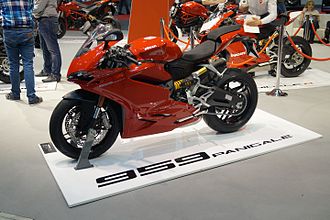
Ducati 959 Panigale: A Complete Guide to Ducati’s V-Twin Superbike
The Ducati 959 Panigale is one of the most important motorcycles in Ducati’s modern superbike history because it successfully carried forward the company’s V-twin performance philosophy while refining the Panigale platform for a new generation of riders. Introduced as the successor to the Ducati 899 Panigale, the 959 brought increased engine displacement, stronger performance, updated electronics, revised styling, and improved emissions equipment while retaining the compact proportions and aggressive character that made the Panigale name famous. It arrived at an interesting moment for Ducati, when the company was developing increasingly sophisticated electronics and simultaneously preparing to transition its flagship superbike range toward the V4-powered Panigale.
The 959 Panigale was never simply a larger version of the 899. Ducati revised the engine, exhaust system, electronics, aerodynamics, and chassis while preserving the lightweight architecture of the smaller model. Its 955cc Superquadro L-twin produced approximately 157 horsepower in European specification and around 155 horsepower in some other markets, giving the motorcycle a remarkable power-to-weight ratio. The combination of a high-revving desmodromic engine, aluminum monocoque-style chassis, Brembo braking system, advanced rider aids, and unmistakable Italian styling made the 959 one of the most accomplished middleweight superbikes of its generation.
The Birth of the Ducati 959 Panigale
The Successor to the 899
The Ducati 899 Panigale had established a compelling position between conventional middleweight sportbikes and extreme liter-class superbikes. Ducati recognized the appeal of that formula and developed the 959 as its direct successor.
Introduced for the 2016 model year, the 959 retained the fundamental Panigale architecture but increased engine displacement to 955cc. The additional capacity came from revised bore and stroke dimensions, with the engine using a 100mm bore and 60.8mm stroke. The larger displacement helped Ducati increase both power and torque while maintaining the high-revving character expected from a Superquadro engine.
The 959 also received updated electronics and revised bodywork. One of the most visible changes was the redesigned exhaust arrangement required to meet increasingly strict emissions regulations. Some enthusiasts preferred the compact under-engine exhaust of the 899, but the 959’s revised system was an important part of making the motorcycle compliant with contemporary regulations.
A Panigale for the Real World
The philosophy behind the 959 was particularly interesting because Ducati did not try to make it simply as extreme as possible. The motorcycle had serious superbike performance, but its engine was smaller and more manageable than the flagship Panigale models.
That balance made the 959 attractive to riders who wanted a genuine Ducati superbike but did not necessarily need the enormous output of the 1299. On the road, 150-plus horsepower was already more than enough to provide extraordinary acceleration. On the track, the lower output could actually make the motorcycle easier to exploit.
The 959 therefore occupied an appealing middle ground: considerably more serious than an ordinary middleweight sportbike, yet less intimidating than Ducati’s flagship superbikes.
The 955cc Superquadro Engine
A Larger Evolution of Ducati’s V-Twin
The heart of the Ducati 959 is its 955cc Superquadro engine. Like the 899’s engine, it uses a 90-degree L-twin configuration, liquid cooling, four valves per cylinder, electronic fuel injection, and desmodromic valve actuation.
Ducati’s European specification listed approximately 157 horsepower at 10,500 rpm and 107 Nm of torque at 9,000 rpm. The engine was designed to deliver strong performance throughout the rev range rather than relying exclusively on its peak power figure.
The 100mm bore and 60.8mm stroke provide the engine with an oversquare configuration that supports high engine speeds. This is an important part of the Superquadro philosophy. Ducati was able to extract substantial power from a relatively compact V-twin without making the engine physically enormous.
The result is an engine that feels increasingly energetic as the revs rise. At lower speeds, the motorcycle can be relatively tractable, but the character becomes much more aggressive as the engine approaches its upper range.
Desmodromic Valve Technology
The 959 also continued Ducati’s famous desmodromic valve system. Rather than relying entirely on conventional valve springs, Ducati uses mechanical control for both valve opening and closing.
This technology has been associated with Ducati for decades and became an important part of the company’s racing and production-engine identity. In the 959, it helped support the engine’s high-rpm operation while maintaining precise valve control.
For owners, however, the technology also means that scheduled valve-clearance inspections are an important part of maintenance. The motorcycle’s performance depends on precise mechanical condition, and a complete service history is particularly valuable when evaluating a used 959.
The Panigale Chassis
Moving Away From the Traditional Trellis Frame
One of the defining characteristics of the Panigale family is Ducati’s decision to move away from the traditional trellis frame. The 959 uses a compact aluminum monocoque-style front structure in which the engine plays an important structural role.
This design allows Ducati to reduce the amount of conventional frame material and create a compact motorcycle around the engine. It also contributes to the Panigale’s distinctive appearance, because the motorcycle does not have a large tubular frame surrounding the engine.
The architecture helps centralize mass and keep the motorcycle relatively light. This matters enormously on a sportbike because reducing weight improves acceleration, braking, cornering, and direction changes simultaneously.
Compact Dimensions
The 959 has a wheelbase of approximately 1,431mm and a dry weight of roughly 176kg, depending on specification and market. These dimensions give it a compact physical presence while retaining the stability required for high-speed riding.
The relatively low mass is particularly noticeable when the motorcycle is being moved from side to side. A rider does not have to fight a large amount of inertia when transitioning between corners, making the 959 feel responsive and precise.
This is one reason the 959 became popular with track-day riders. Its chassis provides enough stability to encourage confidence while remaining agile enough to reward aggressive cornering techniques.
Suspension and Braking Performance
High-End Components
The Ducati 959 was equipped with high-quality suspension and braking hardware appropriate for a serious superbike. The front suspension used an upside-down fork, while the rear featured a fully adjustable monoshock.
Suspension adjustment is critical on a motorcycle capable of such high speeds because the ideal setup varies significantly depending on rider weight, tire choice, road conditions, and riding style. A well-set-up 959 can feel remarkably composed, while incorrect suspension settings can reduce grip and confidence.
At the front, Brembo radial-mount brake calipers work with large dual discs. The braking system provides powerful deceleration and excellent feel, making it possible for skilled riders to brake aggressively for corners.
The 959 also incorporated Bosch-assisted ABS technology, helping manage braking intervention and providing additional security when conditions become unpredictable.
Ducati 959 Electronics
Riding Modes and Traction Control
The 959 Panigale arrived at a point when electronic rider aids had become essential components of modern superbikes. Ducati equipped the motorcycle with multiple riding modes, allowing riders to change how the engine and electronic systems respond.
The riding modes work with Ducati’s electronic throttle system and traction control to produce different levels of performance. A less aggressive setting can make the motorcycle easier to manage on the street, while a more aggressive mode provides sharper throttle response and greater freedom for performance riding.
Ducati Traction Control helps manage rear-wheel slip during acceleration. This is particularly useful when exiting corners because the engine can produce enough torque to overwhelm available grip under poor conditions.
Engine Brake Control and Quickshifting
The 959 also benefited from Ducati’s engine-braking management system, which helps control rear-wheel behavior during aggressive downshifts. This is particularly important with a high-performance V-twin, where closing the throttle and downshifting can create significant rear-wheel deceleration.
The motorcycle was also equipped with Ducati Quick Shift, allowing rapid upshifts without traditional clutch operation. On a racetrack, this technology allows riders to keep the throttle open and maintain acceleration during gear changes.
Together, these electronic systems make the 959 considerably easier to exploit than an older superbike with similar raw performance.
Riding the Ducati 959 Panigale
On the Road
The 959 is a serious sportbike, but its smaller engine and relatively compact dimensions make it surprisingly usable on the road. The riding position is aggressive but not unusual for a modern superbike, with low handlebars and rear-set foot controls encouraging the rider into a forward-leaning posture.
The engine provides enough torque that the rider does not need to constantly use the gearbox in ordinary road riding. At the same time, the upper half of the rev range delivers the explosive performance that makes the motorcycle exciting.
The biggest limitation is comfort. Long periods of riding can place significant pressure on the wrists, shoulders, and legs. Wind protection is considerably better than on a naked motorcycle, but the 959 is still designed around performance rather than relaxed touring.
For a rider who enjoys winding roads, however, these compromises may be easy to accept. The motorcycle feels most natural when the road becomes technical and the rider can use the chassis, brakes, and engine together.
On the Racetrack
The track is arguably the 959’s ideal environment. Its power level is high enough to deliver rapid lap times without making every throttle application a battle against excessive horsepower.
The motorcycle’s relatively low mass, responsive steering, powerful braking, and sophisticated electronics allow the rider to concentrate on technique. Corner entry, trail braking, body positioning, throttle control, and exit acceleration can all be explored without the motorcycle feeling impossibly demanding.
This makes the 959 particularly interesting for experienced riders who want to develop their track skills. It is fast enough to be genuinely exciting but still offers a degree of manageability that can be harder to find in larger superbikes.
Ducati 959 Panigale vs. Ducati 1299
Different Approaches to Superbike Performance
The 959 and 1299 were closely related in design but served different purposes within Ducati’s range. The 1299 used a 1,285cc Superquadro V-twin and produced substantially more power and torque, making it the more extreme machine.
The 959, by comparison, offered a more accessible version of the Panigale experience. Its engine was still exceptionally powerful for its displacement, but its output was easier to exploit.
On a road, the difference in usable performance can be smaller than the numbers suggest. Both motorcycles can reach speeds far beyond what public roads safely permit, but the 959 can feel more manageable when accelerating out of corners or making rapid direction changes.
For many riders, that balance is precisely what makes the 959 appealing.
Ducati 959 Panigale Corse
A More Track-Focused Version
Ducati also produced the Panigale 959 Corse, a more performance-focused version that incorporated premium components and racing-inspired upgrades.
The Corse featured higher-specification suspension, lightweight components, a special livery, and additional equipment aimed at riders who wanted to use the motorcycle on a racetrack. It demonstrated how much potential remained in the 959 platform beyond the standard motorcycle.
The Corse was not a completely different motorcycle, but its upgraded components made it particularly attractive to serious enthusiasts who wanted a more track-oriented package without immediately moving to a larger superbike.
Styling and Design
The Panigale Shape
The 959 remains one of the most visually distinctive motorcycles of its era. Its narrow front fairing, integrated lighting, sculpted fuel tank, compact tail section, and aerodynamic bodywork create a silhouette that looks purposeful even when the motorcycle is parked.
Ducati’s design philosophy has always placed enormous emphasis on the relationship between form and function. The fairing is shaped to manage airflow, the riding position is dictated by the requirements of high-speed riding, and the compact chassis contributes both to performance and appearance.
The motorcycle also looks substantially more sophisticated than older Ducati superbikes. The surfaces are smoother, the bodywork more tightly integrated, and the mechanical components are packaged into a compact overall form.
Buying a Used Ducati 959
What Owners Should Check
The 959 is now increasingly attractive on the used market, but prospective buyers should remember that it is a high-performance motorcycle with sophisticated mechanical and electronic systems.
A complete service history is one of the most important things to look for. Valve-clearance checks, timing-belt service, oil changes, brake-fluid replacement, coolant maintenance, and other scheduled work should have been performed according to Ducati’s recommendations for the specific motorcycle.
The engine should start cleanly, idle consistently, and respond smoothly to throttle inputs. Any unusual mechanical noise should be investigated rather than ignored.
Check for Track Use
Track use is relatively common among Panigale owners, and a motorcycle that has been used on a circuit should not automatically be considered undesirable. However, track riding can place additional stress on tires, brakes, clutch components, suspension, and engine systems.
Buyers should inspect the fairings for replacement panels, check the condition of engine covers and frame areas, and look carefully for evidence of crashes. Aftermarket exhaust systems, race electronics, rearsets, quickshifters, and other modifications should also be documented.
A well-maintained track bike can be an excellent purchase, but a motorcycle with unknown history deserves much greater caution.
The End of the V-Twin Panigale Era
The 959 represents an important transitional point in Ducati history. The motorcycle retained the company’s famous V-twin superbike architecture while Ducati was simultaneously developing the V4 technology that would eventually become the centerpiece of its flagship Panigale range.
The Panigale V4 arrived for 2018, using the 1,103cc Desmosedici Stradale engine and moving Ducati’s production superbike firmly into four-cylinder territory.
That transition made the 959 one of the final representatives of a major Ducati tradition. It combined the revolutionary Panigale chassis with a modern version of the 90-degree V-twin that had defined Ducati superbikes for generations.
For enthusiasts, this gives the 959 additional historical importance. It is not simply an older sportbike; it is part of the final chapter of Ducati’s large-scale V-twin superbike era.
Final Thoughts on the Ducati 959 Panigale
The Ducati 959 Panigale remains an impressive example of how a manufacturer can balance extreme performance with real-world usability. Its 955cc Superquadro L-twin delivers approximately 157 horsepower, while its relatively low weight and compact chassis allow the motorcycle to remain agile and responsive.
Its greatest strength is balance. The 959 is fast enough to provide genuine superbike thrills but not so powerful that the rider can rarely exploit the engine’s capabilities. On a racetrack, that makes the motorcycle an excellent tool for developing technique. On a winding road, it provides strong acceleration, precise handling, powerful braking, and the unmistakable mechanical character of a Ducati V-twin.
The motorcycle is also historically significant. It represents the mature development of Ducati’s Panigale V-twin platform immediately before the company’s transition to the V4 generation. Its Superquadro engine, monocoque-style chassis, advanced electronics, and aggressive styling demonstrate just how far Ducati’s superbike technology had evolved by the middle of the 2010s.
For riders considering a used Ducati today, the 959 remains an attractive option because it offers a combination that is increasingly difficult to find: serious superbike performance, relatively manageable power, sophisticated electronic assistance, and the character of Ducati’s traditional V-twin engine.
The Ducati 959 Panigale may no longer be the newest Panigale, but its combination of Italian design, advanced engineering, lightweight construction, and usable performance ensures that it remains one of the most interesting motorcycles from Ducati’s modern V-twin era.
Ducati 959 Panigale Technical Specifications
The following table summarizes commonly published specifications for the Ducati 959 Panigale. Figures can vary slightly according to market, model year, and measurement method.
| Specification | Ducati 959 Panigale |
|---|---|
| Motorcycle type | Superbike |
| Production period | 2016–2019 |
| Engine | Liquid-cooled 90° L-twin |
| Displacement | 955 cc |
| Bore × stroke | 100 × 60.8 mm |
| Compression ratio | Approx. 12.5:1 |
| Valve system | Desmodromic, 4 valves per cylinder |
| Cooling | Liquid-cooled |
| Fuel system | Electronic fuel injection |
| Maximum power | Approx. 157 hp @ 10,500 rpm |
| Maximum torque | Approx. 107 Nm @ 9,000 rpm |
| Transmission | 6-speed |
| Final drive | Chain |
| Frame | Aluminum monocoque-style front structure |
| Front suspension | Fully adjustable upside-down fork |
| Rear suspension | Fully adjustable monoshock |
| Front brakes | Twin Brembo radial-mount discs |
| Rear brake | Single disc |
| Front wheel | 17-inch |
| Rear wheel | 17-inch |
| Front tire | 120/70 ZR17 |
| Rear tire | 180/60 ZR17 |
| Wheelbase | Approx. 1,431 mm |
| Seat height | Approx. 830 mm |
| Dry weight | Approx. 176 kg |
| Fuel capacity | Approx. 17 L |
| Electronics | Riding modes, traction control, ABS, engine-brake management |
| Quickshifter | Ducati Quick Shift |
| Instrumentation | Digital LCD display |
| Engine family | Superquadro |
| Main character | High-performance V-twin superbike |
| Successor | Ducati Panigale V2 |
.jpg)