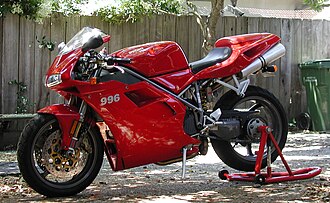
Ducati 996: The Evolution of an Italian Superbike Icon
The Ducati 996 occupies a special place in the history of Italian superbikes. It followed the legendary 916 at a time when Ducati had already created one of the most recognizable motorcycles of the modern era, yet the company understood that the machine could not simply remain unchanged. The answer was the 996, an evolution that increased engine capacity, strengthened performance and refined the chassis while preserving the fundamental design that had made the 916 so influential. Produced from 1999 to 2002, the 996 continued Ducati’s formula of a liquid-cooled 90-degree L-twin, desmodromic four-valve cylinder heads, electronic fuel injection and a tubular steel trellis frame, while introducing more displacement and progressively more sophisticated versions aimed at both road riders and World Superbike competition.
The 996 is sometimes overshadowed by the 916 that preceded it and the 998 that followed it, but that position in the middle of Ducati’s superbike lineage is exactly what makes it so interesting. The 996 refined the ideas established by Massimo Tamburini’s 916 rather than replacing them, and it became the motorcycle associated with one of Ducati’s most important World Superbike periods. By the time the factory racing program reached the 996 F01 in 2001, Troy Bayliss had won the riders’ championship and Ducati had secured its fourth consecutive manufacturers’ title. The production motorcycle and its racing derivatives therefore represented both the maturity of the 916 design and the final stages of Ducati’s Desmoquattro superbike era.
The Birth of the Ducati 996
Developing the 916 Formula
The 916 had given Ducati an extraordinary combination of beauty, performance and racing credibility, but competition never stands still. By the late 1990s, Ducati needed more engine capacity and greater performance if it was going to maintain its advantage in World Superbike racing. The answer was a larger version of the Desmoquattro engine, increasing displacement to 996 cc while retaining the same basic 90-degree L-twin architecture.
The larger engine was created with a 98 mm bore and 66 mm stroke in the standard 996 family, providing more capacity than the 916’s 94 × 66 mm configuration. This increase was not merely a marketing exercise. More displacement gave Ducati additional torque and allowed the engine to produce stronger performance without abandoning the fundamental characteristics that made its V-twin superbikes distinctive.
The 996 therefore represented a classic engineering evolution. Ducati did not throw away the successful formula. Instead, engineers took the architecture that had already proven itself on road and track and concentrated on improving the areas where additional performance could be gained.
That approach also explains why the 996 looks so familiar. At first glance, it can be difficult to distinguish an early 996 from a 916. The silhouette remained essentially intact because Ducati and its designers understood that the 916’s proportions were already exceptionally successful.
A Design That Refused to Age
The Tamburini Legacy
The 996 retained the defining visual elements introduced by Massimo Tamburini on the 916. The slim fairing, compact tail, under-seat exhaust system, twin headlights, exposed trellis frame and single-sided swingarm all remained central to the motorcycle’s identity.
This was important because the 916 had already become a design landmark. Rather than replacing an iconic shape with something completely new, Ducati refined it. The 996 looked slightly more purposeful and mature, but it remained immediately recognizable as part of the same family.
The under-seat exhausts were especially important. They allowed the tail section to remain narrow and clean while giving the motorcycle a distinctive visual balance. The single-sided swingarm similarly combined function and aesthetics, leaving the rear wheel exposed and simplifying wheel removal during competition.
The result was one of those rare motorcycles in which mechanical components became design elements. The trellis frame was not hidden behind plastic, the swingarm was not concealed, and the engine was visually central to the machine. The 996 looked like a motorcycle built around its mechanical architecture rather than a bodywork package wrapped around an engine.
Evolution Rather Than Revolution
One of the 996’s greatest strengths was restraint. Ducati could have dramatically redesigned the motorcycle, but doing so would have risked destroying the visual identity that had made the 916 famous.
Instead, the company allowed the design to mature. The proportions remained compact, the bodywork stayed tightly wrapped around the chassis, and the tail continued to rise sharply behind the rider. The motorcycle retained the aggressive stance that made the 916 so memorable while gaining a more substantial mechanical presence.
This is why the 996 has aged so well. It does not look like a motorcycle desperately trying to imitate modern trends. Its design was already sufficiently resolved that it required very little visual alteration.
The 996 Desmoquattro Engine
More Displacement, More Torque
The heart of the Ducati 996 was its 996 cc liquid-cooled 90-degree L-twin. It used double overhead camshafts, four desmodromic valves per cylinder and electronic fuel injection. Standard versions are commonly specified with a 98 × 66 mm bore and stroke and a compression ratio of approximately 11.5:1.
The larger bore allowed Ducati to retain the relatively short 66 mm stroke while increasing cylinder volume. This was advantageous for a high-performance engine because it permitted substantial displacement without forcing the crankshaft to operate at excessive piston speeds.
The engine retained the unmistakable Ducati character of the Desmoquattro family. Strong low- and midrange torque was combined with an increasingly urgent rush toward the upper part of the rev range. Unlike a four-cylinder superbike, the 996 did not rely entirely on high engine speed to generate acceleration. The large pistons and 90-degree configuration gave the motorcycle a substantial pulse that could be felt through the chassis.
That combination of torque and revving ability made the 996 particularly effective on a racetrack. The rider could exploit strong drive when leaving slower corners while still having enough top-end performance to remain competitive on fast sections.
Desmodromic Valve Control
The desmodromic valve system remained one of the defining technologies of the engine. Instead of using conventional springs to close the valves, Ducati’s mechanism mechanically controlled both the opening and closing movements.
This allowed the engine to maintain precise valve control at high rpm and became a fundamental part of Ducati’s performance-engine philosophy. It also gave the 996 an unmistakable mechanical identity.
The sound of the engine was part of the experience. The dry clutch, desmodromic valve gear, intake system and uneven firing character created a mechanical soundtrack that was completely different from the smoother sound of contemporary four-cylinder superbikes.
For many enthusiasts, that mechanical personality is just as important as the power figure.
Electronic Fuel Injection
The 996 continued Ducati’s development of electronic fuel injection that had begun with the 851 and matured through the 888 and 916 generations. The system used large throttle bodies to supply the two cylinders and provided much more precise fuel metering than the carburetors found on earlier Ducati superbikes.
The standard 996 is commonly quoted at around 112 horsepower at 8,500 rpm and approximately 93 Nm of torque at 8,000 rpm, although specifications vary according to model year and market.
Those figures need to be viewed in their historical context. A modern motorcycle may produce dramatically more power, but the 996 was developed during a period when 110-plus horsepower in a relatively lightweight superbike represented serious performance.
More importantly, the 996’s engine delivered its performance in a manner that made the numbers meaningful. The rider could feel the torque building through the chassis, and the engine’s response encouraged careful throttle control rather than simply relying on electronic intervention.
The Trellis Frame
Steel at the Center of the Motorcycle
The 996 retained Ducati’s tubular steel trellis frame, one of the company’s most recognizable engineering signatures. The frame used a network of steel tubes to create a rigid structure around the engine, while keeping the motorcycle narrow and relatively light.
The choice of steel was significant because many Japanese manufacturers were increasingly using aluminum twin-spar frames on their flagship sport bikes. Ducati’s trellis design was different in appearance and construction, but it remained highly effective.
The frame also made the engine an important structural and visual component of the motorcycle. Rather than hiding the mechanical center of the bike behind large frame spars, Ducati allowed the trellis structure to expose the engine.
This gave the 996 an almost architectural appearance. The frame, engine, swingarm and bodywork all seemed to interlock.
Compact Geometry
The 996 had a wheelbase of approximately 1,410 mm, with a seat height around 790 mm. These dimensions gave the motorcycle a compact, focused stance without making it excessively difficult to control.
The relatively compact wheelbase helped the motorcycle change direction quickly, while the low and narrow L-twin contributed to a centralized mass distribution. This was particularly valuable on a racetrack where rapid transitions between corners could make a major difference.
The rider’s position was deliberately aggressive. Low clip-on handlebars and high footpegs put the rider into a forward-biased stance that was ideal for circuit riding but demanding during long road journeys.
The 996 was never intended to be a touring motorcycle disguised as a sport bike. It was a road-legal superbike with racing priorities.
Suspension and Chassis Development
Showa and Öhlins Equipment
Suspension specifications varied between versions of the 996. Standard motorcycles used adjustable upside-down Showa forks and a rear monoshock, while higher-performance variants received more sophisticated components, including Öhlins rear suspension. The 996 SPS, for example, used an adjustable 43 mm Showa front fork and Öhlins rear shock.
The adjustable suspension was essential because the motorcycle could be used in dramatically different environments. A road rider might want a more compliant setup, while a racing rider required increased support under hard braking and acceleration.
The rising-rate rear linkage also helped maintain stability as suspension forces increased. Combined with the stiff trellis frame and single-sided swingarm, it provided the rider with a predictable connection between throttle input and rear-wheel behavior.
The 996 therefore rewarded riders who understood chassis setup. It was not simply a machine that could be ridden quickly in standard form; it could be tailored to suit different riders, tires and circuits.
Brembo Brakes
The braking system was equally serious. The 996 used twin 320 mm front discs with four-piston calipers and a 220 mm rear disc with a two-piston caliper in commonly cited specifications.
The large front discs were essential for a motorcycle capable of approaching 260 km/h. More importantly, they gave the rider the confidence to brake deeply into corners.
There was no modern cornering ABS or electronic brake management. The rider controlled everything through the front lever, and the quality of the chassis and brake hardware made that direct relationship possible.
This mechanical simplicity is one of the reasons modern enthusiasts find the 996 so engaging. It communicates clearly because there is comparatively little separating the rider from the hardware.
The Ducati 996 on the Road
A Demanding but Rewarding Motorcycle
The 996’s reputation as a difficult motorcycle is partly deserved. The riding position is aggressive, the steering is focused and the engine can feel abrupt at low speeds. Around town, it is not as relaxed as a modern sport-touring motorcycle.
Once the road opens up, however, the character changes dramatically. The engine becomes more responsive as the revs rise, the chassis begins to make sense and the rider can take advantage of the motorcycle’s compact proportions.
The V-twin’s torque is particularly useful on winding roads. Instead of constantly chasing the top of the rev range, the rider can select a gear and allow the engine to drive strongly through corners.
This is where the 996’s engineering philosophy becomes apparent. It was designed to make high-speed riding feel controlled rather than chaotic.
The Sound of the Dry Clutch
One of the most recognizable sounds associated with the 996 is its dry clutch. At idle, the clutch can produce a characteristic metallic rattle that enthusiasts either love or find strange.
For Ducati owners, however, that sound became part of the motorcycle’s personality. It was a mechanical reminder that the 996 was derived from a racing philosophy.
Combined with the V-twin exhaust note and desmodromic valve train, the result is a motorcycle that sounds highly mechanical even before it begins moving.
The 996 SPS
The Homologation Special
The 996 SPS represented a major step beyond the standard road model. Produced from 1999, the SPS was developed as a more focused, race-oriented version of the 996 and used a higher-performance 996 cc engine.
Period-derived specifications commonly list approximately 123 horsepower at 9,500 rpm and 99 Nm of torque, with a compression ratio of 11.5:1. The engine used electronic fuel injection and 50 mm throttle bodies.
The chassis was also upgraded. The SPS used adjustable suspension and an Öhlins rear shock, while retaining the 320 mm front brake discs and four-piston calipers of the standard machine.
The result was considerably closer to a competition motorcycle. Its dry weight is reported around 187–190 kg depending on the source and specification, while top speed was approximately 270 km/h.
The SPS was therefore not simply a more expensive 996. It was a serious homologation-oriented machine intended for riders who wanted substantially more performance.
The 996 S and Other Special Versions
Ducati also produced the 996 S, another high-performance variant positioned between the standard motorcycle and the more extreme SPS. Specifications for the 996 S commonly list around 128 horsepower at 9,250 rpm and 104 Nm at 8,000 rpm, although figures differ between sources and configurations.
These special models demonstrated how flexible the 996 platform had become. Ducati could create different levels of performance from the same basic architecture, allowing the company to serve ordinary road riders, serious enthusiasts and racing customers.
The variety of models also makes the 996 family particularly interesting to collectors. A standard Biposto, an S, an SPS and a later R may all carry the 996 name, yet their engineering specifications and historical significance can be dramatically different.
The Ducati 996R and the Testastretta Revolution
The Beginning of the Next Engine Generation
One of the most important 996 variants was the 996 R. It represented the transition from the Desmoquattro engine toward Ducati’s newer Testastretta architecture.
Ducati’s official account of the 996 F01 identifies the 996 R as the last season’s machine equipped with the Testastretta engine that replaced the previous Desmoquattro. This change was historically important because Testastretta became the foundation for Ducati’s next generation of high-performance engines.
The Testastretta design introduced more compact combustion chambers and revised valve angles, improving combustion efficiency and allowing Ducati to continue extracting more performance from the L-twin configuration.
The 996 R therefore represents something of a bridge between two eras. It retained the unmistakable 916/996 chassis and bodywork but introduced an engine architecture that would influence Ducati motorcycles well into the future.
The 996 and World Superbike
Troy Bayliss and the 2001 Championship
The racing story of the 996 reached one of its most important moments in 2001. Troy Bayliss made his full-time World Superbike debut with Ducati and rode the 996 F01 to the riders’ championship.
Ducati’s official heritage archive records six race wins and nine podiums for Bayliss during that season. Together with teammate Rubén Xaus, he also helped Ducati secure its fourth consecutive manufacturers’ championship.
The achievement was particularly significant because Bayliss would go on to become one of Ducati’s most celebrated World Superbike riders. He later won additional championships with the manufacturer, creating a racing legacy that extended far beyond the 996.
The 996 F01 therefore occupies an important place in Ducati’s racing history. It was not merely a continuation of the 916’s success; it was the motorcycle that carried Ducati into another championship-winning era.
A Proven Racing Formula
The success of the 996 on the circuit reinforced Ducati’s core philosophy. The manufacturer did not need four cylinders and enormous peak horsepower to compete with the Japanese superbikes.
Instead, it relied on a combination of strong V-twin torque, efficient combustion, excellent aerodynamics, low center of gravity and a highly developed chassis.
This formula worked exceptionally well under World Superbike regulations and gave Ducati a distinctive identity in racing.
The 996 was therefore both a road motorcycle and a technological demonstration of what Ducati could accomplish with the L-twin concept.
The 996 Versus the 916
It is tempting to view the 996 simply as a larger 916, but that description misses much of its significance.
The 916 established the visual language and basic architecture. The 996 refined the engine and chassis and matured the package for another generation of racing.
The 996’s increased displacement gave it greater torque and performance, while continuing development improved fueling, suspension and overall usability. In many respects, the 996 was the motorcycle the 916 had been designed to become.
For collectors, the two motorcycles therefore have slightly different personalities. The 916 is often regarded as the pure design icon, while the 996 represents the more developed and mechanically mature version of the same idea.
Both are important, but for different reasons.
The 996 and the 998
The Final Evolution
The 998 eventually replaced the 996, but the transition was not a rejection of the previous motorcycle. Instead, the 998 represented the final development of the Tamburini superbike architecture before Ducati moved to the radically different 999.
The 996 therefore sits near the end of one of Ducati’s most celebrated design eras. It retained the classic twin-headlight front end, under-seat exhausts and single-sided swingarm that had defined the 916 family.
The 998 would refine the engine further, but the basic visual identity remained.
For enthusiasts, this makes the 996 one of the final opportunities to experience Ducati’s original 916 concept in its mature form.
Ducati 996 Technical Specifications
The following table summarizes typical specifications for the standard Ducati 996. Exact figures varied according to model year, market and version, so the SPS, S and R should not be treated as mechanically identical to the standard Biposto.
| Specification | Ducati 996 |
|---|---|
| Production | 1999–2002 |
| Engine | Liquid-cooled 90° L-twin, 4-stroke |
| Displacement | 996 cc |
| Bore × stroke | 98 × 66 mm |
| Valve arrangement | DOHC, desmodromic, 4 valves/cylinder |
| Compression ratio | Approx. 11.5:1 |
| Fuel system | Electronic fuel injection |
| Throttle bodies | Approx. 50 mm |
| Maximum power | Approx. 112 hp @ 8,500 rpm |
| Maximum torque | Approx. 93 Nm @ 8,000 rpm |
| Transmission | 6-speed |
| Clutch | Hydraulic dry multi-plate |
| Final drive | Chain |
| Frame | Tubular steel trellis |
| Front suspension | Fully adjustable upside-down Showa fork |
| Rear suspension | Adjustable monoshock with rising-rate linkage |
| Front brakes | Twin 320 mm discs, 4-piston calipers |
| Rear brake | 220 mm disc, 2-piston caliper |
| Front tire | 120/70 ZR17 |
| Rear tire | 190/50 ZR17 |
| Wheelbase | Approx. 1,410 mm |
| Seat height | Approx. 790 mm |
| Fuel capacity | 17 litres |
| Dry weight | Approx. 198 kg |
| Top speed | Approx. 259–260 km/h |
| 996 SPS power | Approx. 123 hp |
| 996 SPS torque | Approx. 99 Nm |
| 996 SPS top speed | Approx. 270 km/h |
The Ducati 996’s Lasting Legacy
The Ducati 996 is one of those motorcycles whose importance becomes clearer when its entire history is considered. It did not have the shock value of the original 916, nor did it introduce the radically new appearance of the 999. Instead, it occupied the crucial middle ground where Ducati refined an already successful design until it reached a very high level of technical maturity.
The larger 996 cc engine gave the motorcycle stronger performance while retaining the unmistakable character of the Desmoquattro L-twin. The trellis frame kept the motorcycle narrow and responsive, the single-sided swingarm provided both practical and aesthetic benefits, and the adjustable suspension and Brembo brakes gave the chassis the capability expected of a genuine superbike.
Its racing achievements added another layer of importance. Troy Bayliss’s 2001 World Superbike championship on the 996 F01 helped establish one of the most successful rider-manufacturer relationships in modern production-based racing, while Ducati’s fourth consecutive manufacturers’ championship demonstrated the strength of the entire racing program.
The 996 also marked the beginning of a major technical transition. The arrival of the Testastretta-powered 996 R showed that Ducati was already preparing the next generation of engines. That development would eventually lead to the 998 and later superbikes, but the 996 remained the final mature expression of the Desmoquattro concept in the famous 916 family.
Perhaps the greatest achievement of the 996 is that it managed to improve an already legendary motorcycle without destroying what made it special. It became larger, faster and more sophisticated, yet it retained the essential character of the original design.
Today, the Ducati 996 remains desirable because it represents a remarkably complete package. It has the visual drama of the 916, the additional performance of the larger engine, the mechanical personality of the desmodromic L-twin and the racing credibility of a genuine World Superbike champion.
For riders and collectors, that combination is difficult to replicate. Modern superbikes are objectively faster, lighter and more electronically sophisticated, but the 996 belongs to a period when the rider remained directly connected to the engine, brakes and chassis. Its dry-clutch rattle, V-twin pulse, trellis frame and compact riding position provide an experience that feels fundamentally mechanical.
The Ducati 996 was therefore not simply the successor to the 916. It was the model that demonstrated how far the 916 concept could be developed. It took one of the most influential motorcycle designs of the 1990s, increased its capacity, sharpened its performance and carried it to another World Superbike championship.
That is why the 996 deserves to stand alongside the 916 as one of Ducati’s defining superbikes. The 916 may have created the legend, but the 996 proved that the legend could evolve without losing its soul.
