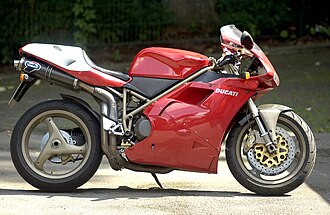
Ducati 916: The Iconic Italian Superbike That Redefined Motorcycle Design
Few motorcycles have had the cultural impact of the Ducati 916. When it appeared at the Milan Motorcycle Show in October 1993, it did not simply replace the successful Ducati 888; it changed expectations about what a superbike could look like and established a design language that would influence Ducati motorcycles for decades. Created by Massimo Tamburini, the 916 brought together sculptural Italian styling, a compact 90-degree L-twin, desmodromic four-valve technology, a steel trellis frame and serious racing capability in one extraordinarily coherent package. Ducati itself describes the 916 as the ultimate expression of its DNA and notes that it combined style, sophistication and performance in a way that made it an instant classic.
The 916 was also much more than a beautiful motorcycle. Its importance came from the way its design and engineering worked together. The narrow waist, aggressive fairing, under-seat exhausts, single-sided swingarm and distinctive twin headlights created an unmistakable silhouette, while the chassis and engine were developed around the demands of World Superbike racing. The standard 916 produced around 114 horsepower at 9,000 rpm according to Ducati’s heritage specification, with a claimed top speed of approximately 260 km/h and a dry weight of 195 kg.
Behind those figures was the culmination of Ducati’s Desmoquattro development. The 916 inherited the essential engineering philosophy of the 851 and 888, but Tamburini and Ducati’s engineers refined almost every part of the motorcycle. The result was a superbike that became one of the defining motorcycles of the 1990s and the foundation for an entire family that would include the 996, 998 and numerous limited-edition racing homologation machines.
The Birth of the Ducati 916
From the 851 and 888 to a New Generation
The 916 did not emerge from nowhere. Its mechanical roots can be traced directly to Ducati’s 851 and 888 superbikes, which had established the company’s four-valve, liquid-cooled, fuel-injected V-twin formula. Those motorcycles had already achieved extraordinary success in World Superbike competition, but Ducati needed a new machine capable of carrying that success into the next generation.
The 888 had become a formidable racing motorcycle, yet its basic design was reaching the limits of its development. Ducati wanted something more compact, more aerodynamic and visually distinctive. The new motorcycle would retain the 90-degree L-twin and trellis frame, but virtually everything around that foundation would be reconsidered.
The result was unveiled publicly in Milan in October 1993. Ducati’s heritage archive describes the 916 as an immediate icon and identifies it as the motorcycle that laid the foundations for the most successful family in Ducati’s Superbike history.
The significance of that debut is difficult to appreciate from a modern perspective because many of the 916’s design features have become familiar. At the time, however, the motorcycle looked radically different from its predecessors and from most of its competitors. It was extremely compact, visually low and aggressive, yet remarkably clean in profile.
Massimo Tamburini’s Masterpiece
Designing a Motorcycle Like a Sculpture
The name most closely associated with the 916 is Massimo Tamburini. Already an influential motorcycle designer and one of the founders of Bimota, Tamburini approached the 916 almost as a sculptor rather than simply an engineer concerned with packaging components.
The design philosophy was based on reduction. Every visible element needed to serve a purpose, and unnecessary visual mass was eliminated. The bodywork flowed tightly around the engine and chassis, while the tail section became dramatically narrower toward the rear. The result was a motorcycle that looked fast even when standing still.
One of Tamburini’s most famous design decisions was the use of under-seat exhaust silencers. Moving the exhausts beneath the tail section freed the sides of the motorcycle and helped create the clean, narrow profile that became one of the 916’s defining characteristics.
The single-sided swingarm added another layer of visual drama. Rather than hiding the rear wheel behind a conventional double-sided swingarm, Ducati left the wheel beautifully exposed. This was functional as well as aesthetic because the single-sided arrangement simplified wheel removal during racing.
Ducati’s heritage material describes Tamburini’s development process as highly tactile. Rather than relying solely on conventional wind-tunnel development, he reportedly rode prototypes in rainy conditions between San Marino and Rimini, studying how water flowed over the bodywork to understand aerodynamic behavior.
That approach helps explain why the 916 feels so carefully sculpted. Its aerodynamic surfaces are not separate from its styling; the design itself is an expression of airflow.
The Shape That Became a Ducati Signature
The narrow front fairing, centrally positioned air intake, compact windscreen and distinctive headlights created an instantly recognizable face. The rear section was equally important, tapering aggressively behind the rider and integrating the exhaust system beneath the seat.
The 916 also demonstrated that a motorcycle could be visually dramatic without being overloaded with decoration. There were few unnecessary surfaces or ornaments. The exposed trellis frame, single-sided swingarm and mechanical components supplied most of the visual interest.
This restraint became enormously influential. Ducati’s subsequent superbikes retained many of the same principles, and competitors across the industry began adopting similar approaches to compact tail sections, exposed mechanical components and visually integrated exhaust systems.
The Ducati 916 Engine
A Refined Desmoquattro V-Twin
At the heart of the 916 was a liquid-cooled 90-degree L-twin with four valves per cylinder and desmodromic valve actuation. The engine displaced 916 cc, using a 94 mm bore and 66 mm stroke. Its compression ratio was approximately 11.0:1 in standard form.
The engine represented the mature road-going form of Ducati’s Desmoquattro architecture. The four-valve cylinder heads allowed the relatively compact twin to breathe efficiently at high rpm, while the desmodromic system mechanically controlled valve opening and closing.
Unlike a conventional spring-return valve system, Ducati’s desmodromic arrangement used dedicated mechanisms to close the valves. This allowed the engineers to maintain accurate valve control at high engine speeds and became one of the defining mechanical features of Ducati’s performance motorcycles.
The 916’s engine was not simply about maximum horsepower. The 90-degree configuration produced a distinctive power delivery characterized by substantial midrange torque and a strong surge as engine speed increased. This suited the motorcycle’s racing-oriented chassis particularly well because the rider could exploit the engine’s torque when exiting corners rather than relying exclusively on very high rpm.
Electronic Fuel Injection
Electronic fuel injection was another essential part of the Desmoquattro formula. Ducati had already developed fuel injection through the 851 and 888, but the 916 benefited from the continuous development of the system.
Fuel injection gave Ducati much greater control over mixture preparation and engine response than the carburetors used on its earlier high-performance motorcycles. It also made it possible to develop increasingly sophisticated race engines, with fueling and ignition settings optimized for different configurations.
For the rider, the result was a highly responsive engine that felt distinctly different from the four-cylinder superbikes dominating much of the Japanese market. The Ducati did not produce the same smooth, turbine-like rush. Instead, it delivered a muscular, rhythmic acceleration that became a central part of the 916 experience.
Performance That Matched the Styling
The standard 916 produced approximately 114 horsepower at 9,000 rpm according to Ducati’s official heritage data. Other period specifications and markets sometimes quote slightly different outputs, with figures around 109–113 horsepower appearing for certain road versions. Torque figures also vary according to specification and measurement method.
Regardless of the exact published number, the 916 was an extremely fast motorcycle for its era. Its aerodynamic bodywork, relatively compact dimensions and strong V-twin torque gave it a combination of acceleration and high-speed stability that made it a genuine superbike rather than simply a sporting road motorcycle.
Contemporary specifications commonly place the top speed around 255–260 km/h for standard road versions. The official Ducati heritage specification gives 260 km/h.
The motorcycle’s performance was particularly impressive because Ducati’s philosophy did not revolve around producing the largest possible engine. The 916 relied on its balance of power, weight, aerodynamics and chassis behavior.
This was precisely what Tamburini’s design philosophy demanded. The motorcycle needed to feel like a smaller machine with the performance of something much larger.
The Trellis Frame
Steel With a Purpose
The 916 retained Ducati’s tubular steel trellis frame, linking the steering head and rear structure around the engine. In an era when aluminum twin-spar frames were increasingly common, Ducati’s continued use of steel tubing might initially have appeared conservative.
In reality, the trellis frame was perfectly suited to Ducati’s philosophy. It provided a strong, lightweight structure while allowing the engine to remain visually prominent. The individual tubes also contributed to the motorcycle’s distinctive appearance.
The frame was designed to work with the engine rather than merely hold it. The compact L-twin configuration allowed Ducati to keep the motorcycle narrow, while the chassis geometry was developed to provide rapid steering response without sacrificing stability.
The result was a motorcycle that felt remarkably concentrated. The rider sits close to the machine’s center of mass, and the narrow engine and chassis allow the 916 to change direction with relatively little effort.
A New Approach to the Swingarm
The single-sided aluminum swingarm was another defining component. It provided an exceptionally clean visual connection between the rear wheel and chassis while allowing rapid wheel removal.
For a road rider, the arrangement was visually spectacular. For a racing team, the ability to remove the rear wheel quickly was a genuine practical advantage.
The swingarm also reinforced the 916’s design philosophy: mechanical components were not hidden simply because they were functional. Instead, Ducati made them part of the motorcycle’s visual identity.
Suspension and Brakes
The 916’s chassis was equipped with serious suspension hardware appropriate for a racing-derived superbike. The standard motorcycle used an upside-down front fork and a rising-rate rear suspension system, while higher-performance variants received upgraded components.
The suspension allowed the rider to adjust the motorcycle for different conditions and riding styles. On a circuit, this meant the machine could be set up for braking stability, cornering grip and acceleration traction; on the road, the adjustability provided the ability to compensate for rider weight, luggage and tire characteristics.
Braking performance was equally important. The motorcycle used twin front discs with four-piston calipers and a rear disc brake. The large front brakes gave the 916 the ability to shed speed aggressively before corners, an essential feature for a machine developed with World Superbike racing in mind.
The combination of powerful brakes, compact dimensions and sophisticated suspension gave the 916 an unusually cohesive chassis. Every component seemed to support the same objective: maximum control at high speed.
The Riding Position
Built Around the Rider
The 916 is beautiful to look at, but sitting on one quickly makes it clear that beauty was not the only priority. The riding position is compact and committed, with relatively high footpegs, low handlebars and a narrow seat.
This arrangement makes sense on a racetrack. The rider can move around the motorcycle, place weight over the front end and maintain a tucked aerodynamic position at high speed. On ordinary roads, however, the same characteristics make the 916 demanding.
The motorcycle was never intended to be a relaxed commuter. It was a road-legal superbike designed around the requirements of performance riding. The low screen, narrow body and forward-biased riding position put the rider into the machine rather than simply sitting on top of it.
That uncompromising character is part of its appeal. The 916 does not pretend to be practical transportation.
The 916 Biposto
A More Usable Version
Ducati eventually introduced the 916 Biposto, adding a passenger seat and associated equipment. The change broadened the motorcycle’s usefulness without fundamentally altering its identity.
The Biposto became an important model because it demonstrated that the 916 could be adapted for road use while retaining the essential styling and performance that made the original motorcycle so compelling.
Later standard versions were also refined in areas such as fueling, suspension and engine management. Published specifications show that power ratings varied during the production run, with later Biposto and related versions commonly listed around 109 horsepower.
The differences may appear minor today, but continuous development was essential for Ducati. The 916 family was simultaneously serving road riders, collectors and racing homologation requirements.
The Ducati 916 SPS
From Road Bike to Homologation Weapon
For enthusiasts who wanted something closer to the factory racing motorcycle, Ducati produced the 916 SPS. This was a far more specialized machine, with an engine enlarged to approximately 996 cc, higher compression and significantly greater output.
Sources commonly list the SPS engine at around 123 horsepower in standard specification, while the earlier SP variants produced figures around 126–131 horsepower depending on year and configuration. The SPS could also approach 270 km/h.
The SPS was built with racing in mind. Higher-specification suspension, lighter components and engine modifications transformed it from an already capable superbike into a genuine homologation special.
The philosophy was straightforward: Ducati needed a production motorcycle that could provide a competitive foundation for World Superbike competition, and customers willing to pay for it could purchase a machine much closer to the factory race bike.
These versions are particularly valuable today because of their rarity and their direct connection to Ducati’s racing program.
The 916 and World Superbike
Ducati’s Racing Revolution
The 916’s importance cannot be separated from racing. The motorcycle inherited the competition DNA of the 851 and 888 and took it into a new era.
The racing 916 F94 and F96 are part of Ducati’s official heritage collection, reflecting the importance of the motorcycle’s competition program.
The 916’s combination of compact dimensions, strong torque, sophisticated chassis behavior and excellent aerodynamics made it exceptionally effective on circuits. Its twin-cylinder configuration also benefited from the World Superbike rules of the period, which allowed Ducati to compete against larger-displacement four-cylinder machines.
This was the environment in which the 916 became more than a design icon. It became a championship weapon.
Carl Fogarty would eventually become inseparable from the racing 916. His aggressive style and Ducati’s increasingly developed racing machines helped create one of the most famous rider-and-motorcycle combinations in World Superbike history.
The racing victories also strengthened the road motorcycle’s image. Owners were not simply buying a beautiful Italian sport bike; they were buying a machine whose architecture had been proven at the highest level of production-based racing.
Why the 916 Looked So Different
The Under-Seat Exhausts
The under-seat exhausts were perhaps the most influential visual feature of the 916. By moving the silencers away from the lower sides of the motorcycle, Ducati created an extremely clean profile.
This also made the rear section appear shorter and higher, emphasizing the motorcycle’s aggressive stance. The exhaust outlets beneath the tail became a visual signature that would appear on numerous Ducati models afterward.
More importantly, the exhaust arrangement helped reinforce the idea that every part of the motorcycle had a purpose. The bodywork was designed around airflow, the tail was designed around the exhaust system, and the exhaust system itself contributed to the visual identity.
The Single-Sided Swingarm
The single-sided swingarm was equally influential. The exposed rear wheel became a major styling feature and immediately differentiated the 916 from motorcycles using conventional double-sided designs.
It also made tire and wheel changes easier, particularly valuable in racing. Ducati managed to turn a practical racing feature into one of the most recognizable elements of the motorcycle.
Together, the swingarm and under-seat exhaust created a rear end unlike almost anything else on the road at the time.
The 916 as a Work of Design
The 916 is frequently described as one of the most beautiful motorcycles ever produced, and Ducati’s own heritage material notes that it was described by Motorcycle News in 2014 as the “most beautiful bike of the last 50 years.”
Yet its importance goes beyond beauty. The motorcycle works because its proportions are exceptionally coherent. The front fairing, fuel tank, seat, tail, wheels and frame appear to belong to one object rather than being separate components assembled together.
The design also communicates motion. The nose points forward, the tail rises behind the rider, and the exposed mechanical components give the motorcycle a sense of tension. Even when parked, it looks as if it is waiting to accelerate.
That is the hallmark of genuinely successful industrial design: the object communicates its purpose before it is used.
Ducati 916 Technical Specifications
The following table summarizes the principal specifications of the 1994 Ducati 916 Strada, the original production road model. Figures vary across model years and markets, particularly for power, torque, weight and equipment. The SPS and SP versions were substantially different motorcycles and are therefore noted separately.
| Specification | Ducati 916 Strada |
|---|---|
| Production | 1994–1998 |
| Engine | Liquid-cooled 90° L-twin, 4-stroke |
| Displacement | 916 cc |
| Bore × stroke | 94 × 66 mm |
| Valve arrangement | DOHC, desmodromic, 4 valves/cylinder |
| Compression ratio | Approx. 11.0:1 |
| Fuel system | Electronic fuel injection |
| Maximum power | 114 hp @ 9,000 rpm |
| Maximum torque | Approx. 92–96 Nm, depending on specification |
| Transmission | 6-speed |
| Clutch | Multi-plate |
| Final drive | Chain |
| Frame | Tubular steel trellis |
| Front suspension | Upside-down adjustable fork |
| Rear suspension | Single shock, rising-rate linkage |
| Front brakes | Twin discs, 4-piston calipers |
| Rear brake | Single disc |
| Front tire | 120/70-17 |
| Rear tire | 190/50-17 |
| Wheelbase | Approx. 1,398 mm |
| Seat height | Approx. 790 mm |
| Fuel capacity | 17 litres |
| Dry weight | 195 kg |
| Claimed top speed | Approximately 260 km/h |
| Standard SPS displacement | 996 cc |
| SPS power | Approx. 123 hp |
| SP power | Up to approximately 131 hp, depending on version |
The Ducati 916’s Influence on Later Superbikes
From 916 to 996 and 998
The 916 was never simply a single model. It established a family architecture that Ducati could continue developing.
The 996 increased engine displacement and refined the Desmoquattro formula, while the 998 represented another significant step in engine evolution. Yet both motorcycles remained visually and mechanically connected to the original 916.
The basic recipe remained remarkably consistent: L-twin engine, desmodromic four-valve heads, trellis frame, single-sided swingarm, under-seat exhausts and aerodynamic bodywork.
That continuity is one of the strongest indications of how successful Tamburini’s original design had been.
A Blueprint for Ducati’s Future
The influence of the 916 extended beyond the immediate Ducati family. Its combination of compact proportions, aggressive fairing, exposed frame and dramatic rear architecture became a reference point for sport motorcycle design throughout the 1990s and beyond.
Even Ducati’s modern superbikes retain traces of the visual philosophy established by the 916. The company has continued to emphasize compactness, aerodynamic efficiency and a clear relationship between styling and mechanical function.
Ducati’s heritage material explicitly presents the 916 as the foundation of its most successful Superbike family, a lineage that continues to shape the brand’s identity.
Why the Ducati 916 Remains Special
The 916 has survived the passage of time better than almost any other 1990s superbike because its appeal is not dependent on being the fastest motorcycle available.
Modern sport bikes are dramatically more powerful and electronically sophisticated. They have advanced traction control, sophisticated suspension systems, quickshifters, aerodynamic devices and braking systems that the 916 could never have imagined.
Yet none of those developments makes the 916 irrelevant. In fact, its lack of electronic intervention is part of its charm. The rider controls the throttle, brakes, clutch and chassis directly. The motorcycle communicates through its engine pulse, steering and suspension rather than through electronic modes and dashboards.
It is also remarkably cohesive. The engine, frame, bodywork and rider position all serve the same purpose. Nothing feels accidental.
That coherence explains why the motorcycle has become a collector’s item rather than simply an old used sport bike.
The Enduring Legacy of the Ducati 916
The Ducati 916 is more than a famous motorcycle. It is a landmark in industrial design, motorcycle engineering and racing history.
When it appeared in 1993, Ducati had already established itself as a serious force in World Superbike through the 851 and 888. The 916 took that foundation and transformed it into something visually and mechanically extraordinary. Its 916 cc Desmoquattro engine provided strong performance, while the trellis frame, adjustable suspension, powerful brakes and aerodynamic bodywork created a motorcycle capable of exploiting that performance.
But the motorcycle’s greatest achievement may have been the way it united engineering and design. The single-sided swingarm was both practical and beautiful. The under-seat exhausts served functional requirements while creating an unmistakable silhouette. The trellis frame provided structural integrity while becoming one of the motorcycle’s most visible design elements.
Massimo Tamburini’s work made the motorcycle instantly recognizable, but the 916’s success was not merely aesthetic. It was fast, effective and competitive, and its racing achievements gave the design genuine sporting credibility.
The 916 also became the foundation for Ducati’s most influential modern superbike family. The 996 and 998 developed its engineering, while later Ducati superbikes continued to reinterpret the principles established by the original.
Perhaps that is why the 916 remains so admired. It belongs to a rare category of machines in which engineering, racing success and visual design all reached an extraordinary level at the same time. It was not merely a motorcycle that happened to look beautiful, nor a race bike that happened to be road legal. It was a complete concept in which every major component supported the same objective.
The Ducati 916 therefore deserves its reputation as an icon. It changed what riders expected from an Italian superbike, influenced the appearance of motorcycles around the world and established a design language that remains recognizable more than three decades after its debut. Its numbers may have been surpassed many times since 1994, but its combination of mechanical character, racing heritage and timeless design remains extraordinarily difficult to reproduce.
The 916 did not simply become one of Ducati’s greatest motorcycles. It became the visual and mechanical definition of what many people still imagine when they hear the words Ducati superbike.
