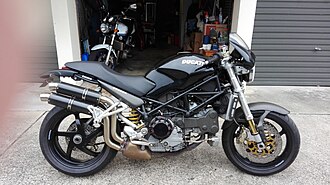
Ducati Monster: The Complete Guide to an Iconic Naked Motorcycle
The Ducati Monster is one of the most influential naked motorcycles ever created, and its impact on the motorcycle industry extends far beyond the sales figures of any individual model. When the original Monster appeared in the early 1990s, Ducati created something that seemed remarkably simple: take a powerful V-twin engine, place it inside a minimalist chassis, remove the traditional full fairing, and give the motorcycle an aggressive, muscular appearance. That basic idea became enormously influential. The Monster demonstrated that a motorcycle did not need extensive bodywork to look exciting, and it helped establish the modern naked-bike category as one of the most important segments in motorcycling.
Over the decades, the Ducati Monster has evolved dramatically while retaining the core philosophy that made the original so successful. Early Monsters relied heavily on Ducati’s air-cooled and liquid-cooled L-twin engines, trellis frames, exposed mechanical components, and unmistakably Italian styling. Later generations introduced increasingly sophisticated electronics, ride-by-wire throttle systems, multiple riding modes, traction control, cornering ABS, lightweight aluminum frames, and more compact engines. The modern Monster is therefore very different mechanically from the motorcycle that launched the name, but the underlying concept remains recognizable: a sporty, compact, minimalist Ducati designed to put the rider directly in contact with the engine and chassis.
The Birth of the Ducati Monster
A New Idea for Ducati
The Ducati Monster was introduced in 1993 as the M900, a motorcycle that combined components from Ducati’s existing sportbike family with a completely different visual philosophy. Instead of surrounding the engine with a full fairing, Ducati exposed the mechanical parts and created a compact, muscular silhouette. The result was immediately distinctive.
The original Monster was designed by Miguel Galluzzi, whose approach helped establish the visual language that would define Ducati’s naked motorcycles for decades. The motorcycle had a round headlight, exposed frame, sculpted fuel tank, minimalist bodywork, and an aggressive stance. The design was simple enough to be visually clear but distinctive enough to become instantly recognizable.
The original M900 used Ducati’s famous air-cooled 904cc V-twin engine and a steel trellis frame. The combination was relatively straightforward compared with modern motorcycles, but it created a strong mechanical identity. The engine was visible rather than hidden behind panels, and the frame became a major part of the motorcycle’s appearance.
This was one of the Monster’s most important innovations. Ducati effectively turned mechanical components into styling elements. The engine, frame, exhaust, suspension, and braking hardware were not things to hide; they were part of what made the motorcycle beautiful.
The Monster’s L-Twin Identity
The Heart of the Motorcycle
For much of its history, the Monster has been associated with Ducati’s 90-degree L-twin engines. The term “L-twin” describes the physical orientation of the cylinders, with one cylinder positioned approximately horizontal and the other vertical. This arrangement became one of Ducati’s defining engineering characteristics.
Different generations of Monster used different versions of the L-twin engine. Earlier motorcycles included air-cooled two-valve engines, while later versions adopted liquid cooling, four-valve cylinder heads, and more sophisticated desmodromic valve systems. The engines varied substantially in displacement and performance, ranging from relatively approachable middleweight versions to high-performance motorcycles producing well over 100 horsepower.
The engine is more than a source of propulsion in a Monster. It is central to the motorcycle’s identity. Ducati’s engineers have historically focused heavily on throttle response, torque delivery, engine braking, intake sound, and exhaust character, creating a powertrain that feels like an active part of the riding experience rather than an anonymous mechanical component.
Desmodromic Technology
One of Ducati’s most famous technical features has been its desmodromic valve actuation system. Instead of relying entirely on conventional valve springs to close the valves, Ducati’s desmodromic system mechanically controls both opening and closing movements.
This technology became an important part of Ducati’s engineering identity, particularly on the company’s higher-performance engines. It allowed engineers to pursue high engine speeds while maintaining precise valve control.
Not every modern Ducati Monster follows the same engine philosophy as earlier models. Ducati eventually introduced its compact Testastretta-based engines and, in the current Monster generation, moved to the liquid-cooled 937cc Testastretta 11° engine with a different overall chassis philosophy. The evolution demonstrates how Ducati has been willing to change fundamental engineering details while preserving the Monster’s broader concept.
The Trellis Frame and the Evolution of the Chassis
A Defining Visual Feature
For many years, the steel trellis frame was almost as closely associated with the Ducati Monster as the L-twin engine. The tubular frame formed an unmistakable structure around the engine and became one of the motorcycle’s most recognizable visual characteristics.
The trellis frame was not merely decorative. Its construction offered a favorable balance between rigidity, weight, manufacturing simplicity, and visual appeal. Ducati’s trellis designs became a major part of the company’s identity across both naked and sport motorcycles.
However, the modern Monster demonstrates that Ducati’s philosophy is not permanently tied to one frame design. The latest generation replaced the traditional large trellis structure with a lightweight aluminum frame attached to the engine. This allowed Ducati to significantly reduce weight and create a more compact motorcycle.
The change was controversial among some long-time Monster enthusiasts because the exposed trellis frame had become an iconic part of the model’s appearance. Nevertheless, it illustrates a fundamental truth about the Monster: the concept has always been more important than any single component.
The Modern Ducati Monster
Lightweight and Compact
The modern Monster represents one of the biggest technical transformations in the history of the model. Instead of focusing on a large visual frame structure, Ducati designed the motorcycle around low mass and compact dimensions.
The current Monster uses a 937cc Testastretta 11° L-twin engine. Ducati lists approximately 111 horsepower at 9,250 rpm and 68 Nm of torque at 6,500 rpm for the current Monster specification, while the motorcycle’s wet weight without fuel is around 188 kg depending on market and configuration.
These figures make the modern Monster significantly more performance-oriented than the original M900. Yet the motorcycle remains approachable because the engine delivers strong torque across the usable rev range and the chassis is designed to be compact and responsive.
The result is a naked motorcycle that feels agile in urban environments while retaining enough performance for fast road riding and occasional track use.
Electronics Have Transformed the Monster
One of the most dramatic differences between the original Monster and the modern motorcycle is the amount of electronic assistance. Early Monsters were almost entirely mechanical machines. The rider controlled throttle, brakes, clutch, and gearbox directly, with very little electronic intervention.
Modern Monsters are completely different. Ducati’s current systems include riding modes, power modes, traction control, wheelie control, cornering ABS, and a color TFT instrument display. These technologies allow the rider to alter the motorcycle’s behavior according to conditions and preferences.
For example, a less aggressive riding mode can make throttle response more manageable in urban traffic or poor weather, while a sportier setting can provide sharper engine response and greater performance freedom. The electronic systems do not eliminate the motorcycle’s character; instead, they provide a way of managing its considerable performance.
Riding the Ducati Monster
Agile Around Town
The Monster’s compact dimensions have always been one of its strongest advantages. Unlike a fully faired superbike, a naked motorcycle provides a relatively upright riding position and excellent visibility in traffic. The absence of a large fairing also makes the motorcycle feel visually and physically smaller.
The modern Monster’s relatively low weight enhances this effect. Steering inputs require little effort, and the motorcycle can change direction quickly. This makes it particularly effective on urban streets, winding secondary roads, and tight mountain routes.
The upright riding position also provides a useful balance between comfort and sportiness. The rider is not forced into the extreme forward lean associated with a dedicated supersport motorcycle, yet there is enough weight over the front end to create a confident connection with the chassis.
Exciting on Open Roads
The Monster becomes especially enjoyable once the road begins to twist. The combination of a responsive engine, relatively short wheelbase, lightweight chassis, and quality suspension creates a motorcycle that rewards smooth and precise riding.
The absence of a fairing does become noticeable at higher speeds. Wind pressure increases significantly compared with a fully faired sportbike, which naturally encourages a more moderate cruising speed. For many Monster owners, this is not a disadvantage. It creates a motorcycle that feels exciting at road-legal speeds rather than requiring extreme speeds to become entertaining.
The engine’s torque is also important. A Monster does not need to be kept at maximum rpm to feel fast. Strong mid-range acceleration allows the rider to drive out of corners with relatively little effort.
The Monster Family
Monster 600, 620 and 695
The smaller Monster models played an important role in expanding Ducati’s appeal to riders who wanted the company’s distinctive styling and engine character without moving directly into a large-displacement motorcycle.
Models such as the Monster 600, 620, and 695 offered progressively updated versions of Ducati’s middleweight naked-bike formula. They were often more approachable than the larger Monsters and became popular choices for newer riders and urban commuters.
These motorcycles also demonstrated the versatility of the Monster design. The basic silhouette remained recognizable even as Ducati changed engine displacement, fuel systems, suspension, brakes, and instrumentation.
Monster 696 and Monster 796
The Monster 696 introduced a more modern interpretation of the classic design. It retained the recognizable trellis frame and exposed L-twin engine but introduced significantly updated styling and engineering.
The Monster 796 then offered more performance while remaining relatively lightweight and accessible. These models helped bridge the gap between entry-level Monsters and larger performance-focused versions.
Monster 1100 and High-Performance Versions
At the other end of the family, Ducati developed larger and more powerful Monsters, including the Monster 1100 and Monster 1100 EVO. These motorcycles emphasized performance while maintaining the naked-bike philosophy.
The larger Monsters demonstrated that the concept could support serious sporting performance without requiring a full fairing. High-quality brakes, suspension components, lightweight wheels, and powerful engines transformed the Monster into a motorcycle capable of rapid road riding while remaining visually minimalist.
Why the Ducati Monster Became So Influential
The Monster’s greatest contribution to motorcycling may have been cultural rather than purely technical. Before its introduction, many motorcycles were categorized relatively clearly as sportbikes, touring motorcycles, standards, or cruisers. The Monster helped create a new space where performance and minimalist styling could coexist.
Manufacturers around the world eventually produced their own naked motorcycles, but Ducati’s formula remained particularly influential. The idea of exposing the engine, emphasizing the chassis, minimizing bodywork, and creating a muscular stance became a defining characteristic of modern street motorcycles.
The Monster also demonstrated the commercial value of design. Many motorcycle buyers are interested in performance, but they also want a machine that creates an emotional response when they see it parked in the garage. Ducati understood this exceptionally well.
The Monster looked mechanical, purposeful, and slightly rebellious. It did not need a large fairing or elaborate graphics to communicate performance.
Maintaining a Ducati Monster
Service Matters
Ducati ownership has traditionally required more attention to scheduled maintenance than some Japanese motorcycles. This is particularly important when buying an older Monster.
Valve-clearance inspection is a major consideration on Ducati engines equipped with desmodromic valve systems. Timing belts on applicable engines also require replacement according to the manufacturer’s recommended service schedule. The exact intervals and procedures vary considerably by engine generation and model year.
A used Monster with comprehensive service documentation can therefore be much more attractive than one that appears cosmetically perfect but lacks maintenance records.
Choosing a Used Monster
Potential buyers should inspect the motorcycle carefully for evidence of crashes, poor modifications, neglected maintenance, and electrical problems. The condition of the clutch, brakes, suspension, tires, chain or belt components, and cooling system should all be considered.
It is also important to understand exactly which Monster is being purchased. The model name covers decades of motorcycles with substantially different engines, frames, electronics, and service requirements. A 1990s M900 and a modern 937cc Monster may share a name and philosophy, but they are fundamentally different machines.
The Ducati Monster’s Legacy
Few motorcycles can claim to have changed an entire category, but the Ducati Monster has a strong case for doing exactly that. Its original formula was remarkably simple, yet the concept proved flexible enough to survive for decades.
The Monster has gone from a relatively basic air-cooled naked V-twin to a technologically sophisticated motorcycle with liquid cooling, advanced electronics, lightweight construction, and powerful engines. Despite those changes, the essential idea remains recognizable: remove unnecessary bodywork, expose the mechanical heart of the motorcycle, and build the riding experience around the engine and chassis.
That continuity is perhaps the Monster’s greatest achievement. Ducati has changed the details repeatedly without losing the personality of the name.
Final Thoughts on the Ducati Monster
The Ducati Monster is much more than a single motorcycle model. It is a philosophy that has influenced how modern naked motorcycles are designed, marketed, and ridden. From the original M900’s minimalist trellis-frame construction to today’s lightweight 937cc machine, the Monster has consistently focused on creating a direct connection between rider, engine, and chassis.
Its appeal comes from the balance between performance and simplicity. Even as modern versions have gained sophisticated electronics and advanced engineering, the Monster remains visually uncluttered. The engine is still an important part of the design, the riding position remains sporty but usable, and the motorcycle continues to prioritize agility over sheer size.
For enthusiasts, the Monster offers something that numbers alone cannot capture. It has character. It sounds distinctive, looks unmistakable, and encourages the rider to take the long way home. Whether someone prefers the mechanical purity of an older air-cooled model or the performance and electronics of the latest generation, the fundamental attraction remains the same.
The Ducati Monster helped prove that a motorcycle could be exciting precisely because it was stripped down. It did not need a giant fairing, massive engine, or excessive bodywork to create an impression. Instead, it allowed the engine, frame, wheels, and rider to become the center of attention. That simple idea became one of Ducati’s greatest successes and helped establish the naked sportbike as a permanent part of modern motorcycle culture.
Ducati Monster Technical Specifications
Because the Ducati Monster name covers numerous generations and engine configurations, there is no single specification sheet that accurately describes every Monster ever produced. The following table uses the current-generation Ducati Monster as the technical reference point, while the article above discusses the evolution of the family as a whole.
| Specification | Current Ducati Monster |
|---|---|
| Motorcycle type | Naked sport motorcycle |
| Engine | Liquid-cooled 90° L-twin |
| Displacement | 937 cc |
| Valve system | Desmodromic, 4 valves per cylinder |
| Cooling | Liquid-cooled |
| Fuel system | Electronic fuel injection |
| Maximum power | Approx. 111 hp @ 9,250 rpm |
| Maximum torque | Approx. 68 lb-ft / 93 Nm @ 6,500 rpm |
| Transmission | 6-speed |
| Final drive | Chain |
| Frame | Aluminum Front Frame |
| Front suspension | Upside-down fork |
| Rear suspension | Monoshock |
| Front brake | Twin discs with radial-mount calipers |
| Rear brake | Single disc |
| Front wheel | 17-inch |
| Rear wheel | 17-inch |
| Seat height | Approx. 30.5 in / 775 mm |
| Wheelbase | Approx. 1,474 mm |
| Wet weight without fuel | Approx. 188 kg |
| Fuel capacity | Approx. 14 L |
| Rider aids | Riding modes, power modes, traction control, wheelie control, cornering ABS |
| Instrumentation | Color TFT display |
| Main character | Lightweight, agile, sporty naked motorcycle |
| Defining design element | Minimal bodywork and exposed mechanical character |
