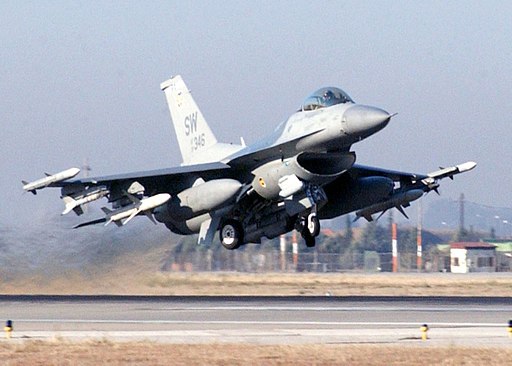
F-16 Fighting Falcon
The F-16 Fighting Falcon, developed by General Dynamics (now Lockheed Martin), stands as one of the most successful and iconic fighter aircraft in history. Designed as a lightweight, multirole fighter, the F-16 boasts exceptional agility, speed, and combat capabilities, earning it the nickname “Viper” due to its resemblance to the Colonial Viper starfighter from the “Battlestar Galactica” television series. Introduced in the 1970s, the F-16 has since become a mainstay in the air forces of numerous countries around the world, serving in various roles from air superiority and ground attack to reconnaissance and electronic warfare.
At the heart of the F-16’s success is its remarkable maneuverability and performance characteristics. Powered by a single Pratt & Whitney or General Electric turbofan engine, the F-16 features a blended wing-body design and a high thrust-to-weight ratio, allowing it to achieve impressive speed and climb rates while maintaining exceptional agility and maneuverability in dogfights. Its fly-by-wire flight control system and advanced avionics further enhance its combat capabilities, enabling precise weapon delivery and superior situational awareness in aerial engagements.
Throughout its operational history, the F-16 has undergone continuous upgrades and modernization efforts to keep pace with evolving threats and technological advancements. These upgrades have included improvements to its avionics, sensors, weapons systems, and structural enhancements to extend its service life and maintain its relevance on the modern battlefield. As a result, the F-16 remains a highly capable and adaptable platform, serving as a cornerstone of air forces worldwide and playing a crucial role in safeguarding global security and stability.
Armament F-16 Fighting Falcon
The F-16 Fighting Falcon, renowned for its versatility and combat capabilities, can be armed with a diverse array of weapons to fulfill its multirole mission. The typical armament options for the F-16 include:
- Air-to-Air Missiles (AAMs): The F-16 can carry a variety of air-to-air missiles for engaging enemy aircraft. These include short-range missiles like the AIM-9 Sidewinder and AIM-132 ASRAAM, as well as medium-range missiles such as the AIM-120 AMRAAM.
- Air-to-Ground Munitions: For ground attack missions, the F-16 is equipped to carry a range of precision-guided munitions. This includes bombs like the JDAM (Joint Direct Attack Munition) and Paveway series, as well as standoff weapons like the AGM-65 Maverick and AGM-158 JASSM (Joint Air-to-Surface Standoff Missile).
- Rockets: The F-16 can also carry rocket pods, typically containing unguided rockets like the Hydra 70 or CRV7, for engaging ground targets with strafing runs or close air support missions.
- Gun: The F-16 is armed with an internally mounted 20mm M61 Vulcan rotary cannon, capable of rapid-fire and effective strafing of ground targets or engaging aerial threats at close range.
- Electronic Countermeasures (ECM): In addition to offensive weapons, the F-16 may carry ECM pods or jamming systems to disrupt enemy radar and electronic systems, enhancing its survivability in contested environments.
Overall, the armament of the F-16 Fighting Falcon is tailored to its role as a highly maneuverable and versatile combat aircraft, capable of executing a wide range of missions including air superiority, ground attack, reconnaissance, and suppression of enemy air defenses (SEAD).
Dimensions of the F-16 Fighting Falcon
The F-16 Fighting Falcon, a versatile multirole fighter aircraft, has the following dimensions:
- Length: Approximately 15.06 meters (49 feet 5 inches) for the F-16C/D variants.
- Wingspan: Approximately 9.96 meters (32 feet 8 inches) for the F-16C/D variants.
- Height: Approximately 5.09 meters (16 feet 8.5 inches) for the F-16C/D variants.
These dimensions may vary slightly depending on the specific variant and configuration of the F-16 Fighting Falcon.
