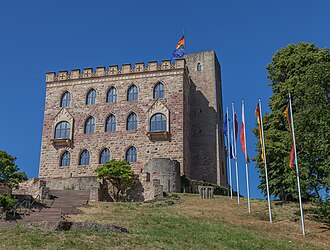
Hambacher Schloss: A Fortress of History and Architectural Brilliance
Nestled atop a hill in the picturesque Palatinate region of southwestern Germany, Hambacher Schloss stands as a remarkable symbol of German heritage, blending centuries of architectural evolution with the layered cultural identity of the region. While the castle is famously associated with the Hambach Festival of 1832—a pivotal moment in German democracy—its architectural and cultural aspects are equally compelling. The castle’s stone walls, towers, and intricate design details offer a vivid narrative of medieval fortification, Renaissance adaptation, Baroque reinvention, and modern restoration. For anyone fascinated by European castle architecture or the enduring interplay of form and function, Hambacher Schloss provides a masterclass in historical construction and cultural continuity.
Its position atop a rocky promontory was no accident; the elevated site allowed the original medieval fortifications to dominate the surrounding landscape, offering both defense and an imposing visual statement. The Palatinate forest stretches below, providing a natural moat of sorts and a scenic backdrop that accentuates the castle’s vertical silhouette. Today, visitors are often struck by how seamlessly the castle integrates with its environment: the jagged stone walls appear almost to rise from the natural rock outcrop, giving Hambacher Schloss a unique sense of harmony between human construction and natural formation.
Origins and Medieval Fortification
The initial construction of Hambacher Schloss dates back to the 11th century, when the site was established as a strategic fortification to guard trade routes and maintain control over the Palatinate region. The earliest structure was a modest hilltop castle, designed primarily for defensive purposes, with thick stone walls, a central keep, and a small courtyard. Its design prioritized protection over comfort, reflecting the turbulent political climate of the High Middle Ages, when territorial disputes between local lords and emerging principalities were common.
The castle’s early architecture was primarily Romanesque in style, with massive, rounded arches and minimal ornamentation. The keep, the heart of the fortification, was strategically placed to provide both surveillance and a last line of defense. Arrow slits and battlements allowed defenders to repel attackers while remaining protected within the castle’s walls. These initial features highlight the medieval emphasis on practicality and military function, demonstrating how architectural design was inherently tied to survival and strategic advantage.
Over the following centuries, the castle underwent several expansions and modifications. The addition of watchtowers, curtain walls, and gatehouses reflected evolving defensive technologies and architectural knowledge. Even in these early stages, cultural aspects began to intertwine with utility; certain decorative elements, like carved reliefs and heraldic emblems, suggested status and authority, subtly signaling the power of the castle’s occupants to visitors and rivals alike.
Renaissance and Baroque Transformation
By the 16th century, the military significance of Hambacher Schloss began to shift. As artillery and new warfare technologies emerged, traditional defensive structures required adaptation, and parts of the castle were repurposed for residential and administrative use. Renaissance architectural principles, emphasizing proportion, symmetry, and light, started to influence renovations. Larger windows, decorative cornices, and refined stonework signaled the transition from purely functional fortification to a residence with both status and aesthetic appeal.
The Baroque period in the 17th and early 18th centuries brought even more dramatic architectural transformations. The castle’s facades were adorned with ornamental stucco work, intricate carvings, and stylized gables. Interiors were redesigned to accommodate the tastes of nobility, incorporating ceremonial halls, private chambers, and galleries for art and artifacts. These spaces reflected the Baroque fascination with theatricality, grandeur, and controlled perspective: corridors and staircases were arranged to create a sense of unfolding drama, guiding visitors through a visual and spatial narrative designed to impress and awe.
Baroque renovations also integrated the castle more closely with its natural surroundings. Terraces, gardens, and viewing platforms allowed occupants to enjoy sweeping vistas of the Palatinate countryside, blending landscape design with architectural intention. Water features, parterres, and carefully aligned sightlines exemplified the period’s emphasis on harmony between nature and built form, demonstrating that architecture was increasingly a tool of cultural expression as well as practical necessity.
Architectural Features and Design Highlights
Hambacher Schloss is particularly notable for its eclectic mix of architectural features accumulated over centuries. The castle’s main gate, with its pointed arch and defensive portcullis, is one of the most iconic medieval elements still intact. This entrance not only provided security but also created a ceremonial passage, emphasizing the transition from the outside world to the interior of power. Visitors passing through the gate experience a subtle theatrical effect, moving from open landscape into the enclosed, fortified space, a hallmark of medieval castle design.
Inside, the keep remains the dominant structural element, rising above surrounding walls and offering panoramic views of the Rhine Valley. The interior of the keep reflects both its defensive origins and later adaptations: narrow passageways and staircases contrast with larger chambers added during the Renaissance and Baroque periods. These spaces were often adorned with decorative murals, tapestries, and woodwork, showcasing a shift from utilitarian stonework to expressive, culturally informed design.
A particularly striking feature is the castle’s chapel, which combines Gothic verticality with Baroque ornamentation. Vaulted ceilings, decorative moldings, and carefully designed acoustics create a space that is both spiritually and aesthetically impactful. The chapel exemplifies how architecture at Hambacher Schloss served multiple purposes: religious devotion, aesthetic enjoyment, and symbolic display of status.
Cultural Significance and the Hambach Festival
While the architectural features of Hambacher Schloss are compelling, its cultural importance adds another layer of fascination. The castle is inextricably linked to the Hambach Festival of 1832, often described as the birth of modern German democracy. During this festival, thousands of citizens gathered at the castle to advocate for civil liberties, national unity, and democratic reform, transforming the fortress from a symbol of feudal authority into a stage for progressive political thought.
The event’s historical significance is reinforced by the castle’s architecture: its terraces and courtyards provided natural spaces for large gatherings, allowing voices to resonate across stone and landscape. The very design of the castle—originally intended to exert control and project authority—was repurposed to amplify the aspirations of ordinary citizens seeking representation and reform. This intersection of built form and social function underscores the castle’s enduring cultural relevance, demonstrating how architecture can transcend its initial purpose to accommodate evolving societal needs.
Restoration and Modern Adaptation
Over the centuries, Hambacher Schloss has endured war, neglect, and environmental wear, necessitating multiple restoration efforts. In the late 20th and early 21st centuries, extensive preservation projects sought to stabilize remaining structures, restore key architectural features, and interpret the castle for public engagement. These restorations involved careful archaeological research, traditional craftsmanship, and the use of historically accurate materials, ensuring that each stone, beam, and decorative element reflects the castle’s historical character.
Modern adaptations have also transformed Hambacher Schloss into a cultural venue. Exhibition spaces, educational facilities, and visitor centers allow guests to explore the architectural and cultural history in depth. Multimedia installations and guided tours emphasize both structural evolution and social significance, providing a holistic experience that combines the visual impact of architecture with contextual storytelling.
Artistic and Decorative Elements
Hambacher Schloss’s interiors showcase the artistry of centuries, including intricate woodwork, frescoed ceilings, and period furnishings. Even small details, such as carved door frames and wrought-iron hardware, illustrate the skill of craftsmen and the aesthetic priorities of different eras. Decorative motifs often reference both natural forms and symbolic imagery, creating layers of meaning that reflect social hierarchies, political alliances, and cultural values.
The castle also hosts temporary and permanent exhibitions of regional art, historical artifacts, and architectural models. These displays offer insight into the artistic techniques and materials employed over centuries, providing visitors with a deeper understanding of how design and culture intersected within the castle’s walls. From Renaissance stonework to Baroque ornamentation, every corner tells a story of creativity and cultural expression.
Integration with the Natural Landscape
One of Hambacher Schloss’s most compelling architectural achievements is its integration with the surrounding landscape. The castle’s elevated position provides commanding views of vineyards, forests, and the Rhine plain. Terraced gardens and observation points were carefully designed to frame these vistas, demonstrating a sophisticated understanding of perspective and environmental aesthetics.
Pathways and staircases linking different sections of the castle with natural slopes reflect both functional and artistic considerations. Visitors experience a seamless transition between constructed spaces and natural terrain, highlighting the castle’s ability to harmonize with its environment while still asserting its presence as a landmark of human ingenuity.
Visitor Experience and Educational Programs
Today, Hambacher Schloss serves as both a historical monument and an educational center. Visitors can explore restored rooms, climb the keep for panoramic views, and participate in workshops that delve into medieval construction, Baroque design, and cultural heritage preservation. Educational programs for schools and universities highlight architectural techniques, historical context, and the castle’s ongoing role in cultural discourse.
Events such as art exhibitions, open-air performances, and cultural festivals utilize the castle’s spaces creatively, demonstrating the adaptability of its architecture. Courtyards, terraces, and halls designed for defense and ceremonial life now host activities that bring contemporary culture into dialogue with historical form.
Conclusion: Architecture as Cultural Narrative
Hambacher Schloss exemplifies the power of architecture to communicate history, culture, and identity across centuries. From its medieval fortifications to Renaissance refinements and Baroque flourishes, the castle illustrates how design evolves in response to changing social, political, and artistic priorities. Its survival and restoration underscore the importance of cultural preservation, while its integration with the landscape demonstrates the enduring dialogue between human creativity and natural beauty.
For anyone passionate about European architecture, historical craftsmanship, or the interplay between built form and cultural meaning, Hambacher Schloss is a living textbook of architectural ingenuity. Every tower, wall, and courtyard tells a story of power, artistry, and resilience, making it one of Germany’s most fascinating and educational castle experiences.
