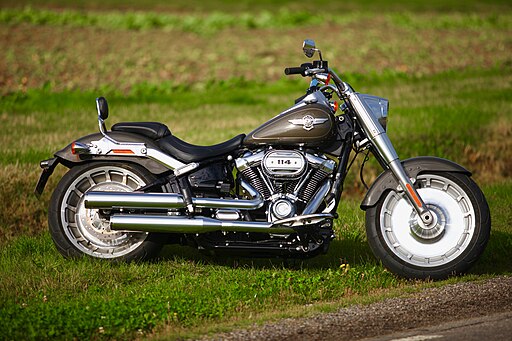
The Harley-Davidson Fat Boy stands as one of the most recognizable motorcycles ever produced by the brand, defined by its muscular proportions, solid disc wheels, and unapologetically bold presence. Introduced in the early 1990s, the Fat Boy was conceived as a modern reinterpretation of classic post-war Harley-Davidson styling, fused with contemporary engineering and manufacturing precision. Its design philosophy centers on visual mass and mechanical authority, projecting strength even when stationary. Unlike minimalist cruisers, the Fat Boy intentionally emphasizes width, solidity, and symmetry, creating a silhouette that is instantly identifiable from any angle.
The motorcycle’s visual weight is reinforced by its wide fuel tank, substantial front end, and deeply valanced fenders that hug the tires closely. Finishes often feature subdued metallic tones or monochromatic paint schemes that enhance the perception of density and cohesion. Chrome is used selectively, not to decorate but to accent structural elements, ensuring the bike maintains a purposeful and industrial aesthetic rather than a purely ornamental one.
Engine Configuration and Power Delivery
At the core of the Fat Boy is Harley-Davidson’s large-displacement air-cooled V-twin engine, offered across generations in Evolution, Twin Cam, and Milwaukee-Eight configurations. While displacement and internal architecture vary by era, the defining characteristics remain consistent: a 45-degree V-twin layout, long-stroke design, and a strong emphasis on torque production at low engine speeds. Bore and stroke ratios are tuned to favor immediate throttle response rather than high-revving output, aligning with the Fat Boy’s cruiser identity.
Modern Milwaukee-Eight versions utilize four-valve cylinder heads, dual spark plugs per cylinder, and precision fuel injection systems to improve combustion efficiency, thermal management, and emissions compliance. Compression ratios are optimized to balance power output with reliability under sustained load. The result is an engine that delivers smooth, authoritative acceleration with minimal effort, allowing the Fat Boy to surge forward confidently without the need for frequent downshifting.
Transmission and Final Drive System
Power from the engine is transmitted through a multi-speed constant-mesh gearbox, typically featuring six forward gears in modern configurations. Gear ratios are deliberately spaced to exploit the engine’s torque curve, with lower gears providing strong initial acceleration and higher gears allowing relaxed highway cruising at reduced engine speeds. The transmission emphasizes smooth engagement and mechanical durability, designed to handle high torque loads over extended service intervals.
Final drive is achieved through a reinforced belt drive system, chosen for its low maintenance requirements, quiet operation, and longevity. Compared to chain drives, the belt system reduces vibration and eliminates the need for frequent lubrication or tension adjustment. This configuration contributes to the Fat Boy’s refined ride quality while maintaining efficient power transfer to the rear wheel.
Frame Architecture and Structural Engineering
The Fat Boy is built around a steel tubular frame engineered for rigidity and stability, accommodating the motorcycle’s substantial mass while preserving predictable handling characteristics. Frame geometry features a relaxed rake angle and extended trail, which enhance straight-line stability and reinforce the bike’s planted feel at highway speeds. The engine acts as a semi-stressed member in later generations, contributing to overall chassis stiffness and reducing unnecessary structural weight.
Weight distribution is biased toward a low center of gravity, achieved through strategic placement of heavy components such as the engine, transmission, and exhaust system. This design approach allows the Fat Boy to feel manageable at low speeds despite its significant curb weight. Structural mounting points are reinforced to handle the loads imposed by wide tires and heavy wheels, ensuring long-term durability under varied riding conditions.
Suspension Design and Ride Characteristics
Suspension systems on the Fat Boy are designed to complement its cruiser-focused mission. The front suspension typically consists of large-diameter telescopic forks with internal damping tuned for smooth, controlled travel rather than aggressive sport response. Fork travel is moderate, prioritizing stability and comfort over sharp handling feedback. Rear suspension is commonly handled by a hidden monoshock or low-profile shock system, preserving the bike’s clean hardtail-inspired appearance while still providing functional compliance.
Suspension tuning favors absorption of road imperfections and consistent chassis behavior under acceleration and braking. While lean angles are limited by the bike’s low stance and wide components, the suspension provides predictable feedback within its intended operating range. This setup makes the Fat Boy well-suited for long, steady rides on open roads rather than technical corner carving.
Braking Systems and Safety Control
Braking performance on the Fat Boy has evolved significantly over time, with modern versions featuring powerful disc brake systems at both the front and rear. Front brakes often utilize large-diameter discs paired with multi-piston calipers, delivering strong and consistent stopping power appropriate for the motorcycle’s mass. Rear braking provides additional stability during deceleration, particularly at low speeds and during controlled stops.
Contemporary models integrate electronic safety systems such as anti-lock braking systems, which help prevent wheel lock-up under hard braking or reduced traction conditions. Brake modulation is progressive, allowing riders to apply braking force smoothly and confidently without abrupt response. The braking system is engineered to prioritize control and predictability rather than aggressive bite.
Wheels, Tires, and Contact Patch Engineering
One of the Fat Boy’s most distinctive technical features is its solid disc wheels, which contribute significantly to both aesthetics and mass distribution. These wheels are typically paired with wide tires, particularly at the front, creating a large contact patch that enhances straight-line stability. Tire profiles are chosen to support the bike’s weight while maintaining consistent grip across varying road surfaces.
The wide front tire, while visually striking, influences steering behavior by slowing initial turn-in. This characteristic aligns with the Fat Boy’s design intent, reinforcing its deliberate, grounded riding feel. Tire compounds emphasize durability and load-bearing capability, ensuring reliable performance over long distances rather than short-term maximum grip.
Ergonomics, Rider Position, and Interface
Ergonomically, the Fat Boy is designed to deliver a commanding riding position. A low seat height allows most riders to place their feet flat on the ground, enhancing confidence during stops and low-speed maneuvers. Wide handlebars provide leverage for steering the substantial front end, while forward-mounted foot controls promote a relaxed, stretched-out posture.
The rider interface is intentionally uncluttered, typically featuring a single large analog speedometer integrated into the tank console, along with essential indicator lights. This minimalism reinforces the motorcycle’s mechanical focus and reduces visual distractions, allowing the rider to engage fully with the riding experience.
Engineering Philosophy and Technical Legacy
The Harley-Davidson Fat Boy represents a deliberate engineering choice to prioritize presence, torque, and stability over lightweight agility or high-performance metrics. Its technical parameters are shaped by the goal of delivering a visceral, confidence-inspiring ride that emphasizes feel and character rather than numerical specifications. Every component, from the massive wheels to the long-stroke engine, contributes to a cohesive mechanical identity.
