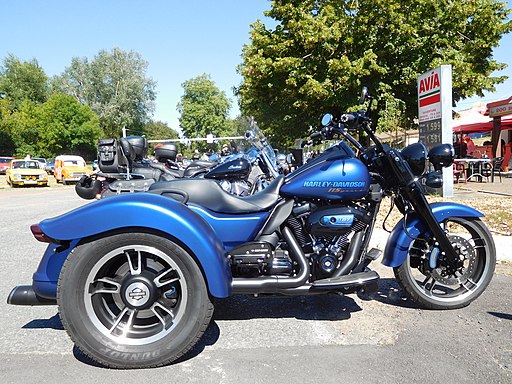
The Harley-Davidson Freewheeler represents a distinct interpretation of the three-wheeled motorcycle platform, positioned as a more aggressive and performance-oriented alternative to traditional touring trikes. While it shares the fundamental stability advantages of a trike layout, the Freewheeler is intentionally stripped of excessive touring accessories to deliver a raw, muscular character that aligns closely with Harley-Davidson’s hot-rod and cruiser heritage. Its visual identity is defined by blacked-out components, compact bodywork, and a squat, powerful stance that emphasizes mechanical mass and road presence rather than long-haul luxury.
From a design standpoint, the Freewheeler prioritizes a minimalist approach while retaining the structural robustness required for three-wheel dynamics. The truncated rear bodywork integrates seamlessly with the dual rear wheels, creating a cohesive silhouette that visually communicates traction and strength. Compared to fully dressed trikes, the Freewheeler projects a more urban and performance-focused persona while maintaining the unmistakable DNA of a heavyweight Harley-Davidson.
Engine Architecture and Performance Output
Powering the Harley-Davidson Freewheeler is the Milwaukee-Eight 114 engine, a large-displacement air-cooled V-twin with a capacity of 1,868 cubic centimeters. This engine employs a 45-degree V-twin configuration with four valves per cylinder and dual spark plugs, optimizing combustion efficiency and power delivery. The engine is tuned to produce substantial low-end and mid-range torque, generating approximately 121 lb-ft of torque, which is critical for moving the Freewheeler’s considerable mass with authority and smoothness.
The long-stroke design of the Milwaukee-Eight 114 enhances throttle response and ensures strong pulling power from low engine speeds. Advanced electronic fuel injection manages air-fuel ratios with precision, delivering consistent performance across varying temperatures and altitudes. The engine also benefits from reduced internal friction and improved oil circulation compared to earlier generations, contributing to lower operating temperatures and enhanced long-term reliability. Rather than focusing on peak horsepower, the Freewheeler’s engine is engineered to provide effortless acceleration and sustained cruising capability.
Transmission and Final Drive System
The engine’s output is managed through a six-speed Cruise Drive transmission, specifically designed to handle high torque loads while maintaining smooth and predictable shifting characteristics. Gear ratios are spaced to complement the torque-rich nature of the engine, allowing the Freewheeler to accelerate confidently without frequent gear changes. The overdrive sixth gear reduces engine RPM during highway cruising, improving fuel efficiency and reducing mechanical stress during extended rides.
Power is delivered to the rear axle via a belt drive system, chosen for its durability, quiet operation, and minimal maintenance requirements. The belt drive offers smoother power transfer compared to chain systems and is well-suited to the Freewheeler’s performance profile. The drivetrain is engineered to handle the additional traction demands imposed by two rear wheels, ensuring consistent and reliable power delivery under acceleration.
Frame Construction and Chassis Geometry
The Freewheeler utilizes a purpose-built steel tubular frame designed specifically for trike applications. This frame is reinforced to accommodate the stresses generated by a three-wheel configuration, including lateral forces during cornering and braking. Structural rigidity is a key design priority, providing a stable platform that maintains predictable handling even under heavy acceleration or load.
Chassis geometry is optimized for stability rather than lean-based cornering, with a longer wheelbase and wider rear track contributing to confident straight-line performance. The engine is mounted low within the frame to keep the center of gravity as close to the ground as possible, enhancing balance and low-speed control. Despite its substantial mass, the Freewheeler feels composed and planted due to careful weight distribution and frame stiffness.
Suspension Systems and Ride Dynamics
Front suspension on the Freewheeler consists of a large-diameter telescopic fork, typically measuring 49 mm, offering the rigidity required to manage the trike’s front-end loads. The fork incorporates air-adjustable preload, allowing riders to fine-tune suspension characteristics based on weight and riding conditions. This adjustability enhances comfort while maintaining front-end control during braking and acceleration.
At the rear, the Freewheeler features an independent rear suspension system that manages each rear wheel individually. This configuration improves ride quality by allowing each wheel to respond independently to road irregularities, reducing harshness and improving traction. Suspension tuning is biased toward stability and control rather than sport-oriented responsiveness, ensuring the Freewheeler remains predictable and comfortable across a wide range of road surfaces.
Braking Performance and Electronic Rider Aids
Given its mass and performance capability, the Freewheeler is equipped with a high-capacity braking system designed to deliver consistent and controlled stopping power. The front end features dual disc brakes with multi-piston calipers, while the rear wheels are each equipped with disc brakes to distribute braking forces evenly. This setup ensures balanced deceleration and minimizes the risk of wheel lock under hard braking.
The braking system is integrated with Harley-Davidson’s Reflex Defensive Rider Systems, which include anti-lock braking, traction control, and drag-torque slip control. These electronic aids continuously monitor wheel speed and throttle input, intervening when necessary to maintain stability. While the Freewheeler maintains a raw and muscular character, these systems provide a critical safety net that enhances rider confidence in variable conditions.
Wheels, Tires, and Road Interface
The Freewheeler features a unique wheel and tire configuration tailored to its trike design. The front wheel is typically an 18-inch cast aluminum unit fitted with a wide, load-rated tire that provides strong straight-line stability and controlled steering response. At the rear, two 18-inch cast wheels support wide, high-load tires designed to handle both propulsion and lateral forces.
Tire selection emphasizes durability, load capacity, and consistent grip rather than aggressive sport performance. The wide rear track enhances traction during acceleration and contributes to the Freewheeler’s planted feel in corners. Tire pressure monitoring systems are included to alert the rider to changes in pressure, helping maintain optimal handling and safety.
Ergonomics and Rider Interface
Ergonomics on the Freewheeler reflect its performance-cruiser intent. The seat height is low, allowing easy mounting and stable footing at stops. Wide handlebars provide leverage for steering, particularly during low-speed maneuvers where trikes require more input than two-wheeled motorcycles. Foot controls are forward-mounted, promoting a relaxed riding posture while maintaining a sense of control.
Instrumentation is streamlined and functional, featuring a combination of analog and digital displays that present essential information such as speed, engine data, and system alerts. The rider interface avoids unnecessary complexity, reinforcing the Freewheeler’s focus on mechanical engagement and direct feedback.
Engineering Philosophy and Market Position
The Harley-Davidson Freewheeler embodies an engineering philosophy that prioritizes strength, stability, and visual impact over touring luxury or extreme performance. Its technical parameters reflect a deliberate effort to create a three-wheeled motorcycle that appeals to riders seeking confidence and control without the formality of a fully dressed touring trike.
.jpg)