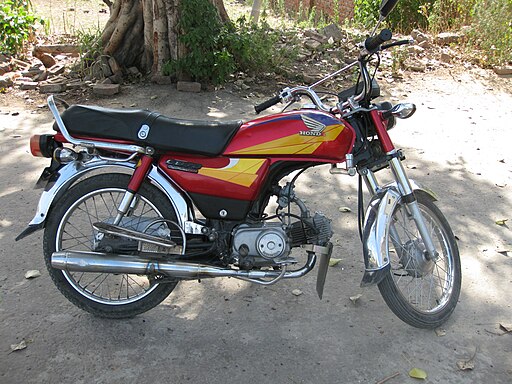
Honda 70
The Honda 70 is much more than a simple commuter bike—it is a symbol of Honda’s commitment to reliability, efficiency, and innovative engineering. Launched in 1970 and originally produced in Japan, the Honda 70 quickly established itself as a practical four‑stroke motorcycle in an era dominated by two‑stroke rivals. Later renamed the Honda CD70 and produced by Atlas Honda in Pakistan from 1991 onward, its design continues to capture the hearts of both vintage collectors and daily riders who appreciate its timeless blend of form and function.
History and Overview
Origins and Market Positioning
Introduced in the early 1970s, the Honda 70 was designed to compete against two‑stroke models of the time—offering a cleaner, more fuel‑efficient, and lower‑maintenance alternative. Its four‑stroke engine set it apart from contemporaries, appealing to riders who valued durability and longevity over sheer power. With its straightforward construction, the Honda 70 was aimed at a wide market, from urban commuters seeking economical travel to enthusiasts who admired minimalist, robust engineering.
Evolution and Global Impact
Over the years, the Honda 70’s design has seen gradual refinements, ensuring its continued relevance. Production in Japan between 1970 and 1991 solidified its reputation, after which manufacturing moved to Pakistan where the CD70 variant further extended its legacy. Today, the Honda 70 is celebrated not only for its technical robustness but also for its cultural impact—serving as a bridge between classic motorcycling heritage and modern-day low‑cost transportation.
Technical Specifications
Engine and Powertrain
At the heart of the Honda 70 is an engine that exemplifies simplicity and efficiency. Designed primarily for urban commuting, the powerplant in the Honda 70 delivers modest output while ensuring low maintenance and excellent fuel economy.
Engine Details
- Type: The Honda 70 is powered by a single‑cylinder, air‑cooled, four‑stroke engine with an overhead camshaft (OHC) design.
- Displacement: Approximately 72 cc, placing the bike squarely in the economical micro‑motorcycle category.
- Bore & Stroke: The engine features a bore of around 47.0 mm and a stroke of 41.4 mm, offering a balanced power curve ideal for city riding.
- Compression Ratio: With a compression ratio of approximately 9.3:1, the engine achieves efficient combustion without compromising reliability.
- Power Output: While modest by today’s standards, the engine produces sufficient power (roughly in the low single‑digit horsepower range) for urban mobility and short trips, delivering dependable acceleration in stop‑and‑go traffic.
Transmission and Drivetrain
The Honda 70 continues Honda’s tradition of creating accessible riding experiences through its well‑integrated transmission and drivetrain.
Transmission Details
- Gearbox: A classic four‑speed manual transmission is employed, allowing the rider to fully engage with the machine while also keeping the mechanical complexity to a minimum.
- Clutch: A wet multi‑plate clutch ensures smooth power delivery and reliable operation under various riding conditions.
- Final Drive: Power is transmitted via a chain‑drive system—a time‑tested solution known for its durability and ease of adjustment.
Chassis, Suspension, and Braking System
The riding dynamics of the Honda 70 are largely determined by its lightweight construction and carefully balanced chassis.
Frame and Construction
- Frame Type: The bike features a pressed‑steel frame which provides a durable and simple structure while keeping costs and weight low.
- Wheelbase: With a wheelbase of approximately 1,206 mm (47.5 inches), the Honda 70 offers stable housing while remaining agile enough for city maneuvers.
Suspension System
- Front Suspension: Equipped with telescopic forks that absorb shocks and smooth out road imperfections, ensuring confident steering on uneven surfaces.
- Rear Suspension: Utilizes a conventional dual‑shock absorber system designed to maintain consistent tire contact with the road, thereby enhancing overall ride comfort.
Braking System
- Front Brake: Drum brakes are typically featured at the front, providing sufficient stopping power for a lightweight, lower‑speed motorcycle.
- Rear Brake: A drum brake system is also used at the rear, ensuring balanced and reliable deceleration even under urban stop‑and‑go conditions.
Dimensions and Performance
Understanding the bike’s size is essential to appreciating its performance and maneuverability.
Key Dimensional Data
- Overall Length: Approximately 1,897 mm (74.7 inches)
- Overall Width: Around 751 mm (29.6 inches)
- Overall Height: Roughly 1,014 mm (39.9 inches)
- Dry Weight: Approximately 82 kg (180‑lb), which contributes to its agile handling and fuel efficiency.
- Fuel Tank Capacity: The Honda 70 is equipped with an 8.5‑liter fuel tank, ensuring a respectable range for daily commuting.
Performance Characteristics
- Top Speed: While modest compared to larger motorcycles, the Honda 70 delivers an appropriate top speed for urban environments—typically in the region of 58 mph (93 km/h) as claimed by early models.
- Fuel Efficiency: Its small displacement and efficient four‑stroke design yield excellent fuel economy, making it a cost‑effective choice for daily riders.
Design and Ergonomics
Styling and Aesthetic Appeal
Honda’s design philosophy for the 70 emphasizes function as much as form. Its clean lines, traditional elements, and minimal bodywork evoke a sense of nostalgia while ensuring aerodynamic practicality.
Classic Features
- Instrumentation: The bike features a rectangular speedometer with gear range markings, providing essential information in an easy‑to‑read layout.
- Bodywork: Minimalist yet purposeful, the design allows for simplicity in construction and repairs, while its retro look appeals to enthusiasts of classic motorcycles.
Rider Comfort and Control
Ergonomics play an essential role in the Honda 70’s continued popularity. The design is focused on user accessibility and control, making it an excellent option for both seasoned riders and newcomers.
Ergonomic Details
- Seating Position: The seat height and overall riding posture are optimized to provide comfort during long commutes, with an upright position that reduces rider fatigue.
- Control Layout: The intuitive placement of handlebars, foot pegs, and the gear lever ensures that all essential controls are within easy reach, fostering a connected and enjoyable riding experience.
Maintenance and Ownership
Ease of Servicing
A hallmark of the Honda 70 is its mechanical simplicity, which not only translates to reduced maintenance costs but also makes it an appealing project for DIY enthusiasts.
- Simplicity: Fewer moving parts and a straightforward engine design mean that routine maintenance tasks such as oil changes, spark plug replacement, and carburetor adjustments can be performed with relative ease.
- Parts Availability: The widespread production history, including models produced in Pakistan under Atlas Honda, means that spare parts and service expertise are readily available, supporting longevity.
Durability and Longevity
The Honda 70’s reputation for reliability is a testament to Honda’s engineering prowess. Its continuous evolution—transitioning from the initial Japanese models to subsequent iterations under the CD70 brand—demonstrates a commitment to quality that ensures dependable performance over decades.
Conclusion
The Honda 70 remains an enduring icon in the world of small displacement motorcycles. With a 72‑cc air‑cooled, OHC four‑stroke engine paired with a four‑speed manual transmission and a reliable, lightweight pressed‑steel frame, this classic bike offers an engaging and cost‑effective riding experience. Its robust design, excellent fuel economy, and approachable ergonomics make it ideally suited for urban commuting and recreational cruising alike.
