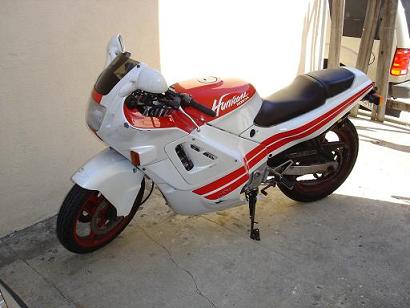
Honda CBR600F
The Honda CBR600F blends accessible handling with spirited sportbike performance, targeting riders who seek everyday usability without sacrificing excitement on twisty roads and track days. This middleweight motorcycle combines a proven engine, refined chassis, and ergonomic comfort to deliver “total control” across a variety of riding scenarios.
Historical Context
1987–2006: The CBR600F Legacy
Introduced in 1987 as the “Hurricane,” the original CBR600F set new standards for middleweight sportbikes by offering a liquid-cooled, four-cylinder engine in an agile chassis. Over successive generations (F2, F3, F4, F4i), Honda refined its powerplant and frame, balancing racetrack capability with everyday practicality.
2011–2013: Revival of the All-Rounder
After a hiatus following the CBR600RR’s debut in 2003, Honda revived the CBR600F in 2011. This modern iteration borrowed its engine from the detuned CB600F Hornet and shared the aluminum backbone frame, while adding a full fairing designed for reduced drag, improved wind protection, and a refreshed electronics package.
Engine and Performance
Engine Architecture
The 2011 CBR600F features a 599 cm³, liquid-cooled inline-four with a 16-valve DOHC head. Its bore and stroke of 67 × 42.5 mm and a compression ratio of 12.0 : 1 yield an engine that revs freely yet delivers strong midrange response. Fuel injection is handled by PGM-FI with 36 mm throttle bodies, ensuring precise mixture control and smooth transition through the rev range.
Power and Torque
Honda’s electronic fuel injection and optimized cam profiles produce a peak output of 75 kW (102 hp) at 12 000 rpm, with 64 Nm of torque available at 10 500 rpm. This wide, usable powerband makes the CBR600F both track-capable and friendly at lower speeds, minimizing abrupt throttle response common to more track-focused models.
Chassis and Handling
Frame and Suspension
A gravity die-cast aluminum mono-backbone frame provides lightness and rigidity. Up front, a 41 mm inverted telescopic fork offers 120 mm of travel and preload adjustment, while the rear monoshock features seven-step preload settings and 128 mm of travel, delivering a compliant yet controlled ride over varying road surfaces.
Braking System
Dual 296 mm front discs with two-piston calipers and a single 240 mm rear disc with a one-piston caliper deliver strong, predictable braking performance. The combined ABS option enhances safety by distributing brake force and reducing wheel lock-up under hard stops or slippery conditions.
Dimensions and Ergonomics
An 805 mm seat height and 193 kg curb weight make the CBR600F approachable for a wide range of riders. A 1386 mm wheelbase strikes a balance between agility and stability, while the multi-layered fairing and sculpted fuel tank enhance aerodynamic efficiency and rider comfort on longer journeys.
Variants and Special Editions
Honda offered a standard full-faring CBR600F and a limited-run CBR600F LCR edition celebrating Stefan Bradl’s championship team. The LCR model featured an Arrow titanium exhaust, Progrip handlebars, a solo seat cover, a rear hugger, and distinctive LCR graphics, along with Combined ABS as standard equipment.
Real-World Performance
Riders report that average fuel consumption hovers around 5.0 L/100 km, translating to a practical range of 350 km per tank on mixed riding. The CBR600F accelerates from 0 to 100 km/h in roughly 3.5 seconds and reaches a top speed of about 223 km/h, showcasing its capability on both urban streets and open highways.
Technical Specifications Summary
| Parameter | Specification |
|---|---|
| Engine type | Liquid-cooled 4-stroke 16-valve DOHC inline-4 |
| Displacement | 599 cm³ |
| Bore × Stroke | 67 × 42.5 mm |
| Compression Ratio | 12.0 : 1 |
| Fuel System | PGM-FI electronic fuel injection (36 mm throttle bodies) |
| Cooling System | Liquid cooled |
| Max Power | 75 kW (102 hp) @ 12 000 rpm |
| Max Torque | 64 Nm @ 10 500 rpm |
| Transmission | 6-speed; chain final drive |
| Clutch | Wet, multi-plate with coil springs |
| Frame | Mono-backbone; rectangular-section die-cast aluminum |
| Front Suspension | 41 mm inverted telescopic fork; 120 mm travel |
| Rear Suspension | Monoshock damper; 7-step preload; 128 mm travel |
| Front Brakes | Dual 296 mm discs; 2-piston calipers |
| Rear Brakes | Single 240 mm disc; 1-piston caliper |
| Front Tire | 120/70 ZR17 |
| Rear Tire | 180/55 ZR17 |
| Rake / Trail | 24° / 96.5 mm |
| Wheelbase | 1386 mm |
| Seat Height | 805 mm |
| Fuel Capacity | 18 L |
| Dry Weight | 170 kg |
| Wet Weight | 193 kg |
| Top Speed | 223 km/h |
For riders who crave further customization, aftermarket adjustable levers, lighter forged rearsets, and performance exhausts can refine ergonomics, weight balance, and acoustic character. Owner communities frequently share tuning tips, optimal suspension settings, and touring routes that maximize the CBR600F’s blend of sportiness and everyday versatility.
