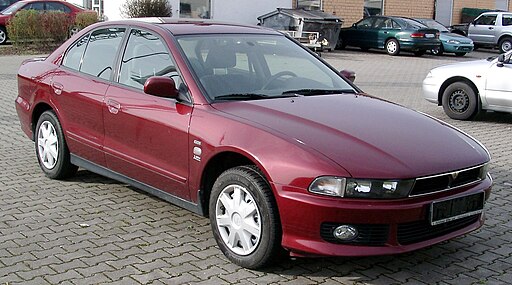
Mitsubishi Galant as a Used Car: A Forgotten Japanese Saloon with Real Character
The Mitsubishi Galant is one of those cars that has become increasingly interesting as it has disappeared from ordinary roads. Once a familiar sight in Europe, the Galant occupied the middle-class family-car segment and competed with models such as the Volkswagen Passat, Ford Mondeo, Opel Vectra and Mazda 626. The eighth-generation Galant, introduced in 1996 and sold in Europe until the early 2000s, was offered as a four-door saloon and five-door estate, with four-cylinder petrol engines, a V6 and a 2.0-litre turbo-diesel depending on market. It was a relatively sophisticated car for its time, with multi-link suspension, a comfortable cabin and, in some markets, four-wheel drive. Today, however, the Galant is no longer an ordinary used family car: even the newest European examples are more than 20 years old, which makes condition, corrosion and maintenance history far more important than the original specification.
That age is both the Galant’s biggest problem and part of its appeal. The model was never as common as the Passat or Mondeo, so finding a genuinely good example can take patience. On the other hand, a healthy Galant offers something that many modern used cars do not: a relatively large, comfortable and mechanically characterful car that can be bought for modest money. The naturally aspirated 2.0-litre petrol is particularly interesting for buyers who value simplicity, while the 2.5-litre V6 turns the Galant into a surprisingly enjoyable long-distance car. There is also the unusual 2.4 GDI direct-injection engine, which was technically innovative but is considerably less attractive to a buyer who wants uncomplicated ownership. The key to buying a Galant today is therefore not simply asking whether the model is reliable, but identifying which version combines a sound body, sensible engine and documented maintenance.
What Is the Mitsubishi Galant Like as a Used Car?
The eighth-generation Galant is a genuine mid-size car rather than a compact family vehicle. European versions measure roughly 4.63 metres in saloon form and have a 2.635-metre wheelbase, giving the cabin considerably more space than a typical compact car. The estate, known in Japan as the Legnum, stretches to approximately 4.68 metres and offers a useful alternative for buyers who need more carrying capacity. The saloon has around 470 litres of luggage capacity, while the estate offers approximately 420 litres in the cited European specification.
On the road, the Galant’s character is one of its strongest selling points. The suspension was designed around comfort and stability rather than the sharp, lightweight feel of a small car, and the multi-link arrangement contributes to a composed ride. The long wheelbase helps it feel stable at motorway speeds, while the larger engines give it the relaxed performance expected from a mid-size Japanese saloon. This is a car that makes much more sense as a comfortable cruiser than as an urban runabout.
The cabin is also worth remembering in its historical context. The Galant was never intended to be a luxury car, but higher specifications could be well equipped, and the basic layout is straightforward. Modern buyers will immediately notice the dated materials, small displays and lack of contemporary connectivity, but these are not necessarily serious disadvantages in an inexpensive second-hand car. What matters more is whether the electrical equipment, air conditioning, windows, central locking and instruments still work correctly, because repairing age-related faults can be disproportionately expensive compared with the value of the vehicle.
Which Engine Should You Choose?
2.0 MPI Petrol: The Sensible Choice
For a buyer who wants a Galant as an inexpensive everyday car, the naturally aspirated 2.0-litre four-cylinder is probably the best place to start. The 4G63 engine was used in naturally aspirated form in the Galant and should not be confused with the turbocharged 4G63 associated with Mitsubishi’s famous Lancer Evolution. European versions generally produced around 133–137 hp depending on specification.
The engine’s greatest advantage is its relatively conventional design. There is no turbocharger and no complicated direct-injection system, making it considerably easier to recommend than some of the more exotic engines offered in the range. However, there is one very important maintenance requirement: the 4G63 uses a timing belt and a separate balance-shaft belt. A buyer should therefore insist on documentary evidence that the complete belt system has been replaced at the appropriate interval. Neglecting this maintenance can lead to serious engine damage, and the balance-shaft belt should not be overlooked simply because it is not the main timing belt.
A properly maintained 2.0 is not especially exciting by modern performance standards, but it suits the Galant very well. It provides enough power for normal family use and gives the car a relaxed character without the additional fuel consumption and mechanical complexity of the V6. For a buyer looking for the most rational Galant, this is the engine to seek out.
2.5 V6: The Enthusiast’s Choice
The 2.5-litre V6 is what makes the Galant particularly interesting. The 6A13 engine produces around 160 hp in European specification and gives the large saloon considerably more effortless performance than the four-cylinder versions. It is smooth, quiet and well suited to long journeys, and its six-cylinder character gives the Galant a level of refinement that makes it feel more expensive than its current used-car price suggests.
The downside is running cost. A V6 naturally consumes more fuel than the 2.0, and the engine bay is more tightly packed, making some maintenance jobs more involved. The extra weight over the front axle also means that suspension, brakes and tyres deserve particular attention. If you are considering a V6, the condition of the gearbox becomes especially important.
The manual gearbox is generally the enthusiast’s preferred choice. The automatic can make the Galant a very comfortable cruiser, but older automatic transmissions are expensive components to replace. Specialist buying information identifies the INVECS-II automatic as an area that deserves particularly careful testing on high-mileage cars, with slipping, harsh shifts or hesitation being reasons to walk away or demand a professional transmission inspection.
2.4 GDI: Interesting Technology, More Risk
The 2.4 GDI is perhaps the most technically interesting mainstream engine in the European Galant range. Mitsubishi was an early pioneer of gasoline direct injection, and the eighth-generation Galant family helped introduce GDI technology to mass production. The European 2.4-litre 4G64 GDI produced approximately 150 hp.
Unfortunately, technological sophistication is not necessarily an advantage when buying a 20-year-old car. The GDI system can be sensitive to carbon accumulation, particularly on the intake valves, because fuel is injected directly into the combustion chamber rather than washing over the intake valves. Symptoms can include rough running, hesitation and loss of performance. The high-pressure fuel system can also become expensive to repair.
This does not mean every GDI Galant is a bad car. A well-maintained example with a documented history of intake cleaning and proper fuel-system maintenance can still be perfectly usable. But if the objective is to minimise unexpected expenditure, the conventional 2.0 MPI is a much safer recommendation. The GDI is best regarded as an option for someone who specifically appreciates the technology and is prepared to accept the additional risk.
2.0 Turbo-Diesel: Economical but Dated
The European Galant could also be ordered with a 2.0-litre turbo-diesel producing approximately 90 hp and 202 Nm. It was a relatively old-fashioned diesel compared with the increasingly popular common-rail units of the period, but its torque and fuel economy made it attractive to drivers covering substantial annual mileage.
The problem today is not simply the engine’s age but the age of the entire vehicle around it. A diesel Galant may have accumulated very high mileage, and components such as the turbocharger, injection system, cooling system and clutch can be expensive relative to the value of the car. The engine itself may still have plenty of life left, but the surrounding hardware can determine whether the purchase makes financial sense.
For a modern buyer who travels only modest distances, a petrol Galant is therefore easier to recommend. The diesel makes sense mainly when you find an unusually well-preserved example with a strong service history and a genuinely appropriate use pattern.
What Problems Should You Check Before Buying?
Corrosion Is More Important Than Mileage
On a Galant of this age, rust should be treated as the first major inspection point. An engine with 250,000 km and an excellent maintenance history can be less worrying than a lower-mileage car with serious structural corrosion. Pay close attention to the body seams, wheel arches, sills, door bottoms and underside, as well as areas around suspension and subframe mounting points. Specialist used-car information specifically identifies corrosion around front-body seams as an issue worth checking.
The inspection should ideally be performed on a lift. Looking at the car from ground level is not enough, particularly if it has been undersealed or recently cleaned underneath. Any evidence of extensive welding should be investigated carefully. Cosmetic rust is one thing; corrosion affecting structural areas, suspension mounting points or brake lines is an entirely different proposition.
Timing Belt and Engine History
For the 2.0 petrol, timing-belt history is essential. Ask for invoices rather than accepting a seller’s statement that the belt was “done recently”. Ideally, the replacement should include the tensioners and the balance-shaft belt, and the date and mileage should be recorded.
The V6 also requires careful attention to maintenance history, while the GDI deserves additional scrutiny of its intake and fuel system. On any engine, inspect for oil leaks, coolant loss and signs of overheating. Start the car from cold if possible and listen for unusual noises before the engine has warmed up and hidden potential problems with a convenient operating temperature.
Suspension and Brakes
A Galant’s size and weight mean that suspension components work harder than those on a small hatchback. Front control arms, bushes and other components can develop play, resulting in knocking noises over poor roads or vague steering. The car should remain stable under braking and should not pull noticeably to either side.
Brakes deserve particular attention on V6 cars because the heavier and more powerful specification can put greater demands on discs, pads and calipers. Uneven braking, vibration through the steering wheel or a soft pedal should never be ignored. On an old car, brake pipes and hoses also deserve a visual inspection.
Automatic Gearboxes
If you are considering an automatic Galant, take considerably more time over the test drive than you would with a manual. The transmission should engage Drive and Reverse without excessive delay, shift consistently when cold and warm, and avoid slipping or violent engagement. Specialist used-car guidance describes the INVECS-II automatic as one of the major potential financial risks on certain Galant versions.
A gearbox that behaves badly should not be dismissed with the assumption that it merely needs fresh fluid. Sometimes a service will help, but internal wear can require a complete rebuild or replacement. On a low-value old car, that can make the repair economically irrational.
How Practical Is the Galant Estate?
The estate version deserves special attention because it gives the Galant a more useful family-car character without losing its comfortable driving experience. The Japanese-market version was known as the Legnum, while export markets also received estate versions of the Galant. The body is slightly longer than the saloon and has a taller rear section, making it considerably easier to carry bulky objects.
An estate Galant is now particularly rare, so buyers should not expect a huge selection. This rarity can make a good example desirable to enthusiasts, but it also means replacement body panels and trim can be more difficult to find. As with the saloon, body condition should take priority over equipment level.
For a buyer who genuinely needs luggage capacity, the estate is arguably the more appealing version. For someone buying primarily because of the Galant’s style and driving character, the saloon remains the more distinctive choice.
What About the VR-4?
The Japanese-market VR-4 is a completely different proposition from the European 2.0 or 2.5-litre Galant. The final-generation VR-4 used a 2.5-litre twin-turbo V6 with four-wheel drive, producing around 206 kW under Japan’s voluntary power limit. It could accelerate to 100 km/h in roughly five seconds and used sophisticated technology including Mitsubishi’s Active Yaw Control on relevant versions.
For most buyers, this is not the Galant to buy as inexpensive transportation. It is an enthusiast car, and its rarity, performance and complex four-wheel-drive system mean that maintenance can be substantially more expensive. A genuine, unmodified example can be highly desirable, but it should be approached in the same way as any other specialist performance car: history, originality and mechanical condition matter enormously.
What Are the Galant’s Biggest Strengths?
The Galant’s strongest quality is its combination of comfort and character. Even the ordinary four-cylinder versions have the dimensions and road manners of a proper long-distance family car, while the V6 adds a level of smoothness that is difficult to reproduce with modern small turbocharged engines. The eighth generation also has a particularly distinctive late-1990s Japanese design that has aged surprisingly well.
Reliability can be good when the car has been maintained properly. Historical inspection data for the 1996–2004 Galant generation actually showed defect rates that were competitive with or slightly better than the average car of comparable age at the time of testing, although those statistics are now old and cannot substitute for inspecting an individual vehicle.
The Galant is also appealing because it has not yet become a fashionable collector car in the way some Japanese performance models have. That keeps purchase prices relatively accessible and allows an enthusiast to own something unusual without necessarily spending classic-car money.
What Are Its Weaknesses?
The obvious weakness is age. Even the newest European Galants are now elderly vehicles, and age affects every part of the car. Rubber bushes deteriorate, seals harden, electrical connections corrode, air-conditioning systems lose their refrigerant and interior trim becomes fragile. These are not necessarily Galant-specific faults, but they are unavoidable considerations when buying a vehicle of this vintage.
Fuel consumption is another issue. The 2.0 is reasonably manageable, but the V6 can consume significantly more fuel, particularly in urban driving. The GDI was designed to improve efficiency, but its complexity makes it less attractive as an old used car. Meanwhile, the diesel may offer good economy but introduces the usual concerns associated with a high-mileage ageing diesel.
Parts availability can also be less convenient than with a common European family car. Mechanical components are generally easier to source than model-specific trim or body parts, but finding a perfect replacement bumper, interior component or unusual electrical module may require patience.
Is the Mitsubishi Galant a Good Used-Car Buy?
The Mitsubishi Galant can be an excellent used car for the right buyer, but it is not a model to purchase casually. Its age means that the condition of the particular vehicle matters enormously, and a low price should never be mistaken for low ownership costs. The best examples are now becoming scarce, so it is worth spending more for a rust-free car with comprehensive maintenance records.
For most buyers, the naturally aspirated 2.0 petrol with a manual gearbox is the most sensible combination. It is relatively simple, durable and powerful enough for normal driving, provided the timing and balance-shaft belts have been maintained correctly. The 2.5 V6 is the more desirable choice for enthusiasts who appreciate smooth performance and are prepared for higher fuel and maintenance costs. The 2.4 GDI is technically fascinating but should be approached with considerably more caution, while the 2.0 diesel makes sense mainly for a buyer with substantial annual mileage.
Ultimately, the Galant is best viewed as an old-school Japanese alternative to the conventional European family car. It is spacious, comfortable, distinctive and capable of very high mileage when properly cared for, but it now demands an owner who is willing to inspect it carefully and maintain it proactively. Find a solid example, preferably with a manual gearbox and a conventional petrol engine, and the Galant can still be a rewarding and surprisingly capable daily driver. Buy one purely because it is cheap, however, and corrosion, neglected belts, suspension wear or an unhealthy automatic gearbox can quickly turn an attractive bargain into an expensive project.
Mitsubishi Galant Technical Specifications
| Specification | Mitsubishi Galant VIII (EA/EC), typical European version |
|---|---|
| Production period | 1996–2004 |
| Generation | Eighth generation, EA/EC |
| Body styles | 4-door saloon, 5-door estate |
| Drive | Front-wheel drive; AWD available in selected markets |
| Seating | 5 |
| Wheelbase | 2,635 mm |
| Saloon length | Approximately 4,630 mm |
| Estate length | Approximately 4,680 mm |
| Width | Approximately 1,740 mm |
| Saloon height | Approximately 1,415 mm |
| Estate height | Approximately 1,445 mm |
| Saloon boot capacity | Approximately 470 litres |
| Estate boot capacity | Approximately 420 litres |
| 2.0 MPI petrol | 1,997 cc, 4-cylinder, approximately 133–137 hp |
| 2.4 GDI petrol | 2,378 cc, 4-cylinder, approximately 150 hp |
| 2.5 V6 petrol | 2,498 cc, V6, approximately 160–163 hp |
| 2.0 TD diesel | 1,998 cc, 4-cylinder turbo-diesel, approximately 90 hp |
| Main transmissions | 5-speed manual; 4-speed automatic on selected versions |
| 2.0 petrol timing system | Timing belt plus balance-shaft belt |
| 2.4 GDI fuel system | Gasoline direct injection |
| Recommended engine | 2.0 MPI petrol |
| Enthusiast engine | 2.5 V6 |
| Best gearbox | 5-speed manual |
| Main buying concern | Rust and structural corrosion |
| Other major concerns | Timing-belt history, automatic transmission, GDI carbon deposits, suspension and electrical equipment |
| Typical kerb weight | Approximately 1,260–1,465 kg, depending on version |
| Fuel tank | Approximately 60 litres |
| Main strengths | Comfort, spacious cabin, V6 refinement, distinctive styling and durable conventional petrol engine |
| Main weaknesses | Advanced age, corrosion, fuel consumption, ageing electronics and potentially expensive automatic/GDI repairs |
