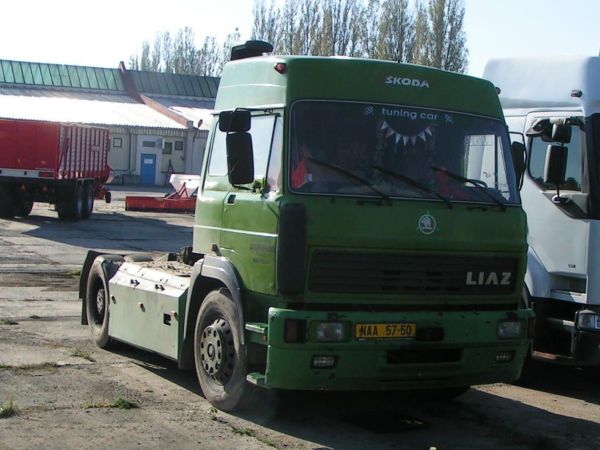
LIAZ 100 Series: The Czechoslovak Truck Family That Carried a Generation
The LIAZ 100 Series was one of the most important families of heavy trucks produced by the Czechoslovak manufacturer LIAZ during the final decades of the country’s socialist industrial era. Introduced in 1974, the series represented a major technological step beyond the company’s earlier Škoda-LIAZ 706 RT and MT trucks, bringing new engines, transmissions, axles, cabins, and a much broader range of chassis configurations. Rather than being a single truck model, the LIAZ 100 Series was an extensive family covering everything from conventional 4×2 tractor units and flatbed trucks to 4×4 tippers, three-axle chassis, special vehicles, and eventually more sophisticated long-distance versions with high-roof cabs and modern equipment. Produced for roughly two decades, the series became a familiar sight throughout Czechoslovakia and other countries of Central and Eastern Europe, while also demonstrating that Czechoslovak engineers could develop heavy commercial vehicles capable of competing with increasingly sophisticated Western European designs.
The Origins of the LIAZ 100 Series
Moving Beyond the 706
The history of the LIAZ 100 Series is closely connected with the development of LIAZ itself. The company had inherited a long tradition of heavy truck production based on Škoda designs, with the Škoda 706 RT and later MT families forming the backbone of Czechoslovak road freight transportation. By the 1960s, however, it was becoming increasingly clear that these designs were approaching the limits of their useful development. LIAZ engineers began working on a new generation during that decade, but difficulties with suppliers and the availability of components delayed the program. Transitional MT models therefore continued to bridge the gap before the new 100 Series finally entered production.
The new truck represented a substantial modernization. Compared with the 706 RT, the LIAZ 100 introduced a new generation of diesel engines, new transmissions and redesigned axles, while its cab was developed around the needs of contemporary heavy transport. The result was a truck that retained the practical, robust character expected by operators in Czechoslovakia but was technically much closer to the international standards of the 1970s. Initial versions included the 100.45 tractor and 100.05 flatbed, with additional configurations following as the family expanded.
The timing was significant. Europe was entering an era in which heavy trucks were becoming increasingly specialized. Long-distance haulage required different equipment from construction, agriculture, municipal work, or military service. Rather than developing completely unrelated trucks for every application, LIAZ created a modular family around common mechanical components. This approach allowed the manufacturer to offer a wide range of vehicles while retaining considerable commonality in engines, axles, transmissions, and other major components.
The LIAZ 100 Engine
The M-Series Six-Cylinder Diesel
One of the defining features of the 100 Series was its new generation of inline-six diesel engines. The early trucks used engines from the LIAZ M family, with a displacement of approximately 11.94 liters. Contemporary development eventually produced successive versions known as the M1 and later M2, with turbocharged variants providing substantially more power than the earliest naturally aspirated engines. Sources give the later development range as reaching approximately 320 horsepower (236 kW).
The basic philosophy behind the engine was well suited to heavy commercial transportation. A large-displacement inline-six provides a useful combination of mechanical simplicity, durability, and torque, particularly when designed to operate at relatively low engine speeds. For a tractor pulling a heavy semitrailer, maximum horsepower is only part of the equation. Strong torque at low and medium rpm is crucial because it allows the truck to maintain momentum on gradients without constantly requiring high engine speeds.
LIAZ continued developing the engine throughout the life of the 100 Series. This evolution was necessary as customer expectations changed and European markets introduced increasingly demanding requirements for power, reliability, noise, emissions, and operating economy. The company’s later engines could produce considerably more power than the units available when the series was introduced, allowing older chassis concepts to remain competitive for longer.
Transmission and Drivetrain
Praga Gearboxes
The engine was paired with robust manual transmissions, particularly gearboxes from Praga. Depending on the version and period, the 100 Series could use nine- or ten-speed Praga transmissions, while later development introduced a 16-speed ZF gearbox. The move toward the ZF transmission was particularly significant because it demonstrated how LIAZ was adapting its vehicles to increasingly competitive European standards during the final years of the series.
Multiple ratios were important for a heavy truck operating under widely varying conditions. A close-ratio gearbox allows the driver to keep the diesel engine within its useful operating range, while lower gears provide the multiplication of torque necessary for starting heavy loads and climbing steep gradients. Higher gears, meanwhile, allow the vehicle to travel more efficiently on relatively level roads.
The 100 Series was offered in several drivetrain configurations. Standard 4×2 models powered only the rear axle, while specialized vehicles included 4×4, 6×2, and other experimental or special arrangements. The breadth of these configurations was one of the strongest characteristics of the family. A basic tractor unit could share much of its mechanical architecture with a construction tipper or specialized off-road truck while receiving different axles, cab arrangements, and bodywork.
Cab Design and Driver Environment
From Fixed to Tilting Cabs
Early LIAZ 100 trucks were recognizable by their characteristic forward-control cab, but the design evolved significantly during production. The first generation included a non-tilting medium cab, while later modernization brought a tilting version that made access to the engine considerably easier. This was an important practical improvement because cab-over-engine trucks require good access to the powerplant for routine maintenance and repairs.
The later versions also offered different cab lengths and roof arrangements. Short and long cabins were available, while the development of the MAXI high-roof cab reflected the growing importance of long-distance international haulage. Features such as improved seats, electric mirrors and windows, additional storage, refrigeration equipment, and other driver-oriented amenities appeared during the final stages of development.
This evolution mirrors a broader transformation in European trucking. In the 1970s, a heavy truck could still be regarded primarily as an industrial machine in which driver comfort was secondary. By the late 1980s and early 1990s, however, long-distance drivers were spending enormous amounts of time in their cabs, and manufacturers increasingly treated the cabin as a working and living environment. LIAZ followed this trend with its later 100 Series variants.
The Main LIAZ 100 Series Configurations
100 and 110 Models
The model numbers provide an important clue to the development of the range. The original 100-series vehicles generally used the early fixed-cab arrangement, while the 110 designation became associated with the later tilting long cab on 4×2 chassis. The 100.47, for example, was a tractor unit, while the 100.05 was configured as a conventional drop-side truck.
The 110 family expanded the range considerably. It could serve as a tractor, rigid truck, or specialist vehicle depending on the chassis and bodywork. This flexibility made it suitable for everything from ordinary freight transportation to tanker work and municipal applications.
Four-Wheel-Drive and Three-Axle Versions
For construction and difficult terrain, LIAZ developed versions with driven front axles. The 111 designation was associated with 4×4 vehicles, while 122 models represented three-axle configurations. Short-cab variants such as the 150 and 151 were also developed, including 4×2 and 4×4 configurations respectively.
The existence of these variants shows that the 100 Series was far more than a highway truck. The 4×4 versions could be adapted for construction and specialized applications, while three-axle chassis provided additional payload and bodywork possibilities. Other configurations, including prototypes with 6×4 and 6×6 drive, demonstrated how far LIAZ engineers were willing to develop the underlying platform.
One particularly interesting special vehicle was the LIAZ 101.860, a fire-service truck that used a spacious special cabin incorporating components from the Karosa 700-series bus family. Such adaptations demonstrate the degree of flexibility available within the LIAZ industrial ecosystem.
Construction and Off-Road Applications
The 150 and 151 Tippers
Construction work placed different demands on a truck from long-distance freight hauling. A construction vehicle may spend much of its life on rough surfaces, repeatedly starting and stopping under heavy load, and carrying abrasive materials such as gravel, sand, or crushed stone. LIAZ responded with short-cab tipper versions including the 150 and 151 families. The latter incorporated four-wheel drive, providing substantially greater traction on poor surfaces.
The 4×4 configuration was particularly useful for operators who needed to work away from paved roads. Although these trucks were not designed as extreme military off-roaders, their robust construction and driven front axle made them considerably more capable on construction sites, forest roads, quarries, and agricultural routes than a conventional 4×2 truck.
The chassis could also be adapted for specialized equipment. Garbage collection, firefighting, tankers, cranes, and other superstructures could be mounted on appropriate LIAZ frames. This modularity helped extend the useful life of the basic engineering and made the 100 Series a common platform for specialist vehicle manufacturers.
The LIAZ 100 Series and Long-Distance Haulage
Preparing for Western European Competition
The late 1980s brought a significant change in the environment in which LIAZ operated. Czechoslovakia was moving toward a more open market, and Western European truck manufacturers increasingly became competitors rather than distant technological references. LIAZ responded by upgrading the 100 Series with equipment that would have been associated with more sophisticated Western trucks.
Among the later options were a 16-speed ZF transmission, high-roof MAXI cab, ABS braking, central lubrication, electrically adjustable equipment, improved mirrors, upgraded seats, and other driver-comfort features. These improvements did not fundamentally change the truck’s underlying architecture, but they made later versions much more competitive for international transport.
The high-roof cab was especially important. Long-distance trucking was becoming increasingly international, and operators expected more interior space and better sleeping arrangements. A truck designed for domestic freight could no longer necessarily compete for international work without offering a comfortable driver environment.
The LIAZ 100 Series in Motorsport
Dakar and Rally-Raid Trucks
An unusual chapter in the history of the 100 Series was its involvement in rally-raid competition. The LIAZ 100.55 D became the first Czech truck to compete in the Paris-Dakar Rally in 1985. The crew of Jiří Moskal, Jaroslav Joklík, and Radek Fencl completed the event in 13th place in the truck category, while another LIAZ reached the finish outside the classification.
The achievement was significant because rally raids place extraordinary demands on heavy vehicles. Trucks must withstand vibration, dust, heat, rough terrain, and sustained high mechanical loads, often for thousands of kilometers. A production-based LIAZ competing successfully in such conditions demonstrated the fundamental strength of the platform and its engines.
The same truck family also achieved a notable result in the Rallye des Pharaons, winning its category above 10 tonnes. These competitions helped create an image of LIAZ as a manufacturer capable of producing trucks that were not merely functional but genuinely durable under extreme conditions.
Production and the End of the Series
From the 1970s Into the 1990s
The conventional history of the LIAZ 100 Series places its main production period from 1974 to 1994, although some references describe later customer-order production and transitional applications extending beyond that date. The successor 200 Series began appearing around the same period, while later 300 Series vehicles continued the company’s development of the basic heavy-truck concept.
Production took place primarily in Czechoslovakia, with assembly and industrial operations also associated with Jablonec nad Nisou, Mnichovo Hradiště, and Zvolen, as well as licensed or related production in Bulgaria. This geographic footprint reflects the importance of the truck within the industrial structure of the former Czechoslovakia and its economic partners.
The end of the 100 Series did not mean the end of its engineering influence. The later 200 and 300 Series inherited many of the concepts developed during the 100 Series era, while LIAZ continued searching for ways to modernize its products for an increasingly competitive European market.
Why the LIAZ 100 Series Matters
The importance of the LIAZ 100 Series lies in its role as a bridge between two eras of European truck manufacturing. At its introduction, it was a thoroughly modern Czechoslovak heavy truck designed around robust mechanical components and relatively straightforward servicing. By the end of its development, however, it had evolved into a considerably more sophisticated vehicle with high-roof cabins, advanced transmissions, ABS, improved driver amenities, and greater emphasis on international long-distance transport.
It also demonstrated the advantages of a modular commercial-vehicle family. Instead of creating separate engineering programs for every application, LIAZ could use a common foundation to build tractors, flatbed trucks, tippers, four-wheel-drive vehicles, three-axle chassis, fire engines, and specialized equipment carriers. That flexibility helped the company serve a remarkably broad customer base.
For enthusiasts today, the LIAZ 100 Series is especially interesting because it captures the character of Czechoslovak truck engineering during a period of enormous technological and political change. Its distinctive cab, large inline-six diesel, mechanical transmissions, robust chassis, and wide range of configurations make it immediately recognizable, while its later variants show how quickly the European heavy-truck industry was changing during the 1980s and early 1990s.
LIAZ 100 Series Technical Specifications
| Specification | LIAZ 100 Series |
|---|---|
| Manufacturer | LIAZ (Liberecké automobilové závody) |
| Country | Czechoslovakia / Czech Republic |
| Main production period | 1974–1994 |
| Vehicle type | Heavy commercial truck family |
| Cab configuration | Cab-over-engine |
| Engine family | LIAZ M / M1 / M2 |
| Engine configuration | Inline six-cylinder diesel |
| Engine displacement | Approximately 11.94 L |
| Engine type | Naturally aspirated and turbocharged |
| Power range | Approximately 148–236 kW, depending on version |
| Maximum later output | Approximately 320 hp / 236 kW |
| Transmissions | Praga 9-speed, Praga 10-speed, later ZF 16-speed |
| Main drive configurations | 4×2, 4×4, 6×2 |
| Special/prototype configurations | 6×4, 6×6 and other arrangements |
| Typical applications | Tractor, flatbed, tipper, tanker, municipal, fire and specialist vehicles |
| Later cab options | Tilting cab, short/long cab, MAXI high-roof cab |
| Braking | Pneumatic; later versions available with ABS |
| Suspension | Heavy-duty leaf-spring arrangements |
| Notable motorsport version | LIAZ 100.55 D |
| Paris-Dakar debut | 1985 |
| Successor family | LIAZ 200 Series |
| Main production locations | Jablonec nad Nisou, Mnichovo Hradiště and associated facilities |
The LIAZ 100 Series covered numerous models and chassis configurations, so there is no single set of dimensions, payload, axle weights, fuel capacity, or performance figures applicable to every vehicle. The table summarizes the principal characteristics of the family; individual models such as the 100.05, 100.47, 110, 111, 122, 150 and 151 differed substantially in configuration.
Conclusion
The LIAZ 100 Series was much more than a successor to the older Škoda-LIAZ trucks. It became the foundation of an entire generation of Czechoslovak heavy commercial vehicles, combining a new family of 11.94-liter diesel engines with robust manual transmissions, adaptable chassis, multiple axle configurations, and progressively more sophisticated cabins. From the straightforward 100.05 flatbed and 100.47 tractor to four-wheel-drive tippers, three-axle chassis, specialist vehicles, and the competition-proven 100.55 D, the range demonstrated remarkable versatility.
Its two-decade development also tells the story of an industry adapting to a changing world. The earliest trucks were products of the 1970s Czechoslovak industrial system, emphasizing mechanical durability and practical serviceability. The final versions, by contrast, incorporated equipment intended to compete in a more open European market. That combination of old-fashioned toughness and gradual modernization is what makes the LIAZ 100 Series such an interesting chapter in European truck history.
For enthusiasts, the series remains recognizable for its distinctive cab and unmistakable mechanical character. For historians, it represents an important stage in the development of the Czechoslovak commercial-vehicle industry. And for anyone interested in heavy trucks, the LIAZ 100 Series offers an excellent example of how one adaptable platform can evolve over two decades while continuing to serve radically different roles—from hauling freight across Europe to carrying construction materials and even competing in the unforgiving environment of the Dakar Rally.