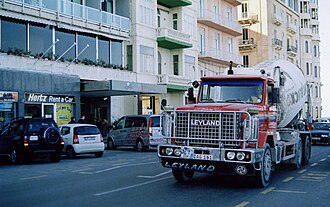
Leyland Landtrain: The British Heavy Truck Built for the World’s Toughest Roads
The Leyland Landtrain was one of the most distinctive heavy trucks produced by British Leyland during the early 1980s. Unlike many European trucks of its period, the Landtrain was developed specifically with export markets in mind, particularly regions of Africa, Asia, Latin America, and the Middle East where long distances, poor roads, extreme temperatures, limited servicing facilities, and difficult fuel logistics were everyday realities. Introduced in 1980, it was a deliberately rugged bonneted truck designed to keep working where more sophisticated highway-oriented vehicles could struggle. Offered in rigid, tipper, and tractor configurations, with 4×2 and 6×4 layouts and gross vehicle weights ranging from approximately 19 to 36 tonnes, the Landtrain represented a distinctly British interpretation of the heavy-duty truck for developing markets. Its relatively simple mechanical construction, large fuel capacity, robust chassis, conventional leaf-spring suspension, and choice of Leyland and Cummins six-cylinder diesel engines all reflected the same philosophy: build a truck that could be maintained in remote locations and continue operating for long periods away from modern infrastructure.
The Origins of the Leyland Landtrain
A Truck Designed for Export
The Landtrain emerged from British Leyland’s recognition that many international markets had transportation requirements very different from those of Western Europe. A truck operating between major European cities could depend on paved roads, plentiful workshops, reliable fuel stations, and relatively sophisticated infrastructure. In parts of Africa, the Middle East, Asia, and Latin America, the situation could be completely different. Long stretches of rough roads, high ambient temperatures, dust, limited spare-parts availability, and enormous distances between service facilities demanded a vehicle that prioritized durability and ease of maintenance over refinement.
The project was internally designated T129, and the truck was launched at the 1980 Geneva Motor Show. British Leyland described it as a truck specifically developed for export markets, drawing on the company’s considerable experience with heavy commercial vehicles and specialist military machinery. The design also benefited from expertise associated with Scammell, another British Leyland company with a long history of producing heavy tractors and off-road vehicles. This background was particularly relevant because the Landtrain needed to combine substantial payload and towing capacity with the ability to survive harsh operating environments.
The name “Landtrain” was particularly appropriate for its intended role. The tractor version could operate at a gross combination weight of approximately 65 tonnes, and in countries where local regulations allowed it, an additional trailer could be added behind the semitrailer. In other words, the Landtrain was not simply a heavy truck but a platform designed to become part of an exceptionally long and heavy transportation combination. This made it particularly attractive for bulk freight, mining-related operations, construction, agricultural transport, and other industries in regions where road transportation was often the only practical method of moving goods over enormous distances.
A Bonneted Design for Harsh Environments
Why the Cab Was Positioned Behind the Engine
One of the most obvious features of the Landtrain was its bonneted configuration. At a time when European manufacturers were increasingly moving toward cab-over-engine designs, Leyland deliberately retained a conventional layout for this export-oriented truck. The decision was practical rather than nostalgic. With the driver sitting behind the engine rather than directly above it, the cab was less exposed to engine heat, an important advantage in hot climates.
The bonnet also provided easier access to the engine compartment. For operators working far from sophisticated workshops, being able to reach the engine and major mechanical components without tilting the entire cab could simplify inspection and maintenance. This was especially important because the Landtrain was intended for countries where workshop equipment and specialized technicians might not always be readily available. The design therefore favored accessibility and straightforward mechanical servicing over the compact packaging that made cab-over trucks attractive in Europe.
The chassis was equally straightforward. A strong bolted ladder frame, developed from the architecture associated with the Scammell Contractor, formed the foundation of the truck. Its channel-section construction was designed to withstand substantial loads and twisting forces, while additional reinforcement could be incorporated where necessary. This rugged chassis was fundamental to the Landtrain’s ability to work as both a heavy rigid truck and a high-capacity tractor.
Engines and Power
Leyland and Cummins Six-Cylinder Diesels
The Landtrain was offered with a range of four different six-cylinder diesel engines, all with approximately 14 liters of displacement. Two came from Leyland and two from Cummins, giving customers a choice between naturally aspirated and turbocharged powerplants. The least powerful engine was the naturally aspirated Leyland L12, rated at approximately 158 kW, or around 212 horsepower, at 2,200 rpm. At the upper end of the range was the turbocharged Leyland TL12, producing approximately 210 kW (282 bhp) at 2,000 rpm and delivering roughly 1,205 Nm of torque at 1,200 rpm.
Cummins engines were also available, including the naturally aspirated NHC250 and turbocharged NTE290. The inclusion of Cummins powerplants was particularly significant for export customers because Cummins had an extensive international reputation and support network. For an operator in a remote region, access to familiar engine technology and replacement parts could be just as important as the original purchase price of the truck.
The engines were intentionally relatively low-revving. The Landtrain was designed to haul heavy loads rather than accelerate rapidly, so strong low-speed torque was more valuable than high engine speeds. The turbocharged TL12, for example, developed its maximum torque at only about 1,200 rpm. That characteristic made it well suited to pulling heavy combinations over rough roads, where maintaining momentum and avoiding unnecessary gear changes were more important than outright speed.
Transmission and Drivetrain
Six-Speed Manual Gearboxes
Transmission choices depended on the engine installed. The naturally aspirated Cummins NHC250 was paired with a ZF AK6-90 six-speed gearbox, while the Leyland TL12 and Cummins NTE290 used Fuller RT09509-series transmissions. The L12 was matched with an Eaton D403 six-speed constant-mesh gearbox featuring an overdrive top ratio. This variety allowed the different engine options to be matched with transmissions appropriate to their torque characteristics and intended operating conditions.
The Landtrain’s drivetrain was deliberately conventional. It did not attempt to introduce complicated electronic control systems or unusual transmission technology. This was entirely consistent with its purpose. A truck operating thousands of kilometers from its manufacturer’s home market needed mechanical systems that local mechanics could understand and repair.
The 6×4 versions were particularly important for heavy-duty applications because the tandem-drive rear bogie provided the traction and axle capacity necessary for high gross weights. Differential locking was available, while axle interlock was specified on 6×4 models. These features helped the Landtrain maintain useful traction when operating on loose or uneven ground, particularly when heavily loaded.
Chassis, Suspension, and Braking
Built Like a Heavy-Duty Workhorse
The Landtrain’s suspension was based on leaf springs throughout the range, another deliberate choice reflecting its emphasis on durability and simplicity. Leaf springs were well understood by mechanics around the world, capable of carrying high loads, and relatively easy to repair compared with more sophisticated suspension systems.
The axles were also designed around substantial load ratings. Published contemporary information gives a nominal front axle rating of approximately 6.6 tonnes, a single rear axle rating of around 13 tonnes, and approximately 26 tonnes for the tandem-drive rear bogie. These figures show how heavily the truck was engineered, particularly in its 6×4 configurations.
Braking used full-air systems, with separate circuits arranged according to the axle configuration. The 6×4 models had the braking system split between the front axle and rear bogie, with spring brake actuators providing secondary braking capability. For a truck designed to operate at high gross combination weights, robust pneumatic braking was essential, particularly when descending long grades or controlling a heavy trailer combination.
The electrical system was similarly conventional, using a 24-volt system with a 128 Ah battery. Such an electrical arrangement was appropriate for a heavy commercial vehicle and provided sufficient capacity for the truck’s starting, lighting, and auxiliary systems without introducing unnecessary complexity.
Fuel Capacity and Long-Distance Operation
Designed for Places Where Fuel Was Scarce
One of the most revealing aspects of the Landtrain’s design was its large fuel capacity. The truck could be equipped with a 300-liter fuel tank, with the option of adding a second tank on most configurations. This allowed total fuel capacity to reach approximately 600 liters, while other descriptions of the export Landtrain cite fuel tankage of up to around 700 liters, depending on configuration.
Large fuel capacity was not simply a matter of convenience. In many of the markets for which the Landtrain was designed, a vehicle might travel hundreds of kilometers between reliable fuel stations. A truck carrying a large load could not afford to make frequent stops, and a remote operator could face serious logistical problems if fuel supplies were unavailable. The Landtrain therefore treated fuel endurance as an important part of the vehicle’s overall design.
The combination of large fuel tanks, relatively simple diesel engines, heavy-duty chassis construction, and conventional mechanical systems made the truck particularly appropriate for long-distance haulage in developing regions. Its operating philosophy was almost the opposite of a modern urban distribution truck: it was intended to spend long periods traveling through difficult environments with minimal support.
The Different Landtrain Configurations
Rigid, Tipper, and Tractor Versions
The Landtrain was offered in several configurations to broaden its usefulness. The three-axle version could be supplied as a rigid truck, tipper, or tractor, while the range also included 4×2 configurations. Gross vehicle weights were offered at approximately 19, 30, and 36 tonnes, with model designations combining the nominal GVW and engine power. Examples included combinations such as 19-24, 19-29, 30-24, 30-29, 36-24, and 36-29.
The 6×4 rigid and tipper versions were approximately 9.34 meters long, 2.48 meters wide, and 2.78 meters high, with a wheelbase of about 5.68 meters. The tractor version was considerably shorter, with a wheelbase of approximately 4.77 meters and an overall length of roughly 7.17 meters. This shorter configuration improved maneuverability and provided the wheelbase needed for heavy trailer work.
The tractor’s rated gross combination weight of approximately 65 tonnes made it the natural choice for long-distance heavy haulage. In jurisdictions permitting additional trailers, the combination could become a true road train, allowing one prime mover to transport a very large quantity of freight over long distances.
The Landtrain in Africa and Other Export Markets
A Truck for Difficult Roads
The Landtrain became particularly associated with Nigeria, Kenya, and Zimbabwe, although it was sold much more widely across international markets. Its success in these regions was closely connected to the original design philosophy. Operators needed trucks that could survive poor roads, high temperatures, dust, heavy loads, and limited servicing infrastructure, and the Landtrain was specifically developed around those requirements.
The truck also demonstrated its versatility in unusual assignments. Landtrains were used for emergency relief work in Sudan and were involved in rebuilding the runway at Port Stanley after the Falklands War. One example even performed strongly in the demanding 1,100-mile, three-day Argungu rally, finishing fifth overall and first in its class. These applications demonstrated that the truck was capable of much more than conventional freight transportation.
Its export success was also supported by local assembly. British Leyland shipped complete knock-down (CKD) kits from its British factories to overseas assembly operations, including facilities in Thika, Kenya, and Ibadan, Nigeria. This approach reduced the need to export complete trucks and allowed vehicles to be assembled closer to their eventual markets.
Production and the End of the Landtrain
From Wolverhampton to Bathgate and Watford
Production initially took place at the former Guy Motors factory in Wolverhampton, with British Leyland reportedly expecting production of approximately 1,000 Landtrains during the first year. Manufacturing subsequently moved to Bathgate in 1982, following the closure of the Wolverhampton operation, and then to the Scammell factory at Watford in 1984 after Bathgate closed.
This sequence reflected the considerable industrial restructuring taking place inside British Leyland during the 1980s. The Landtrain itself remained a capable product, but the company was undergoing major changes, and the heavy commercial vehicle industry was becoming increasingly competitive.
Production finally ended in 1987, following the merger of Leyland with the Dutch manufacturer DAF to form Leyland DAF. The bonneted Landtrain did not fit the direction of the new company’s European truck range, and production was discontinued.
Why the Leyland Landtrain Remains Important
The Landtrain deserves attention because it represents a fascinating period in British truck engineering when manufacturers were designing vehicles specifically for global conditions rather than simply exporting European-market models. Almost every feature of the Landtrain reflected that mission: the bonneted cab protected the driver from engine heat, the ladder chassis emphasized strength, the leaf springs prioritized durability, the large fuel tanks extended operating range, and the choice of Leyland and Cummins engines provided flexibility for international operators.
Its legacy is particularly interesting when viewed against today’s road trains. Modern Australian road-train regulations, for example, recognize combinations extending to 53.5 meters for certain Type 2 configurations, while modern heavy-vehicle legislation imposes detailed requirements governing axle loads, braking, dimensions, and trailer construction. The original Landtrain was developed in a very different regulatory and technological environment, but its fundamental concept—one powerful tractor moving enormous quantities of freight across long distances—remains central to heavy road transport.
Leyland Landtrain Technical Specifications
| Specification | Leyland Landtrain |
|---|---|
| Manufacturer | British Leyland |
| Production | 1980–1987 |
| Primary market | Africa, Asia, Latin America, Middle East and other export markets |
| Configurations | 4×2 and 6×4 rigid, tipper and tractor |
| Engine options | Leyland L12, Leyland TL12, Cummins NHC250, Cummins NTE290 |
| Engine type | Six-cylinder diesel |
| Engine displacement | Approximately 14 litres |
| Maximum published engine output | Approximately 290 bhp, depending on engine |
| Transmission | Six-speed manual, depending on engine |
| Maximum tractor GCW | Approximately 65 tonnes |
| Rigid/tipper GVW options | Approximately 19, 30 and 36 tonnes |
| Fuel capacity | Approximately 300–700 litres, depending on configuration |
| Suspension | Leaf springs |
| Front axle rating | Approximately 6.6 tonnes |
| Single rear axle rating | Approximately 13 tonnes |
| Rear tandem-drive rating | Approximately 26 tonnes |
| Electrical system | 24 V |
| Typical 6×4 rigid/tipper length | 9,337 mm |
| Typical 6×4 rigid/tipper width | 2,478 mm |
| Typical 6×4 rigid/tipper height | 2,780 mm |
| 6×4 rigid/tipper wheelbase | 5,680 mm |
| Tractor wheelbase | Approximately 4,770 mm |
| Tractor length | Approximately 7,174 mm |
| Drive configuration | 4×2 or 6×4 |
| Brakes | Full air, dual-circuit |
| Chassis | Bolted ladder-frame construction |
| Differential equipment | Differential lock available; axle interlock on 6×4 |
| Main applications | Long-distance haulage, heavy transport, construction, mining and general export freight |
Specifications vary according to engine, axle configuration, body style, market, and production version. Contemporary sources give different figures for some items, particularly fuel capacity and engine ratings, so the table should be treated as a summary of the Landtrain range rather than the specification of one individual truck.
Conclusion
The Leyland Landtrain was a truck built around a simple but demanding idea: create a heavy vehicle capable of working reliably in parts of the world where roads, fuel supplies, workshops, and climate could all present serious challenges. Its bonneted configuration, powerful six-cylinder diesels, heavy-duty ladder chassis, leaf-spring suspension, 6×4 drive, large fuel capacity, and ability to operate at very high combination weights made it an unusually purposeful machine.
Although production lasted only seven years, the Landtrain established a strong reputation in several export markets and demonstrated British Leyland’s ability to engineer a truck specifically for conditions far beyond Western European highways. Its story also illustrates how important heavy commercial vehicles were to infrastructure development across Africa and other emerging markets during the late twentieth century. Today, surviving Landtrains are reminders of an era when truck manufacturers still produced highly specialized machines for particular parts of the world, and when simplicity, strength, and serviceability could be more valuable than technological sophistication.
The Landtrain may have disappeared from production after the formation of Leyland DAF, but its basic philosophy remains recognizable in modern heavy haulage: build the tractor strong enough to survive the road, give it enough power to move the load, carry enough fuel to reach the next supply point, and make sure that a mechanic can keep it working when civilization is hundreds of kilometers away.
