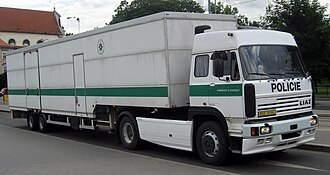
LIAZ 300 Series: The Last Great Evolution of a Czech Trucking Legend
The LIAZ 300 Series represents one of the most important chapters in the history of Czech heavy trucks. Introduced during the dramatic economic transformation of the early 1990s, it was designed to carry the established LIAZ concept into a new era while competing in a market that was suddenly much more open to Western manufacturers. Although its exterior still carried the unmistakable shape of the earlier LIAZ 100 and 200 families, the 300 Series incorporated numerous mechanical, cab and powertrain developments. It became the most diverse LIAZ production range, covering everything from conventional road tractors and rigid freight trucks to construction vehicles, all-wheel-drive chassis and specialized vehicles.
The series was also historically significant because it was effectively the final major development of the traditional LIAZ truck architecture. Production continued for roughly a decade, and sources give slightly different dates depending on whether development, introduction and final production are being considered. LIAZ-focused historical sources generally place the series from the early 1990s through 2003, while other references identify 1993 as the beginning of production. Around 2,800 vehicles of the 300 Series are commonly cited as having been produced.
From the LIAZ 200 to the 300 Series
A new generation built on familiar foundations
The LIAZ 300 Series did not appear from nowhere. It evolved directly from the earlier 100 and 200 families, retaining proven elements while introducing new components and engineering solutions. This evolutionary approach was understandable because LIAZ had spent decades developing a robust heavy-truck platform, and replacing everything at once would have required enormous financial and engineering resources.
The preceding 200 Series had itself been a transitional development, concentrating particularly on improved engine mounting, reduced noise and refinement. The 300 Series took the concept further. The cab remained recognizable, but its position was altered and exterior details such as the bumper and front fenders were revised. Underneath, LIAZ introduced new engines, transmissions and chassis configurations, creating a much broader family of vehicles than before.
This makes the 300 Series particularly interesting historically. It was simultaneously modern and conservative: modern in its equipment and range of powertrains, but conservative in retaining the basic architecture that had its origins in the development of the LIAZ 100.
Cab Design and Driver Environment
The recognizable LIAZ appearance
One of the most striking characteristics of the LIAZ 300 is how familiar it looks. Even after the transition from the 100 and 200 Series, the fundamental cab silhouette remained unmistakably LIAZ. To a casual observer, a 300 can therefore appear like a lightly restyled older truck. In reality, the differences were more substantial.
The cab was positioned higher than before, contributing to the changed appearance around the front axle and wheel arches. New bumper and fender arrangements helped distinguish the 300 Series visually from its predecessors. At the same time, LIAZ offered several cab lengths and heights, allowing customers to choose configurations appropriate for local distribution, construction work or long-distance transport.
This flexibility was one of the defining strengths of the 300 Series. Available cab types included short, middle, long and Maxi versions, with the latter providing greater interior volume for long-haul drivers. A special long cab could accommodate considerably more occupants and was useful for specialized applications where carrying a larger crew was important.
Moving toward long-distance comfort
The long-haul versions illustrate how LIAZ was trying to adapt to the expectations of the 1990s European trucking market. Earlier LIAZ trucks had earned a reputation for toughness, but international freight operators increasingly expected better sleeping accommodation, storage, heating and convenience equipment.
Higher-specification tractor versions could therefore be equipped with features such as a raised Maxi roof, additional storage, electrically adjustable mirrors, independent heating, refrigeration and imported driver seats. Some vehicles were also offered with aerodynamic accessories intended to reduce air resistance.
These improvements did not transform the LIAZ into an entirely new type of truck, but they show how the manufacturer was attempting to close the gap between its established products and increasingly sophisticated Western European competitors.
Engines of the LIAZ 300 Series
LIAZ six-cylinder diesels
The heart of the 300 Series was its range of large diesel engines. One of the most important powerplants was the 11.94-litre LIAZ M1.2C inline-six, which evolved from earlier LIAZ engines. Depending on specification and period, outputs included approximately 290, 330, 360, 380 and 410 horsepower. This represented a substantial development of the company’s established six-cylinder diesel architecture.
The engine’s six-cylinder configuration was well suited to heavy road transport because it provided a useful combination of torque, relatively compact dimensions and straightforward mechanical architecture. Rather than relying on an entirely new engine family, LIAZ continued developing the knowledge it had accumulated through decades of diesel production.
The higher-output versions were particularly important for tractor units and heavily loaded applications, where additional power could improve performance on gradients and during long-distance operation.
MAN and Detroit Diesel engines
The 300 Series was also notable because LIAZ was no longer dependent exclusively on engines produced within its own manufacturing system. Some vehicles could be fitted with 12-litre MAN six-cylinder engines, including versions producing around 420 horsepower, while later or particular applications could use the 12.7-litre Detroit Diesel Series 60, with outputs around 370 or 400 horsepower.
This diversification reflected the changing commercial environment of the 1990s. Offering internationally recognized powertrains could make a truck more attractive to operators who wanted familiar components and established service networks. It also gave LIAZ greater flexibility when responding to emissions regulations, market requirements and customer preferences.
Transmissions and Chassis Engineering
A wide choice of gearboxes
The engine range was matched by several transmission options. Depending on the model and engine, the 300 Series could use Praga manual gearboxes, ZF transmissions and Eaton gearboxes. Historical LIAZ sources identify ten- and fourteen-speed Praga units, sixteen-speed ZF transmissions and twelve-speed Eaton gearboxes among the combinations used in the series.
The availability of a sixteen-speed ZF gearbox was especially relevant to long-distance tractors. More ratios allowed the driver to keep the engine operating closer to its useful power and torque range, while also providing flexibility on varying gradients and road conditions.
The exact gearbox, however, depended on the particular truck. It is therefore misleading to describe one transmission as the universal gearbox of the 300 Series.
An exceptionally broad range of axle configurations
Perhaps the most impressive feature of the 300 Series was its variety of chassis arrangements. Customers could choose from 4×2, 4×4, 6×2, 6×4 and 6×6 configurations, while special versions expanded the possibilities even further. There were also unusual arrangements involving additional steering axles, and an 8×4 prototype was developed.
This versatility allowed the same basic family to serve very different purposes. A 4×2 tractor could be used for conventional road freight, while a 6×4 or 6×6 could be adapted for demanding construction or off-road work. Three-axle configurations could provide additional carrying capacity, while specialized steering arrangements improved maneuverability.
Such variety helps explain why the 300 Series is often described as the most diverse LIAZ production range.
The LIAZ 300 in Everyday Work
Road tractors
Road tractors formed an important part of the range. These trucks were designed to pull semi-trailers and were available with increasingly powerful engines and improved cab equipment. The Maxi cab in particular was aimed at long-distance transport, giving drivers more living and storage space than the basic versions.
The tractor versions also benefited from the broader selection of transmissions and suspension arrangements available within the 300 family. Depending on customer requirements, trucks could be configured for different payloads, routes and operating conditions.
Construction and tipper trucks
The 300 Series was equally important outside long-haul freight. Tippers and construction vehicles benefited from robust chassis designs and multiple driven-axle configurations. The availability of 6×4 and 6×6 layouts made the platform suitable for demanding conditions where traction was more important than maximum highway economy.
Fire engines and other specialist vehicles also became part of the LIAZ story during this period. Historical material on LIAZ fire vehicles notes the transition to 300-Series chassis and highlights the different engine and transmission characteristics compared with the preceding generation.
The LIAZ 300 and Motorsport
Truck racing
The 300 Series was not confined to ordinary commercial transport. LIAZ also used its trucks in motorsport, including truck racing and truck trials. A LIAZ 300.471 competed in the European Truck Racing Championship in the 1990s, following the earlier 250.471 racing truck. (Wikipedie)
Competition work offered more than publicity. Heavy-truck racing provided an opportunity to explore engine performance, cooling, braking, chassis behavior and durability under extreme conditions. For a manufacturer competing in a rapidly changing commercial market, such engineering experience could also help demonstrate the capabilities of its products.
Dakar and the continuing life of the platform
The LIAZ 300 platform also became closely associated with Czech participation in the Dakar Rally. Importantly, competition vehicles were heavily modified and should not be confused with ordinary production trucks. Nevertheless, the continued development of LIAZ-based racing vehicles demonstrated the fundamental strength and adaptability of the underlying concept. Later racing versions continued to evolve even after LIAZ itself had ceased normal truck production. (Garáž)
The End of the 300 Series
Competition from Western manufacturers
The 300 Series arrived at an extremely difficult moment. Following the collapse of the former Czechoslovak economic system, Czech truck manufacturers were suddenly competing much more directly with companies such as MAN, Mercedes-Benz, Volvo, Scania, Renault and DAF.
The 300 Series was substantially improved compared with the trucks that preceded it, but its basic engineering lineage still stretched back decades. By the second half of the 1990s, it was becoming increasingly difficult to compete against completely new Western European designs with more modern cabs, electronics, engines and manufacturing systems. (Garáž)
LIAZ consequently developed the 400 Series, including the Xena tractor, as a much more ambitious attempt to create a modern international competitor. The 400 Series arrived too late and in insufficient numbers to reverse the company’s fortunes, however. LIAZ ultimately produced its final truck in 2003. (Garáž)
LIAZ 300 Series Technical Specifications
Because the 300 Series covered a large number of models, the figures below should be regarded as a series overview rather than the specification of one individual truck. Engine, transmission, axle configuration, cab and payload specifications varied substantially between versions.
| Specification | LIAZ 300 Series |
|---|---|
| Manufacturer | LIAZ / Škoda-LIAZ |
| Country | Czech Republic / former Czechoslovakia |
| Production period | Early 1990s–2003 |
| Approx. production | About 2,800 vehicles |
| Vehicle type | Heavy truck / tractor |
| Cab configuration | Cab-over-engine |
| Main predecessor | LIAZ 200 Series |
| Basic engine | LIAZ M1.2C inline-six diesel |
| LIAZ engine displacement | 11.94 litres |
| LIAZ engine outputs | Approximately 290–410 hp, depending on version |
| Alternative engines | MAN 12-litre; Detroit Diesel Series 60 12.7-litre |
| Detroit Diesel outputs | Approximately 370–400 hp |
| MAN output | Up to approximately 420 hp |
| Transmission options | Praga, ZF and Eaton manual gearboxes |
| Gearbox examples | 10-, 12-, 14- and 16-speed configurations |
| Drive configurations | 4×2, 4×4, 6×2, 6×4, 6×6 and specialized layouts |
| Special configurations | 4×4 AWS, 6×4.4, prototype 8×4 |
| Cab types | Short, middle, long, Maxi and special variants |
| Main applications | Freight, tractor-trailer, construction, tipping, fire and special-purpose work |
| Successor/development | LIAZ 400 Series / Xena and Fox |
Conclusion
The LIAZ 300 Series deserves a special position in the history of Czech commercial vehicles. It was not simply another facelift of an old truck, nor was it the completely new design that LIAZ ultimately needed to compete successfully in the changing European market. Instead, it was a remarkably broad and technically ambitious evolution of an established platform.
Its combination of proven LIAZ engineering, increasingly powerful engines, multiple transmission choices, numerous cab configurations and an unusually extensive selection of axle layouts made it one of the most versatile truck families the company ever produced. The series could work as a highway tractor, a construction truck, a fire engine, an all-wheel-drive specialist vehicle or a competition machine.
Its greatest significance, however, comes from its position in LIAZ history. The 300 Series was the last major evolution of the traditional LIAZ architecture, carrying design ideas developed decades earlier into the final years of the company. The later 400 Series attempted to take LIAZ into an entirely new era, but the 300 remained the workhorse that represented the company’s engineering heritage during one of the most turbulent periods in Czech automotive history. Even today, surviving examples are reminders of a domestic truck industry that once produced vehicles in a remarkable variety of configurations and earned a lasting place in Central European transport history.
