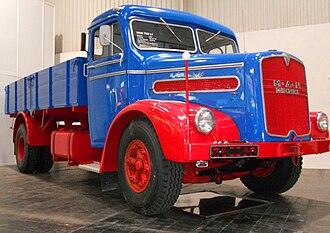
MAN 758: The Powerful German Truck of the 1950s
The MAN 758 was one of the notable heavy trucks produced by Maschinenfabrik Augsburg-Nürnberg (MAN) during the first decade of Germany’s post-war economic recovery. More specifically, the MAN 758 L1 belonged to the generation of short-bonnet trucks that MAN developed in the early 1950s, when German manufacturers were rebuilding their commercial-vehicle businesses and demand for increasingly capable heavy transport vehicles was rising rapidly. The 758 combined a conventional bonneted layout with a powerful V8 diesel engine and a chassis designed for a payload of approximately 7.5 tonnes, making it a substantial vehicle for its era. MAN’s own historical material identifies the 758 L1 as a model built from 1953 to 1955, while surviving examples and specialist museum documentation provide a valuable picture of its dimensions, engine and working applications.
Although the MAN 758 is now a relatively rare historic truck, it represents an important stage in the development of the company’s post-war commercial vehicles. It appeared before the familiar modern cab-over-engine era had fully taken over the European heavy-truck market and therefore retained a traditional front-engine, bonneted configuration. At the same time, its large V8 diesel, relatively high gross-weight capability and useful payload demonstrate how quickly heavy trucks were becoming more capable in the years following the Second World War. The vehicle also found its way into specialist roles, including fire and rescue equipment, where its substantial chassis could carry cranes, winches and other heavy equipment.
The Origins of the MAN 758
Germany’s post-war heavy-truck market
The early 1950s were an important period for German truck manufacturing. The country’s industrial economy was expanding rapidly, road freight was becoming increasingly important and manufacturers were developing vehicles capable of moving larger quantities of goods over longer distances. MAN responded with a family of bonneted trucks that shared a recognizable design language and were offered in different weight and engine classes.
MAN’s historical documentation explains that trucks introduced from 1951 were standardized around a short-bonnet cab design. These vehicles featured short doors, opening side windows for direct ventilation, a split windscreen, a sloping bonnet and the distinctive MAN grille. The design was functional rather than decorative, with the bonnet providing access to the engine while the cab remained relatively compact.
Within this family, the MAN 758 occupied the heavier end of the range. The model designation is closely associated with its approximately 7.5-tonne payload class, and contemporary MAN material emphasizes the favorable relationship between the truck’s own weight and its carrying capacity. This was an important selling point at a time when maximizing useful payload was central to commercial-vehicle economics.
A truck built for serious work
The 758 was not intended to be a light delivery vehicle. Its substantial chassis made it suitable for freight, tipping and tractor applications, while its powertrain gave it the ability to handle loads that would have been beyond the capabilities of smaller trucks.
MAN’s historical booklet identifies the 758 L1 as a six-cylinder, 8,276 cm³, 130 PS model and states that the series was produced between 1953 and 1955. However, surviving documentation also shows a MAN 758 L1 fitted with the company’s larger V8 diesel producing 155 PS. This apparent variation is important: the designation should not be treated as though every surviving 758 had precisely the same engine specification. The best-documented preserved 758 examples, including a 1954 vehicle, use the 155 PS V8 configuration.
The Design of the MAN 758
Classic short-bonnet styling
The MAN 758 has the unmistakable appearance of a 1950s European heavy truck. The engine sits ahead of the driver beneath a long, sloping bonnet, while the cab is positioned immediately behind it. This configuration provided straightforward access to the engine and was familiar to drivers and mechanics of the period.
The front end featured a prominent MAN grille, a split windscreen and relatively narrow doors with ventilation windows. Compared with later cab-over-engine trucks, the design appears long and somewhat formal, but it was practical for its time. The bonnet created a physical separation between the driver and the engine compartment and allowed mechanics to work around the power unit without removing the cab.
The truck’s proportions were also dictated by the technology of the era. Large diesel engines occupied considerable space, and a conventional bonneted layout offered a straightforward solution. European manufacturers would increasingly move toward cab-over-engine designs as regulations, road capacity and payload requirements evolved, but in the early 1950s the bonneted heavy truck remained an established and highly practical configuration.
Dimensions and proportions
A surviving 1954 MAN 758 L1 is documented at approximately 7.76 metres long, 2.72 metres high and 2.40 metres wide, although exact dimensions naturally depended on bodywork and equipment. MAN’s historical material lists these dimensions alongside a stated top speed of around 65 km/h and an unladen weight of approximately 5,860 kg for the documented configuration.
These figures reveal something important about the truck’s design philosophy. The 758 was relatively large by contemporary standards, but its approximately 5.86-tonne empty weight left substantial capacity for cargo. The ability to transport a useful load without the chassis itself consuming excessive weight was an important advantage for commercial operators.
Special-purpose bodies could make the vehicle considerably heavier. A preserved MAN 758 L1 used by the Nuremberg fire service, for example, had a substantially heavier rescue configuration incorporating a crane and winches. Documentation for that particular vehicle lists a length of 8.33 metres, width of 2.55 metres, height of 3.20 metres and a 5-metre wheelbase.
Engine and Performance
The V8 diesel
The most memorable technical feature of the MAN 758 is arguably its V8 diesel engine. A preserved 1954 example is documented with a 155 PS V8, while the Nuremberg fire-service vehicle is specifically identified as a MAN 758 L1 V8 producing 155 PS. The engine displacement is given as approximately 10.57 litres in the fire-service documentation.
A V8 diesel was a significant powerplant for a European truck of the mid-1950s. The additional cylinders provided substantial power for a vehicle intended to carry heavy loads, while the relatively large displacement reflected the engineering priorities of the period. Modern heavy trucks produce vastly more power from smaller or similarly sized engines, but the 155 PS output of the 758 was appropriate to the technology, road conditions and transport requirements of its time.
The V8 also gave the truck a distinctive mechanical character. Historic descriptions of MAN’s contemporary V8-powered vehicles frequently emphasize the sound and smoothness of the engine, qualities that have contributed to the appeal of surviving examples among commercial-vehicle enthusiasts.
A useful power-to-weight balance
The 758’s engine should not be judged according to modern horsepower figures. A contemporary truck producing 155 PS may appear modest beside a modern long-haul tractor developing several hundred horsepower, but the comparison is misleading because the operating environment was completely different.
The important characteristic was the relationship between engine output, vehicle weight and intended payload. The 758 was designed as a working truck rather than a high-speed road vehicle. Its documented maximum speed of roughly 65 km/h reflects the priorities of the period, when reliability, carrying capacity and mechanical durability mattered more than maintaining modern motorway speeds.
MAN 758 in Commercial Transport
Freight and platform bodies
The MAN 758 was available in practical commercial configurations, including platform-type freight bodies. This made it suitable for transporting general cargo, machinery, materials and other goods. A platform body was also adaptable, allowing operators to install different cargo equipment or covers according to their particular requirements.
MAN’s historical description notes that the series included platform trucks, tractor units and tippers. This variety shows that the 758 was conceived as part of a broader commercial-vehicle strategy rather than as a single specialized truck.
The platform configuration also suited the relatively simple logistics of the period. Cargo could be loaded from the side or rear, while the truck’s substantial chassis gave it the structural capacity required for heavy freight.
Tipping applications
The 758 was also offered in tipper form. Construction and infrastructure projects were expanding during Germany’s post-war reconstruction, creating strong demand for trucks capable of carrying aggregates, soil and other bulk materials.
A tipper version had different requirements from a long-distance freight truck. It needed a durable chassis capable of handling repeated loading cycles, uneven surfaces and the additional stresses created when the body was raised. The 758’s heavy-duty character made it a suitable foundation for this kind of work.
The MAN 758 in Specialist Service
Fire and rescue vehicles
One of the most fascinating chapters in the MAN 758’s history is its use by fire and rescue organizations. The Nuremberg fire service operated a MAN 758 L1-based RKW 10 rescue vehicle, constructed by Carl Metz with a Demag crane. The vehicle was built in 1955 and entered service on 29 December of that year. It remained in service until 27 October 1978.
This particular truck demonstrates how versatile the 758 chassis could be. Instead of carrying ordinary freight, it was equipped as a heavy rescue vehicle with a crane and multiple winches. The crane had a maximum lifting capacity of approximately 10 tonnes and could rotate through 360 degrees, while the documented winches provided substantial pulling capability at both the front and rear.
The vehicle’s long operational career is especially revealing. A truck built in the mid-1950s remained useful to a professional emergency organization until the late 1970s, illustrating the durability expected from heavy commercial vehicles of the period.
A surviving industrial artifact
After its retirement from operational service, the Nuremberg rescue vehicle eventually became a preserved example of local industrial and firefighting history. Documentation from the Nuremberg Fire Brigade Museum notes that the vehicle spent considerable time in storage and scrapyards before being rescued and restored by enthusiasts in the late 1980s.
Its survival is particularly valuable because relatively few MAN 758 trucks remain today. Unlike passenger cars, commercial vehicles were generally expected to work until they were no longer economically useful. Trucks were often modified, rebuilt or eventually dismantled, making surviving original examples increasingly important to historians and collectors.
The Driving Experience of a 1950s MAN Truck
Driving a MAN 758 today would be a very different experience from operating a modern MAN TGX or TGS. The steering, braking systems, suspension, engine controls and cab environment all reflect an earlier stage of commercial-vehicle development. The driver sits behind a large steering wheel, surrounded by mechanical controls rather than the electronic interfaces that dominate modern trucks.
The bonnet itself changes the driver’s relationship with the road. Unlike a cab-over truck, where the driver sits almost directly above the front axle, the 758 places the driver behind the engine. This provides a different view of the vehicle’s front corners and changes the truck’s overall proportions. At the same time, the substantial bonnet contributes to the distinctive character that makes trucks of this period so recognizable.
The relatively low top speed also tells us how transportation has changed. At approximately 65 km/h, the 758 was designed for an era in which long-distance road transport took place at much lower speeds. The vehicle’s purpose was not to compete with modern motorway traffic but to move substantial loads reliably over the road network that existed in the 1950s.
Historical Importance of the MAN 758
A bridge between generations
The MAN 758 belongs to an important transitional period in European truck development. It still had the traditional bonneted layout associated with pre-war and immediate post-war trucks, yet it incorporated a powerful diesel engine and a payload capacity that anticipated the increasingly specialized heavy trucks of later decades.
Its production period was relatively short, with MAN’s own historical material placing the series between 1953 and 1955. Nevertheless, its influence can be understood as part of the broader evolution of MAN’s heavy-truck program during the German economic recovery.
The model also illustrates why historical truck design cannot be understood solely by looking at horsepower. Payload, reliability, serviceability, body compatibility and the ability to perform a wide range of jobs were equally important. The 758 succeeded by combining these characteristics in a relatively straightforward package.
Why the 758 remains memorable
Today, the MAN 758 is interesting precisely because it belongs to a period when heavy trucks were highly mechanical machines. There were no modern electronic driver-assistance systems, digital dashboards or automated transmissions. The truck’s identity was defined by its diesel engine, gearbox, chassis, cab and bodywork.
Its surviving examples therefore provide more than a glimpse of an old vehicle. They preserve evidence of the working conditions of an earlier generation of drivers, mechanics and transport operators. The V8 engine, bonneted cab and heavy-duty chassis represent a period when German industry was rebuilding itself and road freight was becoming increasingly important to the country’s expanding economy.
MAN 758 Technical Specifications
The following table combines the most consistently documented specifications for the MAN 758 L1, with particular emphasis on the preserved 155 PS V8 configuration. Some dimensions and weights vary because individual trucks received different bodies and specialist equipment. The Nuremberg rescue truck, for example, was substantially larger and heavier than a standard freight configuration.
| Specification | MAN 758 L1 |
|---|---|
| Manufacturer | MAN |
| Model | 758 L1 |
| Production period | 1953–1955 |
| Vehicle type | Heavy commercial truck |
| Cab design | Short-bonnet / conventional cab |
| Engine | V8 diesel on documented 155 PS configuration |
| Engine displacement | Approx. 10.57 litres |
| Maximum power | 155 PS |
| Typical payload class | Approx. 7.5 tonnes |
| Transmission | Manual |
| Drive layout | Conventional rear-wheel drive |
| Documented length | Approx. 7.76 m; 8.33 m for specialist rescue vehicle |
| Documented width | Approx. 2.40 m; 2.55 m for specialist rescue vehicle |
| Documented height | Approx. 2.72 m; 3.20 m for specialist rescue vehicle |
| Wheelbase | 5.00 m on documented rescue vehicle |
| Unladen weight | Approx. 5,860 kg in documented standard configuration |
| Maximum speed | Approx. 65 km/h |
| Body styles | Platform, tractor and tipper |
| Specialist applications | Rescue, recovery and fire-service vehicles |
| Example crane equipment | Up to 10-tonne lifting capacity on documented RKW 10 |
| Historical significance | Early post-war MAN heavy-truck generation |
Conclusion
The MAN 758 is an excellent example of how much European heavy-truck engineering changed during the 1950s. With its conventional bonneted cab, substantial diesel engine and approximately 7.5-tonne payload class, it belonged to an era when trucks were becoming increasingly capable while retaining relatively simple mechanical construction. The 758 L1 was produced for only a few years, but its combination of useful carrying capacity, robust chassis engineering and flexible body options made it suitable for a wide range of commercial applications.
The surviving V8-powered examples make the model particularly interesting. The 155 PS engine provided the kind of power needed for serious heavy-duty work, while specialist conversions demonstrated that the chassis could be adapted far beyond ordinary freight transport. The Nuremberg rescue vehicle is perhaps the clearest illustration: after being built in 1955, it worked for more than two decades and carried a crane and winches powerful enough for demanding recovery operations.
For today’s enthusiasts, the MAN 758 represents a fascinating snapshot of German commercial-vehicle engineering during the economic recovery of the 1950s. Its split windscreen, short bonnet, imposing grille and V8 diesel give it a character that modern trucks, despite their enormous technical capabilities, cannot easily reproduce. More importantly, preserved examples allow us to understand the practical priorities of an earlier generation of road transport: durability, payload, mechanical simplicity and versatility. The MAN 758 may be a rare sight today, but it remains an important part of MAN’s long history as a manufacturer of heavy commercial vehicles.
