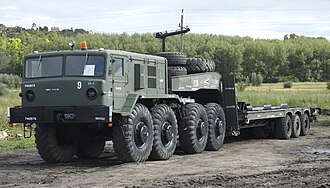
MAZ-537: The Soviet Heavy Tractor That Moved Tanks, Missiles, and Giants of Industry
The MAZ-537 was one of the most remarkable heavy vehicles produced by the Soviet Union during the Cold War. Built not as an ordinary cargo truck but as an extreme-duty tractor for moving enormous loads, it combined an eight-wheel-drive chassis with a 38.8-liter V12 diesel engine, hydromechanical transmission, massive tires, and a reinforced fifth-wheel coupling. Its primary task was to pull heavy semitrailers carrying tanks, artillery systems, missiles, and other equipment, but its capabilities eventually made it useful in airfields, oil and gas fields, heavy industry, and civilian transport. Developed as the successor to the MAZ-535, the 537 became one of the defining heavy tractors of the Soviet military vehicle industry and remained in production, in progressively modified forms, until around 1990.
The Origins of the MAZ-537
A Successor to the MAZ-535
The story of the MAZ-537 begins with the rapid development of Soviet military equipment during the 1950s. Tanks, missile systems, artillery pieces, and other strategic weapons were becoming heavier and more difficult to transport. The MAZ-535 had already demonstrated that a huge 8×8 wheeled tractor could provide exceptional mobility, but its approximately 375-horsepower engine was not enough for the next generation of extremely heavy loads. Soviet designers therefore began developing a more powerful tractor based on the same fundamental concept.
The result was the MAZ-537. Development focused on increasing engine output while strengthening the chassis and drivetrain to handle substantially greater towing loads. Prototypes appeared at the end of the 1950s, and series production began around 1959–1960. The first vehicles were manufactured at the Minsk Automobile Plant, while production was subsequently transferred to the Kurgan Wheel Tractor Plant. The Kurgan factory continued developing and manufacturing the family for decades, eventually producing vehicles under the KZKT designation.
The transition from MAZ to KZKT was not simply an administrative change. It represented the establishment of a specialized production center for Soviet heavy wheeled tractors. The MAZ-537 became the foundation for a long-lived family of heavy transporters, and its basic architecture proved sufficiently successful to remain relevant through changing generations of military equipment.
The Enormous D-12A-525 Engine
A 38.8-Liter V12 Diesel
The defining feature of the MAZ-537 is undoubtedly its engine. Behind the cab sits the D-12A-525, a liquid-cooled V12 diesel with a displacement of approximately 38.88 liters. It produces about 525 horsepower (385 kW) and approximately 2,200 Nm of torque, depending on the particular specification and measurement convention. This enormous engine was a development of the large-displacement diesel technology used in Soviet armored vehicles and was perfectly suited to the task of moving immense loads at relatively modest speeds.
The engine’s enormous displacement was important because the MAZ-537 was not intended to behave like a modern highway tractor. It was designed to start, pull, and continue moving when confronted with extreme resistance. A heavily loaded semitrailer on mud or rough ground places radically different demands on an engine from an unloaded truck traveling on asphalt. The D-12A-525 delivered its power through a relatively low-speed operating range, producing the kind of torque required to keep the huge combination moving.
Starting such an engine in the severe climates of the Soviet Union presented another challenge. The MAZ-537 incorporated engine preheating equipment, while starting systems included an electric starter and a compressed-air backup system. The latter was particularly appropriate for a vehicle expected to operate in remote military environments where reliability could be more important than convenience. Published technical descriptions also indicate that the vehicle was designed for operation in temperatures extending from approximately −50°C to +50°C.
Fuel Consumption Was Secondary
A 38.8-liter V12 was never going to be economical, and the MAZ-537 made no attempt to be. Fuel consumption was a secondary consideration compared with the ability to move strategic loads. Published figures vary with operating conditions, but fuel capacity was substantial, with sources giving figures around 700–840 liters depending on configuration and specification. A commonly cited range is roughly 650 km, although actual range depended heavily on load, terrain, and driving conditions.
This enormous fuel requirement was simply part of the vehicle’s operating philosophy. The MAZ-537 was a machine in which every major component had been designed around heavy-duty performance. The engine was huge because the load was huge; the chassis was massive because the engine and trailer were massive; and the fuel tanks were large because operating such a powerplant required a corresponding supply of diesel.
The 8×8 Chassis
Four Driven Axles
The MAZ-537 uses an 8×8 configuration, with all four axles contributing to propulsion. This was essential because the vehicle was designed to work away from normal highways and often had to tow loads that could weigh several times more than the tractor itself. Distributing power across eight wheels gave the vehicle a much greater chance of maintaining traction on mud, snow, gravel, sand, and broken ground.
The first two axles are steerable, while the rear axles are arranged as the main supporting pair. The chassis incorporates sophisticated differential and reduction systems intended to distribute the engine’s power effectively. Sources describe the vehicle as using a hydrodynamic transmission combined with a three-stage planetary gearbox and a two-speed transfer case. This arrangement allowed the driver to control the immense output of the V12 without relying on a conventional heavy mechanical clutch arrangement.
The engineering was remarkably advanced for the period. The MAZ-535 and MAZ-537 programs introduced an unusually sophisticated combination of hydromechanical transmission, multi-axle drive, independent suspension elements, multiple differentials, and specialized steering systems. The objective was not sophistication for its own sake; every component addressed the practical problem of moving a very heavy vehicle and an even heavier trailer through difficult terrain.
Suspension and Ground Clearance
The MAZ-537’s suspension was another important element of its mobility. The front axles used independent torsion-bar suspension, while the rear axles employed leaf-spring arrangements in commonly described configurations. This allowed the wheels to follow irregular terrain while maintaining sufficient contact with the ground.
Large heavy-duty tires completed the package. Their size, combined with the eight-wheel-drive layout and substantial ground clearance, allowed the tractor to operate over terrain that would be inaccessible to conventional road vehicles. The truck’s ability to climb steep slopes and negotiate difficult surfaces was particularly valuable when its trailer was loaded with armored vehicles or other massive equipment.
Designed Around the Trailer
A Tractor Rather Than a Truck
One of the easiest mistakes when discussing the MAZ-537 is to think of it simply as a gigantic truck. Its true identity is closer to that of a heavy equipment tractor. The vehicle was designed primarily to pull semitrailers rather than to carry a large load directly on its own chassis. Its reinforced fifth wheel was positioned over the rear axle group, allowing enormous vertical loads to be transferred into the chassis while maintaining traction.
Early configurations were designed around loads of approximately 50 tonnes, while later versions could handle semitrailers with maximum weights approaching 65 tonnes. This gave the MAZ-537 the ability to transport individual tanks, armored vehicles, missile equipment, and other extremely heavy machinery.
The importance of the tractor-and-semitrailer combination becomes clearer when considering the weight of a main battle tank. Rather than designing a completely new self-propelled transporter for every type of armored vehicle, the military could use a powerful tractor with an appropriate semitrailer. The same basic MAZ-537 could therefore support several transportation roles simply by changing the trailer or associated equipment.
The MAZ-537G and Its Winch
The Most Recognizable Version
Among the many MAZ-537 variants, the MAZ-537G became particularly well known. Its defining feature was a heavy-duty winch designed to assist with loading and unloading and to provide a means of self-recovery when the tractor became stuck. The winch had a working cable length of approximately 100 meters and a pulling force of around 15 tonnes.
The winch was especially valuable when the MAZ-537 was operating with heavy military semitrailers. Loading a disabled armored vehicle onto a transporter can be a difficult task even under favorable conditions, and it becomes substantially more complicated when the equipment is damaged or immobilized. A powerful integrated winch gave the transporter a degree of independence that a conventional tractor would not possess.
The 537G’s winch also illustrates the practical philosophy behind the vehicle. Soviet designers were not simply interested in maximum engine power. They wanted a complete system capable of performing difficult transport operations in the field. The tractor had to pull, maneuver, recover itself, and help load the equipment it was intended to transport.
Military Applications
Tank Transporter
One of the most important roles for the MAZ-537 was tank transportation. Moving tracked armored vehicles by road reduces wear on their tracks and running gear, saves fuel, and allows military units to relocate over long distances more efficiently. The MAZ-537 was ideally suited to this task because its tremendous towing capacity allowed it to carry tanks that were simply too heavy for ordinary military trucks.
Specialized semitrailers such as the ChMZAP-5247 series were developed for use with the MAZ-537. Depending on the trailer and configuration, these combinations could transport a single main battle tank or multiple lighter armored vehicles. The combination of a powerful tractor and specialized low-loader trailer effectively created a mobile heavy transport system capable of moving major combat equipment between operational areas.
Missile and Artillery Transport
The MAZ-537 also found extensive use with missile forces. Its ability to move very heavy loads made it valuable for transporting missile launchers and associated equipment. Heavy military systems could be moved without requiring their own long-distance road travel, while the tractor’s off-road capabilities meant that transport was not limited to paved highways.
This role became increasingly important during the Cold War, when the Soviet military operated large numbers of missile and artillery systems. Heavy tractors formed an essential but often overlooked part of the logistics chain. A missile system might receive most of the attention, but without vehicles capable of moving its launcher, support equipment, fuel, and associated machinery, its operational mobility would be severely restricted.
Civilian and Industrial Uses
Beyond the Military
The MAZ-537’s capabilities eventually found applications outside military service. Heavy industry, oil and gas exploration, construction, and other sectors sometimes required exactly the kind of extreme towing ability that had originally been developed for the armed forces. The vehicle could be adapted to haul exceptionally heavy industrial loads using specialized trailers and ballast arrangements.
Airfields were another unusual application. Special ballast tractor configurations were used for moving very large aircraft. Some versions incorporated additional ballast so that the tractor could generate enough traction to move aircraft weighing hundreds of tonnes. This was a logical application of the MAZ-537’s design: the tractor did not necessarily need to carry the aircraft; it needed enough mass, power, and tire grip to overcome rolling resistance and move it safely.
The vehicle’s use in civilian industries also demonstrates the durability of its basic engineering. Although expensive and demanding to operate, the MAZ-537 offered a capability that few conventional trucks could match.
The Major MAZ-537 Variants
MAZ-537D, E, A and K
The basic tractor evolved into several specialized versions. The MAZ-537D was associated with an external electrical generator and applications requiring additional electrical power. The MAZ-537E was developed for heavier semitrailer combinations, with later versions capable of handling loads up to approximately 65 tonnes. The MAZ-537A added a flatbed section and increased the vehicle’s versatility, while the MAZ-537K was adapted for crane equipment.
These variants show why the MAZ-537 remained relevant for such a long period. Instead of treating the tractor as a single-purpose machine, Soviet engineers and operators continued adapting the basic platform to different requirements. The chassis was sufficiently robust to accept cranes, generators, winches, ballast, and other specialist equipment.
The Transition From MAZ to KZKT
A Long Production Life
Production of the MAZ-537 began in Minsk, but manufacturing was progressively transferred to the Kurgan Wheel Tractor Plant, commonly abbreviated as KZKT. Sources generally place the overall production period from approximately 1959 to 1990, although exact dates differ depending on whether one refers to the original MAZ production, Kurgan production, or later derivatives.
The extraordinarily long production life is one of the strongest indications of the design’s success. Military trucks normally become obsolete as engines, electronics, weapons, and transport requirements evolve, yet the MAZ-537 remained useful for decades. Its longevity was partly due to the fact that its fundamental mission—moving extremely heavy loads—changed relatively slowly.
The MAZ-537 eventually gave way to newer generations of heavy KZKT tractors, including the KZKT-7428 family. Even so, the 537 remained an important reference point in the development of Soviet and post-Soviet heavy military transport.
What Made the MAZ-537 Special?
The MAZ-537’s importance lies in the way its individual characteristics worked together. A 525-horsepower engine alone would not have made it exceptional. Nor would an 8×8 chassis by itself have been enough. The vehicle became extraordinary because its engine, transmission, suspension, drivetrain, fifth wheel, recovery equipment, and semitrailers were designed as parts of one transportation system.
Its enormous V12 delivered the power, the hydromechanical transmission made that power manageable, the eight driven wheels provided traction, and the reinforced chassis transferred the resulting forces into the trailer. The winch added recovery and loading capability, while the specialized semitrailers transformed the tractor into a tank transporter, missile carrier, aircraft tug, or industrial heavy hauler.
This integrated approach explains why the MAZ-537 became such an enduring design. It was not built for speed, comfort, fuel economy, or mass-market transportation. Every major engineering decision was made in support of one overriding objective: moving very heavy things where they needed to go.
MAZ-537 Technical Specifications
| Specification | MAZ-537 |
|---|---|
| Manufacturer | Minsk Automobile Plant / Kurgan Wheel Tractor Plant |
| Production period | Approximately 1959–1990 |
| Vehicle type | Heavy military tractor |
| Drive configuration | 8×8 |
| Engine | D-12A-525 / D-12A-525A |
| Engine type | Liquid-cooled V12 diesel |
| Displacement | 38.88 L |
| Maximum power | 525 hp (385 kW) |
| Maximum torque | Approximately 2,200 Nm |
| Transmission | 3-speed hydromechanical |
| Transfer case | 2-speed |
| Steering | Power-assisted; front two axles steer |
| Tractor weight | Approximately 21.6 tonnes |
| Length | Approximately 8.96 m |
| Width | Approximately 2.885 m |
| Height | Approximately 2.88 m to cab |
| Wheelbase | 1,700 + 2,650 + 1,700 mm |
| Maximum road speed | Approximately 55–60 km/h |
| Typical semitrailer capacity | Up to approximately 50 tonnes |
| Later maximum semitrailer load | Up to approximately 65 tonnes, depending on variant |
| Fuel capacity | Approximately 700–840 L, depending on version |
| Winch capacity, MAZ-537G | Approximately 15 tonnes |
| Winch cable length | Approximately 100 m |
| Crew | 4 |
| Primary roles | Tank transport, missile transport, artillery towing, heavy equipment transport |
| Civilian roles | Heavy haulage, airfield towing, oil and gas, industrial transport |
Specifications vary between the basic MAZ-537 and later variants such as the 537G, 537E and 537A. Published sources also differ in dimensions, fuel capacity, towing ratings, and production dates according to the particular configuration being described.
Conclusion
The MAZ-537 was one of the defining heavy transport machines of the Soviet Cold War era. Its 38.8-liter V12, 525 horsepower, eight-wheel drive, hydromechanical transmission, massive fifth wheel, and optional 15-tonne winch gave it the ability to perform tasks that were far beyond the capabilities of ordinary trucks. More importantly, it was designed as part of a complete heavy-transport system, working with specialized semitrailers to move tanks, missiles, artillery equipment, industrial machinery, and other oversized loads.
Its appearance also marked an important stage in the evolution of Soviet wheeled engineering. The MAZ-537 took the basic ideas of the earlier MAZ-535 and transformed them into a substantially more powerful and versatile tractor. Its long production life at Minsk and Kurgan demonstrated how successful that formula proved to be. Even decades after its introduction, the sight of a MAZ-537 remains unmistakable: four axles, eight huge wheels, a compact cab, and an enormous V12 hidden behind it, all built around the simple but formidable purpose of moving the heaviest loads possible.
In an era increasingly dominated by electronic systems and sophisticated commercial heavy trucks, the MAZ-537 represents a very different philosophy of engineering. It was brutally mechanical, enormously powerful, demanding to operate, and completely focused on its mission. That uncompromising character is precisely why the MAZ-537 remains one of the most fascinating heavy military vehicles ever produced.
