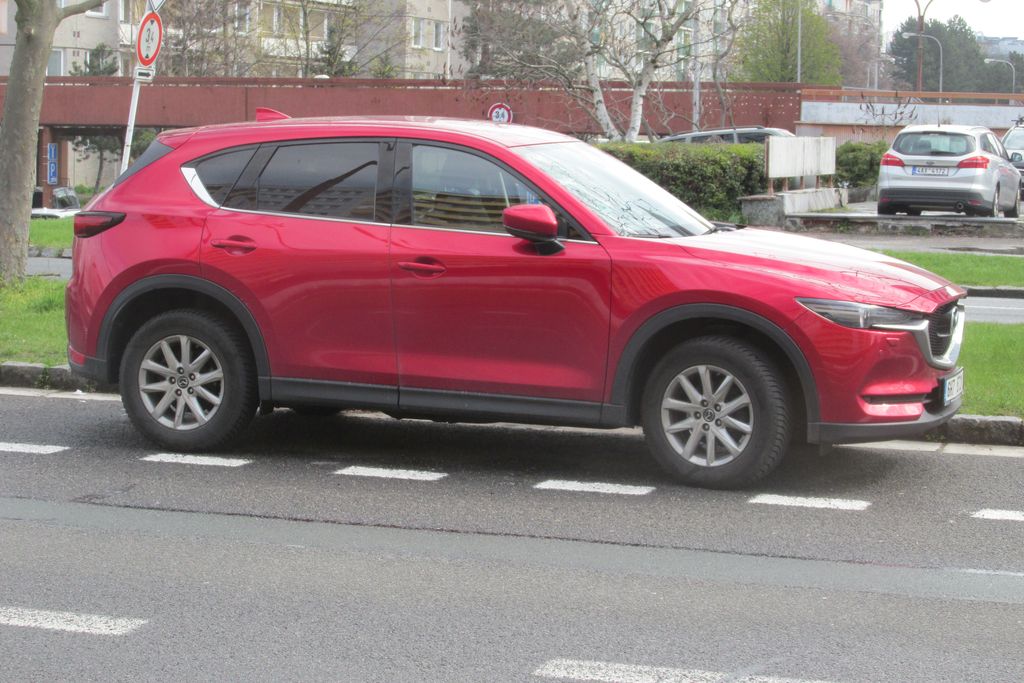
Mazda CX-5 as a Used Car: A Smart Buy or a Risky Choice?
The Mazda CX-5 has established itself as one of the more interesting alternatives to the mainstream compact SUVs. It combines a relatively elegant design with a driver-focused character, a well-finished interior and a range of naturally aspirated petrol engines that can make a great deal of sense on the used market. The second-generation CX-5 arrived for the 2017 model year and has remained remarkably consistent through its life, receiving a number of updates rather than being replaced every few years. Mazda itself identifies 2017 as the beginning of the second generation, while the model received further revisions in subsequent years.
For someone looking for a used family SUV, that consistency is actually one of the CX-5’s biggest strengths. There is no shortage of examples on the second-hand market, and buyers can choose between petrol and diesel engines, manual and automatic transmissions, and front- or all-wheel drive depending on the market and model year. However, choosing the right engine is particularly important. The CX-5 is not equally attractive with every powertrain, and a well-maintained petrol model can be a very different ownership proposition from a high-mileage diesel that has spent most of its life making short urban trips.
Why Buy a Used Mazda CX-5?
The first thing that makes the CX-5 attractive is its design. Even older examples have aged relatively well, particularly the second-generation car introduced in 2017. Mazda used its Kodo design language to give the SUV a more sophisticated appearance than many practical family cars, while the interior follows a similarly restrained philosophy. Instead of filling every surface with buttons and visual clutter, the CX-5 concentrates on a relatively simple dashboard and conventional controls.
That impression is important on the used market because the CX-5 can feel more expensive than its purchase price suggests. Mazda positioned the car as a premium-leaning alternative to mainstream compact SUVs, and higher trim levels can include leather upholstery, advanced driver assistance systems, parking sensors, upgraded audio equipment and other desirable features. Later cars also benefited from improved infotainment and smartphone connectivity.
The second major advantage is the way the CX-5 drives. It is an SUV, but Mazda has traditionally placed considerable emphasis on steering, chassis balance and the relationship between driver and car. The result is a vehicle that feels more composed on a winding road than many family SUVs. It is not a sports car, of course, but that extra sense of involvement can make everyday driving considerably more enjoyable.
Practicality is also good. A 2017 European-specification CX-5 measures approximately 4.55 metres long, 1.84 metres wide and 1.68 metres high, with a 2.70-metre wheelbase. Depending on the specification and measurement method, luggage capacity is around 477 litres with the rear seats in place and can rise substantially when they are folded.
Which Mazda CX-5 Engine Should You Choose?
Petrol: The Safest Used-Car Bet
For many buyers, the petrol CX-5 is the version to seek out. European second-generation cars were offered with naturally aspirated Skyactiv-G petrol engines, including the 2.0-litre four-cylinder. The 2.0 Skyactiv-G 165, for example, produces 165 PS and 210 Nm and was available with a six-speed manual transmission and front-wheel drive. Official combined fuel consumption for an early European specification was around 6.4 l/100 km under the old test cycle.
The attraction of this engine is not outright performance but simplicity and predictability. A naturally aspirated petrol engine does not have a turbocharger to worry about, and the combination with Mazda’s conventional six-speed automatic is also relatively straightforward compared with some increasingly complicated modern powertrains. Independent used-car evaluations have specifically highlighted the naturally aspirated petrol engines and conventional automatic transmission as favourable choices for long-term durability.
The downside is that a naturally aspirated 2.0-litre engine needs revs when the CX-5 is heavily loaded. If you regularly travel with four adults, luggage and a trailer, or simply want effortless acceleration, the larger petrol engines are more convincing where available. Fuel consumption can also rise significantly in predominantly urban driving, so the official figure should never be treated as a guarantee of real-world economy.
Diesel: Excellent for the Right Owner
The 2.2-litre Skyactiv-D diesel is more complicated but offers much more torque. Early European versions included a 150 PS engine producing around 380 Nm, while more powerful variants were also available. The combination of strong low-speed torque and relatively modest official fuel consumption makes the diesel attractive to high-mileage drivers and people who frequently travel long distances.
The problem is that diesel technology is fundamentally less forgiving of the wrong type of use. A CX-5 diesel that has spent years doing short journeys around town is not necessarily a bargain simply because it has a low odometer reading. Buyers should investigate the vehicle’s service history, typical usage and condition rather than judging it solely by mileage.
Reliability survey data also points toward petrol being the preferable choice for buyers prioritising trouble-free ownership. In What Car?’s 2024 reliability survey, petrol CX-5s achieved a 96.1% reliability score, compared with 88.5% for diesel versions; diesel cars were also more likely to have experienced faults.
What Problems Should You Check Before Buying?
Engine and Mechanical Condition
A used CX-5 should always be inspected as an individual vehicle rather than assumed to be reliable simply because the model has a good reputation. Oil leaks, unusual engine noises, neglected maintenance and evidence of poor servicing should all be treated seriously. Some independent used-car assessments have also reported oil consumption on certain 2.5-litre petrol engines, making it sensible to check oil levels and maintenance records carefully.
With diesel models, the inspection should be even more thorough. Look for evidence of correct servicing and ask how the car was used. A diesel that has spent most of its life on motorways can be a far more attractive proposition than an apparently identical car that has spent its life making five-kilometre journeys.
Suspension, Brakes and Tyres
The CX-5 generally has a good chassis, but suspension components are still wear items. Check the rear shocks for leaks, listen for knocks over broken roads and inspect the condition of suspension mounts and bushes. Brakes deserve particular attention too, especially on cars that have spent considerable time parked or used in areas where corrosion is common.
Tyres can also tell an interesting story. Expensive larger wheels look good, but they can make replacement tyres significantly more costly, while low-profile tyres are less forgiving of potholes and damaged roads. A cheaper-looking car with good 17-inch wheels can therefore make more financial sense as a used purchase than a higher-specification example on large wheels.
Electronics and Infotainment
The CX-5 is not an especially electronics-heavy car by modern standards, but buyers should still test every function before purchasing. Operate the infotainment system, cameras, parking sensors, climate control, electric seats if fitted, heated seats and every driver-assistance feature.
Early second-generation cars have also been associated with some infotainment-screen issues, while navigation and software-related complaints have appeared in reliability reports. These are not reasons to reject the model, but they are reminders that an apparently small electronic fault can become an irritating ownership problem.
Is the Mazda CX-5 Reliable?
Overall, the evidence suggests that the CX-5 can be a strong used-car choice, particularly when equipped with a petrol engine and maintained properly. ADAC’s breakdown statistics show the model’s breakdown rate improving considerably for newer registration years, from 13.2 breakdowns per 1,000 vehicles for 2017 registrations to 2.7 for 2023 registrations in its published statistics. (ADAC)
That does not mean every CX-5 is trouble-free. Age, mileage, maintenance and previous ownership remain more important than the badge on the bonnet. A neglected low-mileage example can be a worse purchase than a higher-mileage car with complete documentation and regular servicing.
The CX-5 also benefits from a relatively conventional mechanical philosophy. Buyers who prefer a traditional petrol engine and automatic gearbox rather than a highly complex turbocharged hybrid drivetrain may find it reassuringly familiar.
Which Model Year Is Best?
For buyers with a sensible budget, the second-generation CX-5 from 2017 onwards is arguably the most interesting target. It brought a substantial improvement in refinement and interior quality while retaining the fundamental strengths of the original model.
The later facelifted cars are particularly attractive if the budget permits. Mazda continued to make incremental improvements to the chassis, noise insulation, infotainment and equipment rather than radically changing the formula. The 2021-2022 period is therefore worth investigating if you want a newer-feeling CX-5 without moving into the newest generation.
The 2022 update brought structural and suspension-related revisions intended to improve ride quality and refinement, while equipment levels also evolved over the model’s life.
What to Look for During a Test Drive
A test drive should begin with the car completely cold if possible. Listen carefully to the engine during startup and make sure there are no warning lights remaining illuminated after the initial system checks. On a manual, clutch engagement should be smooth and consistent; on an automatic, gear changes should be prompt and free from unusual jolts.
Drive over a mixture of smooth and rough roads. Listen for suspension knocks, check whether the steering tracks straight and pay attention to braking behaviour. Try reversing and parking to make sure the cameras and sensors work correctly. If the car has adaptive cruise control, lane assistance or other electronic safety systems, test those features as far as conditions safely allow.
Most importantly, do not rush the inspection. A professional pre-purchase inspection is often money well spent on a used SUV. It can reveal suspension wear, fluid leaks, brake problems and accident repairs that are difficult for an inexperienced buyer to identify.
Mazda CX-5 Used-Car Verdict
The Mazda CX-5 is one of those used cars that makes most sense when you choose the right version rather than simply searching for the cheapest example. Its combination of attractive styling, good driving manners, practical dimensions and a generally solid reputation makes it a compelling alternative to more conventional family SUVs.
For the majority of private buyers, a well-maintained petrol CX-5 would be my starting point. The naturally aspirated Skyactiv-G engines are well suited to mixed driving, while the conventional six-speed automatic can provide a straightforward ownership experience. Diesel versions remain worth considering for drivers covering substantial annual mileage, but their condition and service history deserve additional scrutiny.
In other words, the Mazda CX-5 is not perfect, but perfection is not really the point of a used car. What matters is whether the car offers a sensible balance of purchase price, reliability, practicality, running costs and driving enjoyment. The CX-5 performs well across those categories, and that is why a carefully selected example can remain an excellent family SUV long after the original depreciation has been absorbed by its first owner.
Mazda CX-5 Technical Specifications
The following figures use the 2017 European second-generation CX-5 2.0 Skyactiv-G 165 as a representative used-car specification. Exact figures vary according to engine, transmission, equipment level, drivetrain and model year.
| Specification | Mazda CX-5 2.0 Skyactiv-G 165 |
|---|---|
| Generation | Second generation (KF) |
| Representative model year | 2017 |
| Engine | 2.0-litre Skyactiv-G |
| Engine type | 4-cylinder petrol, naturally aspirated |
| Displacement | 1,998 cc |
| Maximum power | 165 PS (121 kW) |
| Maximum torque | 210 Nm |
| Maximum power rpm | 6,000 rpm |
| Maximum torque rpm | 4,000 rpm |
| Transmission | 6-speed manual |
| Drive | Front-wheel drive |
| Length | 4,550 mm |
| Width | 1,840 mm |
| Height | Approx. 1,680 mm |
| Wheelbase | 2,700 mm |
| Ground clearance | Approx. 192–200 mm, depending on wheels |
| Fuel tank | 56 litres |
| Boot capacity | Approx. 477 litres |
| Maximum boot capacity | Up to around 1,620 litres |
| Official combined consumption | Approx. 6.4 l/100 km (NEFZ) |
| Typical seating capacity | 5 |
| Rear seats | Folding |
| Safety rating | 5 stars Euro NCAP (2017) |
Specifications can differ substantially between European markets and individual model years, so the VIN-specific equipment list and original documentation should always be checked when assessing a particular used CX-5. Mazda’s European specification documentation and contemporary technical data provide the most reliable reference for an individual vehicle.
