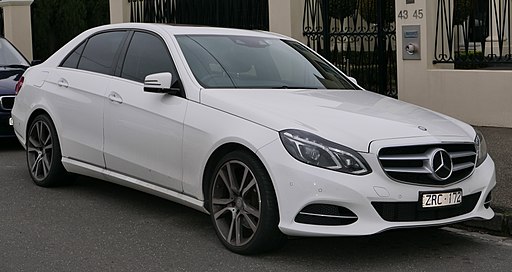
Mercedes-Benz E as a Used Car
The Mercedes-Benz E-Class has long occupied an unusual position in the premium-car market. It is more spacious and prestigious than a typical executive saloon, yet it is generally more attainable than an S-Class, while offering considerably more comfort and technology than a smaller C-Class. On the used-car market, that combination can make the E-Class particularly attractive. A well-kept example can provide the quiet cabin, long-distance comfort and sophisticated equipment associated with a luxury vehicle without requiring the price of a new premium car.
For buyers today, the W213 generation, produced from 2016 to 2023, is especially relevant because there are now many examples on the used market. The newer W214 generation arrived in 2023, making the W213 the previous-generation E-Class and giving buyers a wide choice of cars at different ages, mileages and prices. The W213 was available as a saloon and estate, with Coupé and Cabriolet versions joining the range later. A significant facelift arrived in 2020, bringing updated engines, electronics and infotainment.
Why buy a used Mercedes-Benz E-Class?
The main reason to choose a used E-Class is the balance between comfort, practicality and technology. This is a car designed to cover long distances with minimal effort. The suspension isolates passengers from poor road surfaces, the seats are suitable for extended journeys and the cabin has the kind of quietness that makes motorway travel considerably less tiring. At the same time, the E-Class is sufficiently agile to feel at home on winding roads rather than simply being a motorway cruiser.
The W213 also brought the E-Class much closer to Mercedes-Benz’s larger models in terms of technology and cabin presentation. Depending on specification, buyers can find digital instruments, advanced navigation, sophisticated LED or Multibeam lighting, adaptive cruise control, lane-assistance systems, parking cameras, electrically adjustable seats and high-end audio systems. However, equipment varies enormously between individual cars, so a buyer should examine the exact specification rather than assuming that every E-Class has the same features.
Another major advantage is the sheer variety of body styles and engines. Someone looking for a traditional executive saloon can choose an E-Class sedan, while families can select the considerably more practical T-Modell estate. There are also petrol, diesel, mild-hybrid and plug-in hybrid versions, together with powerful AMG derivatives for buyers who want substantially more performance.
The W213 generation as a used car
The early W213
The fifth-generation E-Class appeared in 2016 and represented a major technological step forward from its predecessor. The styling became smoother and more aerodynamic, while the interior adopted a much more digital character. Mercedes also placed considerable emphasis on semi-autonomous driving assistance and electronic safety systems.
Age is now the main consideration with the earliest cars. A 2016 or 2017 E-Class may look remarkably modern from the outside, but it is already approaching a decade old. That makes condition, mileage and maintenance history more important than the badge on the boot.
Early diesels deserve particular attention to their emissions systems. Used-car specialists and motoring publications have reported issues involving AdBlue, SCR and NOx systems on W213 diesel models, while some early OM654 diesel engines have also been associated with valvetrain-related concerns. (RAC)
The 2020 facelift
The 2020 facelift is an important point in the W213’s history. The updated cars received revised engines, exterior styling changes and a substantially updated interior technology package. MBUX became a key part of the facelifted E-Class, and the car generally feels more contemporary from behind the wheel.
This does not automatically make every facelifted E-Class a better used-car purchase, but it does explain why prices can differ substantially between apparently similar cars. Buyers who want a modern digital experience without paying for the newest W214 generation may find the later W213 particularly interesting.
Which engine should you choose?
E 220 d: the long-distance specialist
The E 220 d is one of the most logical versions for buyers who regularly cover large distances. The 2.0-litre diesel combines substantial torque with relatively low fuel consumption, while the nine-speed automatic transmission suits the relaxed character of the car.
The diesel is particularly effective on motorways, where the engine can operate efficiently for long periods and its torque makes overtaking easy. It is also worth remembering that official consumption figures are laboratory measurements; real-world consumption depends on speed, traffic, temperature, tyres, wheels and driving style.
However, modern diesel technology means that buyers should inspect the complete emissions system rather than concentrating solely on the engine itself. AdBlue, SCR, NOx sensors and EGR components can all create expensive problems when they develop faults.
E 200 and E 300 petrol
Petrol versions can make more sense for drivers who primarily use their E-Class for shorter journeys or who simply prefer the quieter, smoother character of a petrol engine. The four-cylinder petrol units offer enough performance for everyday use while avoiding some of the complexity associated with modern diesel emissions systems.
The E 300 sits higher in the range and offers stronger performance. As with any premium used car, however, buyers should investigate the exact engine and production year because Mercedes changed its powertrain range during the W213’s long production run.
Six-cylinder engines
Six-cylinder E-Class models are where the car’s character changes considerably. Engines such as the E 350 d, E 400 d and petrol six-cylinder models offer a level of smoothness and effortless acceleration that suits the E-Class exceptionally well.
The downside is obvious: fuel consumption, insurance and maintenance can all increase. A six-cylinder E-Class that looks inexpensive on the used market may therefore be considerably more expensive to own over five years than a four-cylinder model.
Plug-in hybrids
The E-Class was also offered with plug-in hybrid powertrains. These can be particularly attractive for drivers who have access to convenient charging and make many short journeys, because electric driving can reduce fuel consumption substantially in the right circumstances.
A used plug-in hybrid needs a slightly different inspection. Battery condition, charging operation, electric range and the history of the hybrid system should all be checked. The purchase decision should be based on how the car will actually be used rather than on the official electric-range figure.
What are the common problems?
The W213 has a generally strong reputation, but it is not a simple car. Its enormous amount of technology means there are more components capable of producing faults than in an older, less sophisticated executive saloon.
Diesel emissions systems
Diesel E-Class models deserve careful examination of the AdBlue and SCR systems. Faulty NOx sensors, AdBlue dosing problems and related emissions-system warnings have been reported as recurring concerns.
A warning light should never be dismissed simply because the car drives normally. A proper diagnostic scan can reveal stored faults that are not obvious during a short test drive.
Air suspension
Cars equipped with Airmatic can deliver an exceptionally comfortable ride, but air suspension is more complex than conventional springs. As these cars accumulate mileage and age, components such as air springs, compressors and valve blocks can require attention.
During an inspection, check whether the car sits evenly when parked and whether it raises and lowers correctly if the system allows different height settings. Listen for the compressor operating for unusually long periods and look for any suspension warning messages.
Electronics and batteries
Modern Mercedes models rely heavily on electronic control units and communication networks. A weak 12-volt battery can sometimes produce a surprisingly large collection of unrelated warning messages, while genuine electronic faults can also affect displays, cameras, parking sensors and infotainment.
For that reason, a professional diagnostic scan is one of the most useful investments a buyer can make before purchasing a used E-Class.
Suspension and steering
The E-Class is a heavy car capable of covering enormous mileages, so suspension components deserve attention. TÜV-related reports have identified suspension and axle components as areas that can become more relevant as W213 cars age and accumulate kilometres.
Listen for knocking noises over broken roads and check for uneven tyre wear. The condition of the front suspension is particularly important because worn bushes, links or other components can affect both ride quality and steering precision.
How practical is the E-Class?
Saloon
The E-Class saloon is a strong choice for buyers who primarily need passenger space and a conventional boot. The W214 successor retains a 540-litre boot in saloon form, illustrating the practical dimensions of the current E-Class concept.
The rear seats are spacious enough for adults, while the wide cabin and substantial wheelbase give the E-Class the relaxed feel expected from an executive car.
Estate
The estate, or T-Modell, is arguably the most versatile version. It combines the E-Class’s comfort with considerably more luggage capacity. The newer W214 estate, for example, offers 615 litres with the seats in place and up to 1,830 litres with the rear seats folded, demonstrating the practical philosophy carried forward from the previous generation.
For families, business users or anyone who regularly transports bulky luggage, the estate can be considerably more useful than the saloon without sacrificing the essential E-Class experience.
What should you check before buying?
The first priority should be the service history. An E-Class that has been serviced regularly and documented properly is worth considerably more consideration than an apparently cheap car with gaps in its history. Check invoices as well as service-book entries, because invoices can reveal what has actually been replaced.
The second priority is a diagnostic inspection. Ask a Mercedes specialist to scan the vehicle for stored faults and inspect the hybrid, transmission, emissions and electronic systems where applicable. This is especially important on highly equipped cars.
The third priority is a detailed road test. The engine should start cleanly from cold, the automatic gearbox should shift smoothly and the steering should remain free of vibrations. Test the air conditioning, electric seats, windows, infotainment, cameras, parking sensors, lighting and driver-assistance systems. A fault in a luxury feature may not prevent the car from driving, but repairing it can still be expensive.
Finally, inspect the tyres and brakes carefully. Large wheels and premium tyres can make replacement costs surprisingly high, while a complete set of brakes on a heavy executive car can represent a significant maintenance bill.
Is the Mercedes-Benz E-Class expensive to maintain?
The E-Class is not necessarily unreliable, but it is important to distinguish reliability from running costs. A well-maintained E-Class can cover very high mileages, and current TÜV-related assessments generally show the W213 performing well for its age and mileage.
Nevertheless, this remains a premium car with premium components. Airmatic suspension, advanced LED headlights, electronic driver-assistance systems, large wheels and complex infotainment equipment can all be expensive when they require repair. The W213’s 9G-Tronic automatic transmission is generally regarded as robust, but neglected maintenance can become a problem, particularly as mileage increases.
This is why buying the cheapest E-Class available is rarely the right strategy. The better approach is to find a car with a transparent history, appropriate maintenance and a specification that suits your needs without unnecessarily increasing complexity.
Verdict: Mercedes-Benz E as a used car
The Mercedes-Benz E-Class remains one of the most convincing used executive cars for buyers who value comfort, refinement, technology and long-distance ability. The W213 generation is now old enough to offer a broad choice on the second-hand market, while later facelifted examples still feel remarkably modern.
Its biggest strength is also its biggest warning. The E-Class delivers a huge amount of technology and engineering, but that sophistication means buyers must be more careful than they would be with a simpler car. Diesel emissions equipment, air suspension, electronics and advanced assistance systems all deserve inspection.
For most used-car buyers, the condition of the individual vehicle matters more than choosing a particular badge or equipment package. A high-mileage E-Class with an excellent service history and predominantly motorway use can be a more sensible purchase than a low-mileage car that has spent years making short journeys with neglected maintenance. Current used-car assessments likewise emphasise the importance of maintenance history and inspection of suspension, emissions systems and electronics.
Ultimately, a good Mercedes-Benz E-Class is still exactly what the model has traditionally promised: a comfortable, quiet and capable executive car that can make long journeys feel effortless. As a used purchase, it becomes particularly attractive when the buyer understands that the purchase price is only the beginning of ownership and budgets appropriately for the maintenance of a sophisticated premium automobile.
Mercedes-Benz E-Class technical specifications
Because the E-Class has been sold with numerous engines, body styles and drivetrains, there is no single specification covering every used example. The table below provides representative figures for the W213 generation and illustrates the range rather than describing every individual model.
| Specification | E 220 d | E 300 petrol | E 400 d 4MATIC |
|---|---|---|---|
| Generation | W213 | W213 | W213 |
| Typical production period | 2016–2023 | 2016–2023 | 2018–2023 |
| Engine | 2.0-litre 4-cyl. diesel | 2.0-litre 4-cyl. petrol | 3.0-litre 6-cyl. diesel |
| Approx. maximum power | 194–200 PS* | approx. 245–258 PS* | approx. 330–340 PS* |
| Transmission | 9G-TRONIC automatic | 9G-TRONIC automatic | 9G-TRONIC automatic |
| Drive | RWD / 4MATIC depending on version | RWD / 4MATIC depending on version | 4MATIC |
| Body styles | Saloon / Estate | Saloon / Estate | Saloon / Estate |
| Seats | 5 | 5 | 5 |
| Saloon length | approx. 4.92 m | approx. 4.92 m | approx. 4.92 m |
| Estate luggage capacity | approx. 640–1,820 l* | approx. 640–1,820 l* | approx. 640–1,820 l* |
| Fuel tank | approx. 66 l | approx. 66 l | approx. 66 l |
| Typical character | Efficient long-distance cruiser | Smooth all-rounder | Powerful long-distance GT |
| Main used-car considerations | AdBlue/SCR, NOx, EGR | Electronics, servicing, engine-specific issues | Higher fuel and maintenance costs |
*Figures vary by model year, body style, facelift, market and individual engine specification. The W213 engine range changed considerably during its production run, so the exact technical data should always be checked against the VIN and registration documentation of the car being considered. The W213 was produced from 2016, received a major facelift in 2020 and was replaced by the W214 generation from 2023.
_%E2%80%93_f_05072025.jpg)