Schloss Dürrwangen: A Forgotten Bavarian Castle Between Medieval Memory and Baroque Calm
In the grand narrative of European castles, there are names that echo through international tourism brochures and cinematic fantasies: Neuschwanstein, Hohenzollern, Heidelberg, Windsor, Chambord, and countless others that have become symbols of national identity and romantic imagination. Yet hidden beyond the spotlight of mass tourism lies another category of historic architecture—castles that have survived not because they became monuments to spectacle, but because they quietly remained part of the landscape, woven into the everyday rhythms of local life. Schloss Dürrwangen belongs to this second category. Located in the Bavarian municipality of Dürrwangen in Middle Franconia, this former moated castle may not attract millions of visitors every year, but it possesses something far rarer: authenticity, continuity, and a deeply rooted connection to regional history.
Schloss Dürrwangen stands at the eastern edge of the small market town, near the Sulzach lowlands, where medieval settlement patterns once depended heavily on waterways, defensible terrain, and agricultural resources. At first glance, the castle appears modest compared to the sprawling royal residences of Bavaria. Yet this apparent simplicity conceals centuries of transformation. Beneath the Baroque façade lies the memory of a medieval stronghold. Behind the renovated walls survives the structure of a former water castle that endured war, political transition, peasant unrest, dynastic change, and the slow modernization of rural Germany.
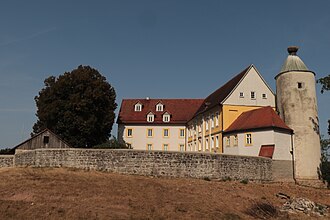
The castle is believed to contain elements dating back to the early Middle Ages, including a round tower that likely served as the original keep of the fortified complex. Over the centuries, the site changed ownership multiple times, passed through noble families, suffered damage during the German Peasants’ War, and was reshaped during the Baroque period in the eighteenth century. What survives today is therefore not a frozen historical object from a single era, but rather a layered architectural biography.
To understand Schloss Dürrwangen properly, one must look beyond its physical appearance and consider the broader world that shaped it. The castle reflects the evolution of Franconian society itself—from feudal fragmentation to territorial administration, from defensive necessity to representative architecture, and from noble residence to practical civic use. It mirrors the shifting balance between military power and cultural refinement, between rural isolation and political integration.
Unlike castles preserved solely as museums, Schloss Dürrwangen continues to exist within the living structure of the town. This creates a fascinating tension between past and present. It is not merely an artifact enclosed behind velvet ropes. It is part of the local identity of Dürrwangen, a place where history remains visible in stone, masonry, bridges, and surviving fortifications.
This article explores the history, architecture, cultural significance, and enduring atmosphere of Schloss Dürrwangen in depth. It examines the medieval origins of the site, the influence of noble dynasties, the transformations brought by the Baroque era, the effects of war and modernization, and the castle’s role in contemporary regional memory. More importantly, it seeks to understand why places like Schloss Dürrwangen still matter in an age increasingly disconnected from historical continuity.
The Geographic Setting of Dürrwangen
Before discussing the castle itself, it is essential to understand the environment in which it emerged. Dürrwangen lies in the district of Ansbach in Bavaria’s Middle Franconia region, an area historically shaped by agriculture, ecclesiastical territories, small noble domains, and trade routes connecting larger urban centers. Franconia differs culturally and historically from southern Bavaria in several ways. While modern political maps place both within the Free State of Bavaria, Franconia developed its own regional identity over centuries through independent bishoprics, imperial cities, and noble lordships.
The landscape around Dürrwangen is characterized by rolling fields, wooded areas, and river valleys that once offered both agricultural fertility and strategic value. In medieval Europe, castles were rarely built arbitrarily. Their placement reflected careful calculations regarding defense, communication, administration, and economic control. The Sulzach region provided all of these advantages. Waterways supported settlement and farming while also creating natural barriers against attack.
The original castle site was likely chosen because of its defensible position near wet lowlands. Schloss Dürrwangen was once surrounded by a moat, making it a classic example of a water castle, or Wasserschloss. Such structures were particularly common in areas where flat terrain prevented the use of elevated hilltop fortifications. Instead of relying on steep cliffs or mountain ridges, these castles used artificial water defenses, embankments, and walls.
Today the moat has largely disappeared or become marshy and overgrown, but traces of the original fortifications remain visible. This surviving relationship between architecture and landscape is one of the most compelling aspects of Schloss Dürrwangen. Even in altered form, the castle still communicates the defensive logic of the medieval world.
Dürrwangen itself evolved gradually around the castle. Like many European settlements, the relationship between fortress and town was mutually dependent. The castle offered protection and administrative oversight, while the surrounding population supplied labor, agricultural products, taxes, and economic activity. Over time, this interaction created a stable local society centered around noble authority and ecclesiastical influence.
Although modern transportation and industrialization transformed many parts of Germany, Dürrwangen retained much of its rural character. This relative continuity helps explain why Schloss Dürrwangen still feels integrated into its historical environment rather than isolated from it.
Medieval Origins and the Early Fortress
The earliest phase of Schloss Dürrwangen reaches deep into the medieval period, possibly even into the early Middle Ages. Historians believe that the surviving round tower, or Bergfried, may date back as far as the ninth century. If this dating is accurate, the site would represent one of the oldest surviving structures in the region.
The early medieval world was politically fragmented, unstable, and often violent. Central authority was weak, and local nobles relied heavily on fortified residences to maintain control over territory and resources. Castles were not initially romantic residences. They were instruments of survival and domination.
The earliest documentary references to the castle appear in the thirteenth century, when the site was associated with the Lords of Wahrberg. At that time, the Holy Roman Empire consisted of a complex network of overlapping authorities, including bishops, counts, imperial cities, and noble families. Power depended not only on military force but also on landholding rights, legal privileges, and dynastic alliances.
The castle was referred to as “castrum Durnwang,” indicating its recognized importance as a fortified site. In 1262, Ulrich von Wahrberg reportedly donated the castle to the Bishopric of Eichstätt for the salvation of his soul, a common medieval practice reflecting the close relationship between aristocratic power and religious institutions.
However, medieval property rights were rarely simple or permanent. Ownership disputes, inheritance complications, and political reversals frequently reshaped territorial control. Schloss Dürrwangen subsequently came under the influence of various noble lineages, including a ministerial family named after the settlement itself.
The ministerials of medieval Germany occupied a unique social position. Though technically unfree in origin, many rose to become powerful administrators and military retainers serving kings, bishops, and princes. Over generations, these families often developed hereditary influence and local authority.
During this era, the castle functioned not merely as a residence but also as an administrative and judicial center. Medieval castles served as hubs of governance where taxes were collected, disputes settled, and territorial claims enforced. The surrounding population would have experienced Schloss Dürrwangen not as a picturesque landmark, but as the visible center of political power.
Architecturally, the original fortress was probably far more austere than the later Baroque structure. Thick walls, narrow entrances, elevated access points, and defensive towers prioritized security over comfort. The surviving round tower reflects these priorities. Medieval keeps often functioned as last-resort defensive positions during attacks.
One particularly fascinating feature of the tower is the presence of elevated pointed-arch entrances, a characteristic associated with defensive medieval construction. Access to such entrances often required ladders or removable stairways, making direct assault more difficult.
Though much of the earliest structure disappeared through later rebuilding, the medieval foundation remains essential to the castle’s identity. Without this ancient defensive core, Schloss Dürrwangen would simply be another eighteenth-century rural residence. Instead, it embodies the architectural memory of nearly a thousand years.
Noble Families and Dynastic Control
The history of Schloss Dürrwangen cannot be separated from the noble families that controlled it. Like many castles in the Holy Roman Empire, the site passed through multiple dynastic hands over the centuries, reflecting the fluid and often unstable nature of feudal politics.
One of the most influential noble houses associated with the castle was the House of Oettingen. Beginning in the fifteenth century, the Counts of Oettingen acquired control over Dürrwangen and integrated the castle into their broader territorial administration.
The Oettingen family was among the most significant noble dynasties in Franconia and Swabia. Their territories were repeatedly divided among different branches of the family, leading to a complex political geography. Such fragmentation was typical within the Holy Roman Empire, where inheritance customs often divided lands among heirs rather than preserving centralized authority.
Under Oettingen rule, Schloss Dürrwangen gained administrative importance as a local seat of governance. Noble residences during this period were expected not only to provide defense but also to symbolize legitimacy and status.
Yet the late medieval and early modern periods were marked by continual instability. Economic pressures, peasant dissatisfaction, religious conflict, and dynastic rivalry repeatedly disrupted local life.
One of the most dramatic episodes in the castle’s history occurred during the German Peasants’ War of 1525. This massive uprising affected large parts of southern and central Germany as peasants, townspeople, and lower-ranking groups rebelled against feudal oppression, economic burdens, and political inequality.
The “Ellwanger Haufen,” one of the rebel bands active in the region, attacked Schloss Dürrwangen. Contemporary accounts suggest that the castle was plundered and burned during the conflict. Such attacks were not unusual. Castles symbolized aristocratic privilege and feudal domination, making them natural targets for peasant anger.
The destruction caused during the uprising illustrates how vulnerable even fortified sites could become during periods of widespread social unrest. Medieval castles were effective against small-scale raids or rival nobles, but mass uprisings involving thousands of determined rebels posed different challenges.
Despite the damage, Schloss Dürrwangen survived. It was rebuilt and continued to function as an administrative center. This pattern of destruction and reconstruction became a recurring theme throughout European castle history.
The Thirty Years’ War in the seventeenth century likely caused additional hardship and damage in the region. Although specific details about the castle’s wartime experience remain limited, Franconia suffered enormously during this catastrophic conflict. Armies crossed the region repeatedly, spreading famine, disease, looting, and devastation.
By the end of the Thirty Years’ War, many castles across Germany had lost much of their military relevance. Advances in artillery reduced the effectiveness of medieval fortifications, while centralized states increasingly relied on standing armies and bureaucratic administration.
This transformation set the stage for the next major chapter in Schloss Dürrwangen’s evolution: its Baroque reconstruction.
The Baroque Transformation
The most visually dominant part of Schloss Dürrwangen today dates from the eighteenth century, when the castle was extensively rebuilt in the Baroque style. This transformation reflects one of the most important shifts in European aristocratic culture: the movement away from purely defensive architecture toward residences emphasizing prestige, elegance, and comfort.
Between approximately 1720 and 1740, the existing medieval complex was reshaped into a long three-story Baroque structure. The architectural vocabulary changed dramatically. Instead of heavy defensive forms, the new design incorporated symmetry, decorative plasterwork, pilasters, and more refined spatial organization.
The Baroque period was deeply connected to displays of authority and cultural sophistication. Across Europe, rulers and nobles commissioned palaces, churches, and gardens intended to project stability, wealth, and legitimacy. Even smaller regional residences adopted elements of this aesthetic language.
Schloss Dürrwangen never became an extravagant princely palace, yet its reconstruction clearly demonstrates the influence of Baroque ideals. The building projected order and status while maintaining practical functionality.
Importantly, the reconstruction did not erase the medieval past entirely. Instead, the old round tower remained integrated into the newer structure. This coexistence between medieval and Baroque elements gives the castle much of its unique character.
Architectural layering is one of the most fascinating aspects of European historic buildings. Rather than replacing old structures completely, successive generations often adapted them according to changing needs and tastes. Schloss Dürrwangen therefore tells multiple historical stories simultaneously.
The surviving defensive walls and bridge further reinforce this sense of continuity. Even as military architecture became less essential, older fortifications continued to shape the spatial organization of the site.
Inside the castle, renovations restored parquet floors and stucco ceilings that reflect eighteenth-century aristocratic aesthetics. Such details remind visitors that noble life involved not only politics and warfare but also domestic refinement.
The Baroque era also changed how castles interacted with surrounding communities. Earlier fortresses often emphasized separation and protection. By contrast, eighteenth-century noble residences increasingly participated in regional social and administrative networks.
At Schloss Dürrwangen, this meant functioning as a seat of local authority while also serving as a symbol of continuity under Oettingen administration.
Architectural Features and Surviving Elements
Although Schloss Dürrwangen may appear relatively understated compared to famous royal palaces, its architecture rewards careful observation. The castle represents a fascinating combination of medieval defensive construction and Baroque residential adaptation.
The most historically significant feature is undoubtedly the medieval round tower. This Bergfried once formed the defensive core of the original fortress. Its thick masonry walls, elevated entrances, and compact circular design reflect military priorities from a period when sieges and armed conflict shaped everyday aristocratic life.
Round towers offered several advantages over square designs. They resisted undermining more effectively, reduced blind spots for defenders, and better deflected projectiles. The survival of the Dürrwangen tower provides a direct physical connection to the medieval origins of the site.
Equally important are the remains of the surrounding fortifications. Sections of the defensive wall still survive, offering insight into the original layout of the moated castle complex.
The former moat, though largely silted and overgrown today, once created a powerful defensive barrier. Water castles depended heavily on such features. Attackers faced not only walls but also difficult terrain that hindered siege equipment and troop movement.
A particularly picturesque element is the surviving sandstone bridge from the eighteenth century. Bridges at castles often held symbolic as well as practical significance. Crossing the bridge marked the transition from ordinary space into the controlled domain of noble authority.
The main Baroque building itself is elongated and relatively restrained in ornamentation. Its three stories and plastered façade create an impression of dignified simplicity rather than overwhelming grandeur.
Pilasters articulate the façade rhythmically, while gateways emphasize central axes. Such features reflect broader Baroque principles emphasizing balance, order, and visual coherence.
The integration of old and new architectural elements creates a subtle but compelling tension. Visitors can simultaneously perceive the medieval defensive heritage and the later aristocratic desire for comfort and representation.
This layered quality distinguishes Schloss Dürrwangen from buildings designed entirely within a single stylistic period. It feels organic rather than purely planned, shaped by centuries of adaptation.
Life Around the Castle in Earlier Centuries
To imagine Schloss Dürrwangen only as a noble residence would be misleading. The castle functioned within a larger social ecosystem involving peasants, craftsmen, clergy, administrators, soldiers, and servants.
In medieval and early modern rural Germany, noble authority depended on agricultural production. Surrounding villagers cultivated fields, paid taxes, and performed obligations linked to feudal structures.
The castle therefore stood at the center of economic as well as political life. Grain storage, livestock management, judicial proceedings, and market regulation all formed part of local administration.
Seasonal rhythms shaped everyday existence. Harvests determined prosperity or hardship. Severe winters, crop failures, disease outbreaks, and warfare could destabilize entire communities.
Servants working within the castle performed countless tasks necessary for maintaining aristocratic households. Cooking, cleaning, repairing structures, tending animals, and managing supplies required constant labor.
The castle also served as a place of ceremony. Noble weddings, legal assemblies, feasts, and religious observances reinforced social hierarchy and political legitimacy.
At the same time, the surrounding population likely viewed the castle with mixed emotions. It represented protection and order, but also taxation and authority.
During periods of crisis, these tensions could erupt violently, as demonstrated during the Peasants’ War. Yet despite occasional unrest, castles remained central organizing structures within regional society for centuries.
Religious life also played an important role. Franconia’s complex confessional history during and after the Reformation affected local governance and identity. Catholic and Protestant influences competed across the region, often depending on territorial rulers.
Schloss Dürrwangen existed within this broader religious landscape. Noble patronage of churches and ecclesiastical institutions formed an important aspect of political power.
Schloss Dürrwangen and the Passage of Time
One of the most remarkable aspects of Schloss Dürrwangen is not simply that it survived, but that it survived continuously. Many European castles became ruins, were demolished, or lost their original functions entirely.
Dürrwangen’s castle adapted repeatedly instead.
As military technology evolved, defensive requirements changed. Thick medieval walls became less important than administrative efficiency and residential comfort.
As aristocratic political power declined during the nineteenth century, castles across Germany faced uncertain futures. Some were abandoned. Others became museums, schools, government offices, or private estates.
Schloss Dürrwangen experienced its own functional transformations. For many years, the building served as a forestry office, reflecting the growing bureaucratic organization of the modern state.
This practical reuse likely contributed significantly to the castle’s preservation. Buildings that remain economically useful are often more likely to survive than structures maintained solely as monuments.
In the late twentieth and early twenty-first centuries, extensive renovations restored parts of the castle and added a new wing. These efforts balanced historical preservation with modern functionality.
The restoration of parquet floors and stucco ceilings demonstrates increasing appreciation for regional architectural heritage. Across Europe, local communities have become more aware of the cultural importance of preserving smaller historical sites alongside internationally famous landmarks.
Schloss Dürrwangen therefore represents not only medieval and Baroque history but also modern attitudes toward heritage conservation.
The Castle in the Modern Imagination
Today, Schloss Dürrwangen occupies a curious position within cultural memory. It is historically important yet relatively unknown outside regional circles.
This obscurity may actually enhance its appeal.
In an age dominated by overtourism and commercialized heritage sites, smaller castles often provide more intimate and authentic experiences. They encourage slower observation and deeper reflection.
Visitors approaching Schloss Dürrwangen encounter not a theatrical fantasy landscape but a genuine historical environment shaped gradually across centuries.
The absence of overwhelming crowds allows the architecture itself to speak more quietly. One notices details that might disappear amid the spectacle of more famous destinations: weathered stone, surviving fortification lines, subtle façade rhythms, and the integration between castle and village.
There is also something emotionally powerful about continuity. Schloss Dürrwangen was not preserved as a staged reconstruction. It endured because generations continued to adapt and use it.
Modern audiences often romanticize castles as symbols of chivalry, nobility, and medieval adventure. Yet places like Schloss Dürrwangen remind us that real castles were working institutions deeply embedded in political, economic, and social systems.
Their beauty lies partly in their imperfections and accumulated histories.
Franconian Identity and Regional Heritage
Schloss Dürrwangen also contributes to broader Franconian cultural identity. Franconia possesses a distinctive historical character within Germany, shaped by fragmented political territories, independent imperial cities, and regional traditions.
Unlike centralized kingdoms, Franconia developed through overlapping jurisdictions and local powers. Castles like Dürrwangen therefore played particularly important roles in structuring territorial authority.
Today regional heritage remains an important aspect of Franconian identity. Historic architecture connects communities to their past while reinforcing a sense of place.
Smaller towns often rely on such landmarks to preserve continuity amid social and economic change.
The castle’s presence helps anchor Dürrwangen historically. It reminds residents and visitors alike that even relatively small settlements participated in larger European historical processes.
Wars, dynastic politics, religious conflict, and architectural trends all left traces here.
Preserving such sites therefore serves not merely aesthetic goals but educational and cultural ones as well.
The Atmosphere of Schloss Dürrwangen
Architecture alone cannot fully explain the appeal of historic places. Atmosphere matters equally.
Schloss Dürrwangen possesses a quiet, almost introspective atmosphere shaped by scale, setting, and historical layering.
Unlike monumental palace complexes designed to overwhelm visitors, the castle invites contemplation. Its proportions feel human rather than imperial.
The surrounding landscape contributes significantly to this mood. The remnants of the moat, the nearby lowlands, and the modest village environment create a sense of historical continuity between architecture and nature.
Seasonal changes likely transform the castle dramatically. In winter, the bare trees and muted light emphasize the austerity of the medieval tower. In spring and summer, greenery softens the defensive lines and reconnects the site to its agricultural surroundings.
Such environments encourage historical imagination. One can easily picture medieval guards crossing the bridge, administrators overseeing local affairs, or villagers approaching the castle during market days.
Yet the atmosphere is not purely nostalgic. Signs of renovation and modern use remind visitors that the building remains part of contemporary life.
This coexistence between past and present gives Schloss Dürrwangen emotional depth.
Restoration and Preservation Challenges
Preserving historical buildings always involves difficult choices. Restoration requires balancing authenticity, functionality, structural safety, and financial realities.
Schloss Dürrwangen underwent major renovation around the turn of the millennium, including the addition of a new wing. Such interventions can generate debate among preservationists.
Some argue that historical sites should remain as untouched as possible. Others emphasize the importance of adaptive reuse, believing that buildings must evolve to survive.
In practice, successful preservation usually requires compromise.
Completely freezing a structure in time is rarely feasible. Historic buildings require maintenance, infrastructure upgrades, and practical functions.
At Schloss Dürrwangen, renovation efforts sought to preserve important historical features while enabling continued use. Restoring original interior elements such as stucco ceilings and parquet flooring demonstrated respect for the building’s architectural heritage.
At the same time, modern additions acknowledged that historical continuity sometimes depends on adaptation rather than strict conservation.
Climate, moisture, and aging masonry present ongoing challenges for former water castles. Structures originally designed for medieval conditions must now withstand modern environmental pressures.
Preservation therefore remains an ongoing process rather than a completed achievement.
Why Lesser-Known Castles Matter
In discussions about cultural heritage, attention often focuses disproportionately on internationally famous landmarks. Yet lesser-known sites like Schloss Dürrwangen may offer equally valuable historical insights.
Large royal palaces frequently represent centralized political narratives. Smaller castles, by contrast, reveal the everyday realities of regional governance and local society.
They demonstrate how historical processes unfolded outside major capitals.
Schloss Dürrwangen illustrates the complexity of the Holy Roman Empire more effectively than many famous monuments. Its layered history reflects feudal fragmentation, noble administration, peasant resistance, Baroque transformation, and modern adaptation.
Furthermore, smaller heritage sites often maintain stronger connections to local communities. They remain integrated into ordinary life rather than existing solely as tourist destinations.
This connection encourages more sustainable forms of historical engagement.
Visitors encountering Schloss Dürrwangen may leave not with dramatic photographs alone, but with a deeper appreciation for historical continuity and regional identity.
Imagining Daily Life Within the Castle
To fully appreciate Schloss Dürrwangen, it is useful to imagine the sounds, routines, and human experiences that once filled its spaces.
In the medieval period, mornings likely began before sunrise. Servants prepared fires, fetched water, and tended animals while guards monitored entrances and surrounding land.
Nobles overseeing the estate dealt with disputes, financial matters, and political obligations. Messengers arrived carrying news from neighboring territories. Clergy conducted religious observances.
The smells of wood smoke, damp stone, livestock, and cooking would have permeated the complex.
During the Baroque period, life inside the castle probably became somewhat more refined. Decorative interiors reflected changing aristocratic tastes.
Music, conversation, and formal dining gained greater importance within elite culture.
Yet practical realities never disappeared entirely. Rural estates depended on constant management.
The castle also witnessed moments of fear and uncertainty. During wartime or peasant uprisings, residents would have confronted genuine danger.
Walls and towers that now appear picturesque once represented survival.
These human dimensions transform historical architecture from abstract heritage into lived experience.
The Symbolism of Water Castles
Schloss Dürrwangen’s origins as a water castle deserve particular attention because water fortifications occupy a distinctive place within European architectural history.
Unlike dramatic hilltop castles dominating mountain landscapes, water castles relied on controlled environments created through moats, marshes, ponds, and embankments.
This form of defense reflected both practical necessity and symbolic authority.
Water created psychological as well as physical separation. Crossing a bridge into a moated castle emphasized the transition into noble territory.
Water also introduced beauty and reflection into castle design. Even defensive landscapes possessed aesthetic dimensions.
In many surviving water castles, reflections in surrounding ponds or moats enhance the visual impact of the architecture.
Although Schloss Dürrwangen’s moat no longer functions as originally intended, understanding this historical context helps explain the castle’s layout and atmosphere.
The remaining traces of the water defenses remind visitors that landscapes themselves were once engineered for protection.
Schloss Dürrwangen in the Context of Bavarian Castle Culture
Bavaria is internationally associated with castles, yet public imagination often focuses narrowly on romantic nineteenth-century monuments such as Neuschwanstein.
Schloss Dürrwangen represents a very different tradition.
Rather than embodying idealized medieval fantasy, it reflects genuine historical continuity from the Middle Ages into modernity.
Its modest scale aligns more closely with the realities of regional Franconian nobility than with royal spectacle.
This distinction matters because it broadens understanding of German architectural heritage. Bavaria contains not only extravagant palaces but also countless smaller castles shaped by local conditions and practical governance.
Together, these structures form a rich architectural network documenting centuries of political and cultural evolution.
Schloss Dürrwangen may never achieve the fame of larger Bavarian landmarks, but it contributes an equally important chapter to the story of regional history.
The Importance of Historical Memory
Places like Schloss Dürrwangen raise broader questions about historical memory itself.
Why preserve old buildings? Why maintain structures connected to feudal systems and aristocratic privilege?
The answer lies partly in complexity.
Historical sites allow societies to confront the layered realities of the past rather than reducing history to simplified narratives.
Schloss Dürrwangen embodies conflict, adaptation, inequality, artistry, survival, and continuity simultaneously.
Its walls witnessed medieval power struggles, peasant rebellion, dynastic politics, Baroque cultural aspirations, and modern restoration efforts.
Destroying or neglecting such places would mean losing not only architectural heritage but also opportunities for reflection.
Historic buildings anchor memory spatially. They make history tangible.
Standing beside a medieval tower produces a different understanding of time than reading dates in a textbook.
The physical survival of Schloss Dürrwangen therefore carries emotional and educational significance beyond regional tourism.
Experiencing the Castle Today
Visitors approaching Schloss Dürrwangen today encounter a site shaped by calm rather than spectacle.
The castle does not overwhelm with monumental scale. Instead, it rewards patience and attentiveness.
The surviving fortifications, bridge, and tower reveal traces of the medieval fortress.
The Baroque façade introduces elegance without excessive ornamentation.
The relationship between castle and village remains visible, preserving a sense of historical integration often lost at heavily commercialized heritage sites.
Walking around the complex encourages awareness of architectural layering. One can literally see centuries coexisting within the same structure.
The renovated interiors and continued use of the building demonstrate that heritage preservation need not imply abandonment.
For historically minded travelers, such experiences can feel far more meaningful than crowded tourist attractions.
Schloss Dürrwangen offers not fantasy but authenticity.
Conclusion: The Quiet Endurance of Schloss Dürrwangen
Schloss Dürrwangen may never become one of Europe’s most famous castles, yet its historical value and emotional resonance are undeniable. Hidden within the Franconian landscape, it preserves the memory of a world shaped by medieval fortification, noble administration, peasant unrest, Baroque transformation, and modern adaptation.
Its surviving tower connects the present to the early Middle Ages. Its Baroque architecture reflects changing cultural ideals. Its restored interiors and continued use demonstrate the possibilities of thoughtful preservation.
More importantly, Schloss Dürrwangen reminds us that history does not belong only to grand capitals and monumental palaces. Small towns and regional castles also participated in the great movements of European civilization.
Within its walls can be found traces of feudal politics, religious tension, warfare, architectural evolution, and local resilience.
The castle’s enduring presence beside the Sulzach lowlands speaks to the remarkable continuity of place across centuries. Generations have rebuilt, adapted, restored, and reused the site without erasing its past.
In a rapidly changing world, such continuity possesses rare cultural power.
Schloss Dürrwangen stands not as a frozen relic but as a living historical landscape. Its quiet endurance may ultimately be more meaningful than the theatrical grandeur of more famous castles.
It invites visitors to slow down, observe carefully, and recognize that history often survives most profoundly in places that remain close to ordinary life.
That is the true significance of Schloss Dürrwangen: not merely its age or architecture, but its ability to connect the medieval world to the present through continuous human presence, memory, and care.
