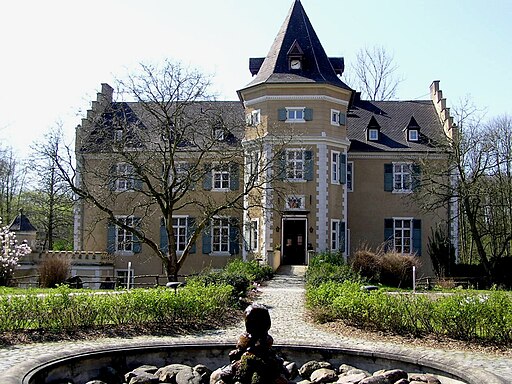
Schloss Westhusen is located in the western part of Dortmund, in an area that historically lay between agricultural land and emerging trade routes of the Ruhr region. The site was once defined by open fields, small streams, and fertile soil, making it well suited for a noble estate that combined residence with agricultural management. Its position outside the dense urban core allowed the complex to develop with relative autonomy, while still maintaining close ties to nearby settlements. Over time, as Dortmund expanded, the castle became part of a broader cultural landscape shaped by both rural traditions and urban growth.
Medieval Origins and Early Estate Formation
The origins of Schloss Westhusen can be traced back to the Middle Ages, when fortified manor houses were established to secure land ownership and assert local authority. Early buildings on the site were likely modest in scale, constructed primarily to protect agricultural resources and serve as a residence for a local noble family or ministerial household. These early structures formed the nucleus of what would later become a more substantial castle complex. As the estate gained importance, stone construction replaced earlier materials, reflecting increased wealth and a desire for permanence in a period marked by regional conflict and political change.
Architectural Development and Defensive Character
Architecturally, Schloss Westhusen evolved as a water-influenced castle complex, making use of surrounding wetlands and engineered water features for defense and boundary definition. A moat or system of water-filled ditches played a central role in protecting the estate, while thick walls and controlled access points enhanced security. The main residential buildings were arranged around an inner courtyard, creating a cohesive and functional layout. While defensive in nature, the architecture also emphasized livability, with interior spaces designed to accommodate domestic life, administration, and storage in a balanced and practical manner.
Noble Residence and Economic Function
For centuries, Schloss Westhusen served as the residence of noble families who managed extensive agricultural lands from the estate. The castle functioned as an administrative center where rents were collected, legal matters were addressed, and production from surrounding fields was organized. This role connected the castle closely to the daily lives of local farmers and workers, making it an essential component of the regional economy. The estate also acted as a social center, hosting gatherings and reinforcing the status of its owners within the local hierarchy.
Transition in the Early Modern Period
As the Middle Ages gave way to the early modern era, the role of Schloss Westhusen gradually shifted. The need for strong defensive structures declined as political stability increased and warfare evolved. In response, the castle underwent modifications that reflected new priorities, particularly residential comfort and representation. Interior spaces were adapted to contemporary tastes, and some defensive elements became more symbolic than functional. These changes allowed the castle to maintain its relevance as a noble residence while adapting to changing social and political conditions.
Decline, Adaptation, and Survival
In later centuries, economic changes and the expansion of Dortmund led to shifts in land use that affected Schloss Westhusen. Parts of the estate lost their original function, and maintaining the castle became increasingly challenging. Some structures were altered or repurposed, while others fell into disrepair. Despite these challenges, significant elements of the castle survived, preserving its historical character. Restoration and adaptation efforts helped integrate the complex into the modern landscape without erasing its past.
Cultural Importance and Historical Legacy
Today, Schloss Westhusen stands as an important reminder of Dortmund’s medieval and early modern history, offering insight into the region’s transformation from rural estates to an urban-industrial environment. The castle embodies the layered history of land ownership, architectural adaptation, and social change that shaped the Ruhr area over centuries. As a cultural landmark, Schloss Westhusen continues to contribute to the historical identity of the region, connecting present-day Dortmund with its noble and agricultural past.
