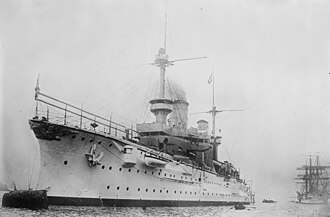
At the turn of the twentieth century, the world’s major naval powers were engaged in a period of extraordinary technological transformation. Steam propulsion, increasingly powerful naval artillery, improved armor protection, and expanding overseas ambitions were reshaping the design and purpose of warships. Among the vessels that emerged from this era was SMS Fürst Bismarck, a German armored cruiser that represented an important milestone in the development of the Imperial German Navy, known as the Kaiserliche Marine. Commissioned on 1 April 1900, the ship was Germany’s first purpose-built armored cruiser and reflected the country’s growing determination to protect its overseas interests while establishing a stronger presence on the world’s oceans.
Unlike a traditional battleship designed primarily for heavy fleet engagements, an armored cruiser had to combine considerable firepower and defensive protection with the ability to operate over long distances. This made the type particularly attractive to countries with commercial interests, colonial possessions, and diplomatic commitments far from their home ports. Fürst Bismarck embodied this approach through its substantial displacement, powerful main battery, extensive secondary armament, and steam-powered machinery. Although its design would eventually be surpassed by newer and faster warships, the vessel played a significant role in the early development of German overseas naval operations and provides a fascinating example of the engineering priorities that shaped warship construction before the First World War.
The ship’s importance extended beyond its physical characteristics. Named in honor of Otto von Bismarck, the influential Prussian statesman who played a decisive role in German unification, the cruiser also carried considerable symbolic meaning. Its construction reflected a period when the newly unified German Empire was seeking to translate its growing industrial and political strength into international influence. From its construction in Kiel to its deployment in East Asia and its eventual withdrawal from active service, Fürst Bismarck offers a compelling case study of the relationship between naval technology, imperial strategy, and the changing character of maritime warfare.
The Historical Background of SMS Fürst Bismarck
Germany’s Emergence as a Naval Power
The establishment of the German Empire in 1871 fundamentally changed the political balance of continental Europe. Under the leadership of Prussia and the influence of Otto von Bismarck, the German states had been united into a powerful industrial and military nation. During the following decades, Germany’s manufacturing capacity, commercial shipping, and overseas ambitions expanded considerably. As German merchants developed new trading relationships and the government acquired colonial possessions, the protection of maritime interests became an increasingly important strategic concern.
The Imperial German Navy initially operated with more limited resources than the established fleets of Britain and France. However, developments in international trade, colonial competition, and naval technology gradually encouraged German policymakers to invest in more capable warships. Cruisers were especially valuable because they could protect merchant shipping, represent national power in foreign ports, gather information, and operate independently of the main battle fleet. An armored cruiser offered an additional advantage: unlike a lightly protected cruiser, it could carry substantial armor and heavier guns, improving its ability to withstand enemy fire while remaining capable of extended operations.
By the 1890s, Germany had strong reasons to acquire a vessel that combined these qualities. Existing protected cruisers provided useful speed and range, but their defensive arrangements were less comprehensive than those of a true armored cruiser. Fürst Bismarck was conceived to fill this gap. Its design was larger and more heavily armed than earlier German cruisers, demonstrating that the Imperial Navy was beginning to pursue a broader range of capabilities rather than relying exclusively on smaller vessels intended for scouting and overseas patrol duties.
Why the Ship Was Named Fürst Bismarck
The name Fürst Bismarck means “Prince Bismarck” and refers to Otto von Bismarck, who was granted the title of prince after playing a central role in the unification of Germany. Although Bismarck had left the office of chancellor in 1890, his reputation remained closely connected to the formation and political identity of the German Empire. Naming a major warship after him therefore connected the vessel with the country’s national history and the statesmanship associated with German unification.
The prefix SMS stands for Seiner Majestät Schiff, meaning “His Majesty’s Ship.” It was the designation used by the Imperial German Navy for its commissioned vessels, comparable in function to the prefixes used by other national navies. The full name, SMS Fürst Bismarck, consequently identifies the vessel as a commissioned warship of the German emperor rather than a civilian ship or a vessel belonging to a later German navy.
The naming also highlights an important distinction between the ship and Otto von Bismarck himself. The cruiser was not built during the statesman’s period of greatest political influence, nor should its later operational history be interpreted as a direct expression of his personal policies. Instead, the name served as a national symbol during an era when Germany was developing a more ambitious overseas presence and a modern naval establishment.
Construction and Commissioning
Building the Cruiser at Kiel
SMS Fürst Bismarck was constructed at the Imperial Shipyard in Kiel, one of the principal naval construction facilities of the German Empire. Kiel’s location on the Baltic Sea made it an important center for German maritime activity, and its shipyard infrastructure supported the construction of increasingly large and technically sophisticated warships. The project began with the laying of the keel on 1 April 1896, followed by the launch on 25 September 1897. After several years of fitting out, machinery work, and preparation for naval service, the ship was commissioned on 1 April 1900.
The interval between laying down and commissioning reflected the complexity of building a large armored cruiser during the late nineteenth century. A ship of this type required extensive structural work, the installation of large gun mounts, the fitting of armored sections, and the integration of boilers, steam engines, shafts, and auxiliary machinery. The design also had to accommodate ammunition storage, crew quarters, command facilities, navigation equipment, and the many systems required to operate independently at sea. These demands made the construction of a modern warship an extensive industrial undertaking rather than simply an exercise in assembling a large hull.
The ship’s reported construction cost was approximately 18.945 million German marks, a substantial investment that reflected the material, engineering, and labor requirements of a vessel of its size. The expense also illustrates why the introduction of armored cruisers was a strategic decision: governments had to balance the cost of building heavily protected cruisers against the need for battleships, lighter cruisers, torpedo craft, and the infrastructure required to support an expanding fleet.
A Ship Between Two Naval Eras
When Fürst Bismarck was designed, naval architects were still working through the practical consequences of rapid technological change. Traditional sailing warships had already given way to steam-powered iron and steel vessels, but the relative importance of speed, armor, gun caliber, and endurance remained subjects of continuing debate. Some navies emphasized battleships capable of confronting enemy fleets, while others valued cruisers that could operate independently and defend commercial or colonial interests.
Fürst Bismarck belonged to the latter category, but its substantial armor and heavy guns gave it capabilities that went beyond those of a conventional protected cruiser. It was intended to survive engagements with significant opponents while remaining useful on distant stations where immediate reinforcement might not be available. This combination of strength and endurance was attractive to the German Navy because the country’s overseas responsibilities extended well beyond the North Sea and Baltic Sea.
Nevertheless, the cruiser entered service during a period when naval technology was advancing so rapidly that designs could become outdated within a relatively short time. Improved engines, better fire-control systems, more efficient armor arrangements, and new classes of capital ships gradually changed the balance between battleships and cruisers. Fürst Bismarck was therefore both a pioneering achievement and a transitional design, demonstrating what the Imperial German Navy could build at the end of the nineteenth century while revealing the limitations that later developments would address.
Design and Engineering Characteristics
Hull Dimensions and Displacement
Fürst Bismarck was a substantial warship by the standards of its commissioning period. Its overall length was approximately 127 metres, its beam measured about 20.4 metres, and its maximum reported displacement was approximately 11,461 metric tonnes. These dimensions provided the internal volume necessary for its heavy artillery, armor protection, machinery, fuel supplies, ammunition magazines, and crew facilities.
Displacement is particularly important when comparing historical warships because it describes the mass of water displaced by the vessel and is commonly used as a measure of overall size. Figures can differ depending on whether a source reports design displacement, normal displacement, or full-load displacement. Fürst Bismarck is often listed at approximately 10,690 tonnes under a design or construction-related measurement and 11,461 tonnes at maximum displacement. Such differences should not automatically be treated as errors; they may reflect distinct loading conditions or conventions used by different references.
The hull was designed to support both seaworthiness and the considerable weight of the ship’s armament and protection. Its dimensions allowed the designers to distribute heavy guns between the forward and aft portions of the vessel while accommodating a substantial battery of medium-caliber weapons along the sides. The resulting arrangement made Fürst Bismarck a powerful platform for its time, although its size and weight also meant that the vessel depended on a large engineering plant and careful management of fuel and maintenance.
Steam Propulsion and Machinery
The ship’s propulsion system consisted of three triple-expansion steam engines driving three screw propellers. Steam was supplied by a mixed installation of four water-tube boilers and eight fire-tube boilers, combining different boiler technologies within the same vessel. This arrangement was intended to provide the power needed to propel a large armored cruiser while supporting the operating requirements of a long-distance naval deployment.
Triple-expansion engines worked by allowing steam to expand successively through cylinders of increasing volume, extracting useful energy at multiple stages before the steam was exhausted. Compared with earlier steam-engine arrangements, this process could improve fuel efficiency, a valuable characteristic for a cruiser expected to spend extended periods away from home ports. Three propellers also allowed the machinery to distribute propulsion across multiple shafts, although the performance and reliability of the overall installation depended on the condition of the engines, boilers, and supporting systems.
Reported output varies slightly among references, with figures commonly placed around 13,500 to 13,600 metric horsepower, depending on the source and measurement convention. The ship achieved a maximum speed of approximately 18.7 knots, equivalent to about 34.6 kilometres per hour. While this was respectable for a large armored cruiser of the period, it was not exceptional by the standards of later warships. Its speed reflected the compromise between the weight of armor, the size of the artillery battery, the capabilities of contemporary steam machinery, and the need to preserve enough internal space for fuel and supplies.
Operational Range and Endurance
A cruiser intended for overseas service needed more than heavy guns and armor; it also required sufficient endurance to travel long distances without frequent access to major naval bases. Fürst Bismarck had a reported range of approximately 4,560 nautical miles at 10 knots and 3,230 nautical miles at 12 knots. These figures demonstrate the close relationship between speed and fuel consumption in steam-powered warships: traveling faster generally required a greater rate of fuel use, reducing the distance the ship could cover before replenishment.
The ability to operate far from Germany was essential to the ship’s original purpose. Naval forces stationed in East Asia had to cross extensive stretches of ocean, maintain readiness after arrival, and remain capable of moving between distant ports and areas of strategic interest. A cruiser with limited endurance would have depended heavily on local support or frequent visits to coaling stations, reducing its freedom of action and increasing the logistical burden on the navy.
Coal logistics remained a major consideration for steam-powered vessels during this era. Even a ship with a considerable theoretical range depended on the availability of fuel supplies, suitable ports, maintenance facilities, and a network of friendly or controlled stations. Consequently, the operational effectiveness of Fürst Bismarck cannot be measured by speed and armament alone. Its endurance formed part of a wider system of maritime logistics that connected shipyards, supply depots, overseas bases, and the naval formations operating far from European waters.
Armament: Heavy Guns and Supporting Weapons
The Main Battery
The principal armament of SMS Fürst Bismarck consisted of four 24-centimetre SK L/40 naval guns mounted in two twin turrets, one forward and one aft. The arrangement allowed the ship to engage important targets with a powerful broadside while retaining the ability to fire its main battery in both forward and rearward directions under suitable circumstances. The use of large-caliber weapons reflected the designers’ intention to create a cruiser capable of confronting heavily protected opponents rather than relying exclusively on speed to avoid combat.
The designation L/40 indicates a barrel length of approximately forty times the gun’s bore diameter. For a 24-centimetre weapon, this corresponds to a nominal barrel length of roughly 9.6 metres. Longer barrels could contribute to higher muzzle velocity and improved ballistic performance, although actual effectiveness depended on ammunition design, propellant characteristics, gun mounting, range estimation, and the ability of the crew to deliver accurate fire.
The main guns were mounted in armored turrets that protected the weapons and their crews while permitting them to train toward different targets. Their location at the bow and stern reflected a common arrangement in heavy warships of the period, allowing substantial firepower to be concentrated without placing the entire main battery along the ship’s sides. The four-gun battery was not as large as the main armament of later dreadnought battleships, but it represented a formidable level of firepower for an armored cruiser entering service in 1900.
Secondary Artillery and Close-Range Defense
The secondary battery comprised twelve 15-centimetre SK L/40 guns, generally mounted in protected positions along the ship’s sides. These weapons supplemented the heavy main guns by providing a faster-firing battery suitable for engagements in which the largest guns were not the most practical choice. Their placement enabled the cruiser to bring several guns to bear against targets within the appropriate arcs of fire, while their smaller caliber allowed the ship to carry more of them than it could have carried large turret-mounted weapons.
Fürst Bismarck also carried ten 8.8-centimetre guns intended for lighter defensive duties, together with smaller rapid-firing weapons. These guns broadened the vessel’s ability to respond to threats that did not warrant the use of its main battery and formed part of the layered armament typical of late nineteenth-century warships. The precise effectiveness of each weapon depended on factors such as ammunition supply, training, target distance, visibility, and the increasingly important challenge of directing fire accurately from a moving platform.
The ship’s weapon arrangement illustrates the logic of pre-dreadnought naval design. Instead of relying on a uniform battery of very large guns, designers equipped the vessel with several calibers to address different tactical situations. Heavy artillery delivered powerful blows against major surface combatants, medium guns provided a sustained volume of fire, and lighter weapons were available for smaller or closer threats. This layered approach was characteristic of the period, although the increasing importance of standardized heavy batteries and improved fire control would eventually encourage different design philosophies.
Torpedo Armament
In addition to its guns, Fürst Bismarck carried six torpedo tubes for 45-centimetre torpedoes. Torpedoes provided a potential means of attacking an enemy ship at relatively close range with a weapon that could cause severe damage below the waterline. Their inclusion reflected the broader importance attached to underwater weapons during a period when naval designers were reconsidering how armored vessels could be attacked and defended.
The torpedo tubes were not a substitute for the ship’s artillery, and their usefulness depended on suitable tactical circumstances. A torpedo attack generally required the vessel to approach within effective range, maintain an appropriate firing position, and anticipate the movement of the target. Against an alert opponent, such an approach could be dangerous. Nevertheless, torpedoes offered an additional threat that could influence an adversary’s movements and broaden the range of options available to the commanding officer.
The presence of torpedo armament also reflects the transitional character of the cruiser. At the end of the nineteenth century, the relationship between guns, armor, and torpedoes was still evolving. Naval officers had to consider how increasingly powerful artillery would interact with short-range underwater weapons, while designers attempted to protect vulnerable machinery spaces, magazines, and other essential compartments. Fürst Bismarck embodied these competing considerations in a single large warship.
Armor Protection and Survivability
The Main Armor Belt
Armor was one of the defining characteristics that distinguished Fürst Bismarck from lighter protected cruisers. The ship’s main armor belt reached approximately 200 millimetres in thickness in its most heavily protected areas. This belt was intended to shield important portions of the hull, especially the machinery spaces and other vital internal compartments, against enemy shellfire. Its value lay not simply in the thickness of the metal but in the way the armor was arranged in relation to the vessel’s displacement, internal structure, and vulnerable systems.
The armored belt formed part of a larger defensive arrangement rather than an isolated wall of steel. Designers had to decide which sections of the hull deserved the greatest protection and how much weight could be devoted to armor without compromising speed, stability, and endurance. A cruiser operating overseas might be expected to encounter a variety of opponents, making a balance between offensive power and survivability particularly important. Excessive armor could reduce performance, while insufficient armor could leave the ship vulnerable to opponents carrying comparable guns.
Armor performance also depended on the characteristics of the incoming shell, the angle of impact, the distance from which it was fired, and the construction of the protective material. A stated armor thickness therefore cannot be interpreted as an absolute guarantee against penetration. Instead, it provides a useful indication of the level of protection the designers sought to achieve within the limits of contemporary naval engineering.
Turret, Deck, and Command Protection
In addition to its belt armor, Fürst Bismarck incorporated protection for its main gun turrets and other important fighting positions. The turrets needed to shield the guns and their crews while still allowing the weapons to rotate and engage targets. The protective structure around the artillery therefore had to reconcile strength with mechanical movement, ammunition handling, and the need to maintain usable firing arcs.
Deck armor offered a different kind of protection. While a vertical armor belt was primarily intended to resist shells striking the sides of the ship, deck protection could help reduce the danger posed by shells descending at steeper angles, particularly at longer ranges. Sources commonly list deck armor in the approximate range of 30 to 50 millimetres, with variations depending on the specific area and the reference consulted. The ship’s defensive layout consequently combined heavy protection in selected locations with thinner armor elsewhere, a compromise dictated by the limited weight that a vessel could carry.
Command positions were another important concern because the loss of officers, communication systems, or the ability to observe and direct combat could compromise the effectiveness of the entire ship. Armored command structures helped reduce this risk, although visibility, communications, and situational awareness remained essential to effective command. Overall, Fürst Bismarck’s armor arrangement demonstrates how naval architects sought to protect the most important elements of a warship without making it prohibitively heavy or slow.
Service in East Asia
Deployment to the German East Asia Squadron
Fürst Bismarck’s operational history is closely associated with the German East Asia Squadron, a naval formation intended to represent German interests and provide a military presence in waters far from Europe. Stationing a large armored cruiser in East Asia gave Germany a more capable instrument for overseas operations than a force consisting only of smaller or more lightly protected vessels. The cruiser could support other warships, demonstrate national power during diplomatic disputes, and contribute substantial firepower to a squadron operating in a strategically important region.
East Asia was an important arena for international competition during the late nineteenth and early twentieth centuries. European powers, the United States, Japan, and regional governments were navigating a complex environment shaped by trade, political influence, territorial ambitions, and military modernization. A German warship stationed in the region was therefore part of a much larger international picture. Its presence was intended to strengthen Germany’s ability to respond to developments affecting its citizens, commercial interests, and diplomatic position.
Operating in such a distant theater imposed significant demands on the ship and its crew. Long voyages required careful planning, machinery maintenance, fuel management, and coordination with other naval units. Supplies and repair facilities could not always be obtained as conveniently as they could in German home waters. The ship’s value consequently depended on both its technical capabilities and the broader organization supporting the East Asia Squadron.
The Boxer Rebellion and the Events of 1900
One of the most significant events associated with Fürst Bismarck’s early service was the Boxer Rebellion in China. During 1900, anti-foreign violence and a wider political crisis led to the intervention of an international coalition of powers. Germany participated in this intervention, and its naval forces formed part of the military presence assembled in the region. Fürst Bismarck’s role placed the cruiser within the broader history of the international response to the crisis.
The Boxer Rebellion emerged from a complicated combination of political, social, economic, and religious tensions. Opposition to foreign influence and Christian missionary activity developed amid broader dissatisfaction with the presence and privileges of foreign powers in China. The resulting violence, the siege of foreign diplomatic compounds in Beijing, and attacks against Chinese Christians and foreigners contributed to an international military response. The intervention itself involved multiple governments and forces, each with its own interests and objectives.
Fürst Bismarck’s participation in this period demonstrates the kind of work expected from a large overseas cruiser. Such a vessel could serve as a visible symbol of state power, support the movement and protection of naval personnel, and contribute to military operations alongside other ships. However, the broader historical significance of the Boxer Rebellion should not be reduced to a technical account of naval deployment. The intervention occurred within an unequal imperial environment and had serious consequences for Chinese sovereignty and the people affected by the conflict. Understanding the ship’s service therefore requires attention both to its military role and to the political context in which that role was performed.
Modernization and the Return to German Waters
Reassessment of the Ship’s Capabilities
As the first ship of its type in the German Navy, Fürst Bismarck was built around assumptions that gradually changed as naval engineering advanced. Newer cruisers incorporated improvements in machinery, speed, armor distribution, and weapons systems. The introduction of increasingly capable ships meant that a vessel which had once represented a major advance could eventually become less suitable for the duties assigned to the fleet’s most modern units.
The development of German naval construction was particularly important because the Imperial Navy was expanding its ambitions and seeking more capable vessels for both overseas and home-water operations. Newer armored cruisers could offer improved performance and more modern equipment, while changing international circumstances placed additional demands on naval forces. Fürst Bismarck’s original design remained significant, but it was no longer the sole expression of German armored-cruiser capability.
The cruiser underwent modernization after returning to Germany, reflecting the navy’s attempt to keep the vessel useful even as its original operational environment changed. Modernization could involve updating equipment, repairing machinery, replacing worn components, and adapting internal systems to contemporary requirements. It could not, however, eliminate every limitation inherent in the ship’s original design. Hull dimensions, basic armor geometry, and the fundamental arrangement of the machinery imposed boundaries on how far the vessel could be improved.
Replacement by Newer Warships
By 1909, Fürst Bismarck’s role in the East Asia Squadron had been superseded by newer German cruisers, including SMS Scharnhorst. The arrival of more modern vessels reflected a broader transition in naval policy, as Germany invested in ships with improved combinations of speed, firepower, protection, and operational capability. For Fürst Bismarck, this transition meant that the ship’s most prominent overseas role was drawing to a close.
The replacement of an older ship did not necessarily mean that it had become useless. Naval vessels could continue to serve in secondary roles long after newer designs entered service. Training, local defense, support duties, and other less demanding assignments could extend the practical life of an expensive warship. This was especially relevant when a vessel remained structurally sound and its machinery could still perform the tasks expected of it.
The ship’s changing role illustrates a fundamental feature of naval history: technological progress often transforms the value of existing equipment before that equipment becomes physically unserviceable. A cruiser could remain a powerful and seaworthy vessel while no longer being the best choice for a demanding overseas assignment. In this sense, Fürst Bismarck’s replacement was a consequence of the development of the navy around it rather than a simple verdict on the quality of its original construction.
Fürst Bismarck During the First World War
A Changed Strategic Environment
When the First World War began in 1914, the strategic environment of European naval warfare had changed dramatically from the one in which Fürst Bismarck had been conceived. Battleships and battlecruisers were larger and more heavily armed, naval operations increasingly depended on coordinated fleets and modern reconnaissance, and the importance of submarines and mines was becoming increasingly apparent. The older cruiser no longer possessed the same relative advantages it had enjoyed during its early career.
Germany’s naval priorities also shifted. The High Seas Fleet confronted the powerful Royal Navy in the North Sea, while overseas squadrons operated under the pressures created by the outbreak of a global conflict. Overseas supply networks became more difficult to sustain, and the loss or isolation of distant naval bases could sharply limit the usefulness of individual ships. For a vessel whose original role had centered on overseas service, these changes made its earlier strategic purpose much harder to fulfill.
Fürst Bismarck was employed in a coast-defense role during the early part of the war, but it was soon assigned to stationary training duties. These tasks were less demanding than the cruiser operations for which the ship had originally been designed. Nevertheless, training remained essential to the navy, since sailors required instruction in seamanship, machinery operation, gunnery procedures, and the routines of shipboard service. Even an older vessel could provide a useful environment for developing practical experience.
Training Duties and the End of Active Service
The shift to training duties highlights how the useful life of a warship can continue beyond its most active operational period. A ship that is no longer competitive in frontline combat may still offer valuable space, equipment, and facilities for instruction. It can help prepare personnel for more modern vessels, provide experience with naval procedures, and support the institutional continuity of the fleet during a period of rapid change.
Fürst Bismarck remained in the Imperial German Navy’s service structure during the war, but its strategic significance had diminished considerably from its earlier years. The ship was formally decommissioned on 31 December 1918, shortly after Germany’s defeat and the end of major hostilities. Its withdrawal occurred as the Imperial German Navy itself was undergoing profound political and organizational change following the collapse of the German monarchy.
The conclusion of the ship’s active career also marked the end of an era in German naval construction. The cruiser had entered service when armored cruisers represented an important development in naval power, but it was retired after the emergence of newer technologies and a conflict that had transformed the requirements of modern warfare. Its service history therefore mirrors the broader transition from late nineteenth-century naval thinking to the more complex and demanding maritime environment of the twentieth century.
Decommissioning, Scrapping, and Historical Legacy
The Ship’s Final Fate
Following its decommissioning, Fürst Bismarck was struck from the naval register on 17 June 1919 and subsequently broken up for scrap. Scrapping took place during 1919–1920, with accounts associating the dismantling process with Rendsburg. The disposal of the vessel reflected the changing status of the German Navy after the First World War, when the defeat of the empire and the new political order brought an end to many of the institutions that had shaped German naval expansion.
Unlike warships that are sunk in battle or preserved as museum vessels, Fürst Bismarck disappeared through the ordinary industrial process of dismantling. Its steel and other recoverable materials could be reused, while the ship’s original equipment and fittings were dispersed or removed. As a result, the vessel survives primarily through historical records, technical descriptions, photographs, and accounts of its service rather than as a physical ship that visitors can inspect today.
The absence of a surviving hull makes documentary accuracy particularly important. Specifications published in different references may use different conventions for displacement, draft, machinery output, or armor thickness, and later summaries can occasionally combine figures that were recorded under different conditions. Anyone researching the vessel in detail should therefore distinguish between broadly accepted characteristics and measurements that vary among sources. This approach makes it possible to reconstruct the ship’s design without presenting every published number as equally precise.
Why SMS Fürst Bismarck Still Matters
The lasting significance of Fürst Bismarck rests primarily on its position in the development of the Imperial German Navy. As Germany’s first armored cruiser, it represented an effort to combine the long-range utility of a cruiser with the heavier weapons and defensive arrangements associated with more powerful combatants. Its design reflected the strategic realities of a country seeking greater influence overseas, while its operational history reveals how distant naval deployments depended on logistics, diplomacy, and the availability of supporting forces.
The ship is also useful for understanding the limits of technological progress. Its armor, artillery, and machinery were substantial achievements when the vessel was conceived, yet subsequent developments steadily altered the balance between protection, firepower, speed, and endurance. The rapid evolution of warship design meant that no single combination of characteristics could remain optimal indefinitely. Fürst Bismarck demonstrates how a ship could be advanced for its generation and still become less suitable for frontline duties within a relatively short period.
Its history also connects technical naval research with the wider story of imperialism and international conflict. The cruiser operated in an era when European states projected power across the globe, and its service during the Boxer Rebellion places it within a controversial episode in China’s modern history. A complete assessment of the vessel must therefore consider more than its engines, guns, and armor. It must also acknowledge the political purposes for which those technologies were employed and the consequences of overseas military intervention.
Conclusion: An Important Milestone in German Naval History
SMS Fürst Bismarck occupies a distinctive place in the history of the German Imperial Navy. Laid down in 1896, launched in 1897, and commissioned in 1900, it was the country’s first purpose-built armored cruiser and an important expression of German industrial and naval ambition. Its combination of a substantial hull, three-shaft steam propulsion, four 24-centimetre main guns, twelve 15-centimetre secondary guns, torpedo armament, and heavy armor protection made it a formidable vessel for the period in which it entered service.
Its deployment to East Asia demonstrated the practical value of an armored cruiser capable of operating far from home, while its participation in the events surrounding the Boxer Rebellion revealed how naval power was used to support national objectives during a period of intense international competition. Later modernization, replacement by newer ships, wartime reassignment, and eventual scrapping illustrated the changing demands of naval warfare and the difficulty of maintaining a leading position as technology advanced.
Although Fürst Bismarck did not survive as a museum ship and did not become as widely recognized as some later German warships, its historical importance remains clear. It bridged the gap between earlier protected cruisers and the increasingly sophisticated armored cruisers of the early twentieth century. For enthusiasts of naval history, researchers of Imperial Germany, and readers interested in the evolution of military engineering, SMS Fürst Bismarck remains a valuable example of how technological innovation, strategic ambition, and historical circumstances combined to shape the warships of a changing world.
