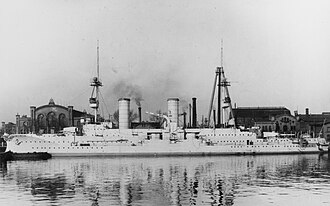
At the beginning of the twentieth century, the Imperial German Navy was undergoing a period of significant technological development, driven by the ambition to strengthen Germany’s international position and improve its ability to operate across distant seas. Naval architects were attempting to balance several competing requirements: powerful artillery, effective armor protection, high speed, long operational range, and reasonable construction costs. Among the warships that emerged from this period was SMS Prinz Heinrich, a German armored cruiser commissioned on 11 March 1902. Built at the Imperial Shipyard in Kiel, the vessel represented an important step in the evolution of German cruiser design, combining a reduced main battery with a faster machinery installation and a revised approach to armor distribution.
Prinz Heinrich was particularly significant because it was designed as a development of Germany’s first armored cruiser, SMS Fürst Bismarck, rather than as an entirely unrelated vessel. The earlier cruiser had demonstrated the potential of combining heavy artillery and substantial protection in a ship intended for independent operations, but it was also expensive and comparatively large. The designers of Prinz Heinrich attempted to refine that concept by reducing displacement and simplifying aspects of the armament while improving speed and concentrating protection around important areas of the hull. This approach reflected a central challenge facing naval engineers of the period: building a warship that could perform demanding overseas duties without consuming the resources required for an increasingly expensive fleet.
Although Prinz Heinrich was not as heavily armed as some contemporary armored cruisers, its influence extended beyond its own operational career. The ship introduced design features that became characteristic of subsequent German armored cruisers, particularly the concentration of much of the secondary artillery within a protected central section. It also demonstrated how naval design was evolving away from simply increasing the size of individual weapons toward a more deliberate balance between firepower, protection, propulsion, and the internal arrangement of the ship. Its service before and during the First World War, including operations in the North Sea and Baltic Sea, further illustrates how quickly the strategic value of older warships could change as naval technology and international circumstances developed.
Historical Background: Germany’s Search for a More Capable Cruiser Fleet
The Expansion of the Imperial German Navy
The German Empire emerged in 1871 as a unified state with growing industrial capacity, an expanding economy, and increasing ambitions beyond continental Europe. Although Germany’s early military strength was primarily associated with its army, the development of international commerce and overseas possessions encouraged policymakers to devote greater attention to naval power. A modern navy could protect merchant shipping, safeguard maritime communications, demonstrate national prestige, and provide the government with an instrument for influencing events far from German territory. These responsibilities became particularly important as European powers competed for overseas markets, strategic ports, and colonial possessions.
During the final decades of the nineteenth century, the Imperial German Navy expanded its capabilities through the construction of battleships, protected cruisers, torpedo craft, and other specialized vessels. Each type served a different purpose, and cruisers were especially valuable because they could operate independently for extended periods. They could scout for enemy forces, patrol distant waters, protect commercial interests, and support diplomatic initiatives without requiring the constant presence of a main battle fleet. However, a cruiser expected to operate in potentially hostile waters needed more than speed and endurance. It also required enough firepower and armor to defend itself against serious opponents.
The armored cruiser emerged as one answer to this challenge. By combining heavier guns and stronger protection than a conventional protected cruiser, it offered a potentially useful compromise between a battleship and a lighter scouting vessel. Germany’s first example, Fürst Bismarck, provided experience with this concept but also revealed the expense associated with a large, heavily armed cruiser. Prinz Heinrich was developed in the context of these lessons, with the intention of preserving the essential advantages of an armored cruiser while producing a more economical and somewhat faster design.
The Influence of Naval Laws and Strategic Planning
German naval construction was increasingly shaped by legislation and long-term planning intended to establish a more predictable framework for fleet expansion. The Naval Law of 1898, associated with Admiral Alfred von Tirpitz’s naval policy, formed part of the broader effort to develop a stronger German fleet. This policy reflected the belief that naval power could contribute to Germany’s international standing and influence the calculations of other major powers. At the same time, the construction of each new warship required difficult decisions about cost, technical capability, and the roles that the vessel would be expected to perform.
Prinz Heinrich was conceived as a cruiser suitable for overseas station service and for operations within the wider fleet. Its designers had to consider the demands of long voyages, the availability of coaling facilities, the possibility of encountering enemy cruisers, and the need to provide effective firepower without exceeding the limits imposed by the navy’s construction budget. The resulting ship was smaller than Fürst Bismarck and carried fewer heavy guns, but its machinery offered a modest improvement in speed. This was not a simple case of making the vessel weaker; it was an attempt to decide which capabilities mattered most for the ship’s expected duties.
The compromises embodied in Prinz Heinrich reveal the practical nature of warship design during this period. Every additional gun, layer of armor, or increase in machinery power added weight and expense, often forcing changes elsewhere in the design. Naval architects therefore had to evaluate the vessel as a complete system rather than as a collection of individual specifications. Prinz Heinrich became an important example of this approach, showing how a carefully revised design could influence later ships even if its own service life did not extend far into the era of modern naval warfare.
Construction and Commissioning of SMS Prinz Heinrich
Construction at the Imperial Shipyard in Kiel
SMS Prinz Heinrich was built at the Kaiserliche Werft, or Imperial Shipyard, in Kiel, one of the German Empire’s principal naval construction centers. Its keel was laid on 1 December 1898, and the ship was launched on 22 March 1900. Following fitting-out work, machinery installation, and preparation for active service, it was commissioned on 11 March 1902. The vessel was named after Prince Heinrich of Prussia, a member of the Hohenzollern royal family and a prominent naval figure who became closely associated with the development and leadership of the German fleet.
The construction of a large armored cruiser required extensive coordination among shipbuilders, engineers, metalworkers, weapons specialists, and naval authorities. The hull had to support the weight of the machinery, armor, artillery, ammunition, and fuel while maintaining sufficient stability and seaworthiness for operations in varied conditions. The installation of the propulsion system was particularly important because the ship’s performance depended on the efficient interaction of boilers, engines, shafts, and propellers. At the same time, the arrangement of the internal compartments had to accommodate magazines, command spaces, workshops, crew accommodation, and the numerous supporting systems required for extended naval service.
The reported construction cost was approximately 16.6 million German marks, making Prinz Heinrich a substantial investment even though it was smaller and less heavily armed than its predecessor. That cost reflected not only the materials and labor used in building the vessel but also the specialized infrastructure necessary to manufacture and install naval artillery, armor plate, and steam machinery. A ship of this kind was a major industrial product, and its construction demonstrated the growing capacity of German shipyards to produce sophisticated warships that could compete with the designs of other major naval powers.
A New Balance Between Speed, Armor, and Firepower
Prinz Heinrich’s design represented a deliberate departure from the philosophy embodied by Fürst Bismarck. Instead of retaining four 24-centimetre main guns in two twin turrets, the newer cruiser carried only two 24-centimetre guns, each mounted in a separate turret at opposite ends of the ship. Its secondary battery was also reduced slightly, while its armor arrangement was redesigned to provide more focused protection around important areas. These decisions helped reduce the ship’s overall displacement and construction cost, while the more powerful machinery contributed to a higher maximum speed.
The reduction in heavy artillery was an important compromise. Large-caliber guns were capable of delivering powerful blows against armored opponents, but they were expensive, heavy, and demanding in terms of ammunition storage and supporting equipment. By carrying two main guns instead of four, Prinz Heinrich sacrificed some of its ability to deliver a heavy broadside. In exchange, the design could devote resources to other characteristics, including machinery and the arrangement of armor around the central portion of the vessel. Whether this trade-off was advantageous depended on the kind of engagement the ship was expected to fight and the strength of the enemy it might encounter.
The ship’s design was therefore not simply an exercise in reducing size. It reflected an attempt to make the armored cruiser more efficient for its intended role, particularly in overseas service where endurance, operational flexibility, and the ability to operate independently could be as important as maximum firepower. Subsequent German armored cruisers would develop many of the same principles, making Prinz Heinrich a significant link between the earliest German armored cruiser and the more advanced vessels that followed.
Hull Design and Physical Characteristics
Dimensions and Displacement
SMS Prinz Heinrich measured approximately 126.5 metres in overall length, with a beam of 19.6 metres. Its design displacement was approximately 8,887 metric tonnes, increasing to about 9,806 metric tonnes at full load. These figures made it smaller than Fürst Bismarck, which had a maximum displacement of approximately 11,461 metric tonnes. The reduction was significant because displacement affected nearly every aspect of the ship’s performance, including the weight of armor that could be carried, the size of the machinery installation, the amount of fuel available, and the space allocated to crew and supplies.
Displacement figures in historical naval references must be interpreted with care because they may refer to different loading conditions. A design or normal displacement figure generally describes a vessel under a specified standard load, whereas full-load displacement includes additional fuel, supplies, ammunition, and other material carried for operations. The maximum displacement of Prinz Heinrich was therefore higher than its design displacement, and both figures are useful for understanding different aspects of the ship’s characteristics. For comparisons with other warships, it is important to use measurements that refer to equivalent conditions.
The hull’s proportions were intended to accommodate the central armored section, the artillery battery, and the machinery necessary for sustained steam-powered operations. The vessel’s overall size also influenced its suitability for overseas deployment, since a cruiser operating far from its home ports needed room for fuel and provisions as well as equipment for navigation, maintenance, and combat. Its relatively compact dimensions were part of the design’s effort to achieve a practical balance between operational capability and cost, although they also imposed limits on how much armor and armament could be installed.
Hull Construction and Overseas Service
The ship was designed for service that could involve long periods in warm or tropical waters, where marine growth and deterioration of the underwater hull could become persistent maintenance concerns. Contemporary naval construction sometimes employed protective sheathing over wooden hull coverings to help manage fouling and facilitate maintenance. Such arrangements reflected the practical difficulties of keeping a steam-powered warship efficient when it operated far from major repair facilities. A cruiser could possess excellent machinery and powerful weapons, yet still lose operational effectiveness if its hull condition significantly increased resistance through the water.
The external form of Prinz Heinrich also reflected the broader transition from nineteenth-century cruiser designs to the more standardized steel warships of the twentieth century. Naval architects had to consider how the shape of the hull interacted with displacement, stability, speed, and seaworthiness. A vessel intended for distant stations needed to handle changing sea conditions while providing a sufficiently stable platform for its guns. It also needed to carry the fuel necessary for extended voyages without making the ship excessively heavy or compromising its defensive qualities.
Although the physical dimensions of Prinz Heinrich were relatively straightforward to record, their significance becomes clearer when considered alongside the vessel’s intended role. The cruiser was designed not merely to move quickly through the water but to maintain a useful combination of speed, endurance, firepower, and protection over the course of an extended deployment. Its hull and internal arrangement were consequently part of a larger engineering compromise that influenced every stage of its operational life.
Propulsion, Machinery, and Performance
Triple-Expansion Steam Engines
Prinz Heinrich was powered by three triple-expansion steam engines driving three screw propellers. Its boilers included fourteen Dürr water-tube units, which supplied the steam required by the engines. The machinery was designed to produce approximately 15,000 metric horsepower, providing a maximum speed close to 20 knots. This represented a modest improvement over the speed of Fürst Bismarck and reflected the decision to use a more powerful propulsion installation within a smaller overall vessel.
Triple-expansion steam engines extracted energy from steam through successive stages of expansion. Rather than allowing the steam to perform its work in a single cylinder, the system passed it through cylinders of increasing size, improving the use of the steam’s available energy. The technology had become an important feature of late nineteenth-century steamships because it offered a useful combination of power and fuel efficiency. In a warship, this mattered enormously: the engines had to provide enough thrust to move a heavily armored hull while also supporting the long voyages expected of an overseas cruiser.
The three-shaft arrangement allowed the propulsion system to distribute power across three propellers, but it also created a complex engineering installation that required skilled operators and continuous maintenance. Boilers had to maintain suitable pressure, engines needed lubrication and inspection, and the shafts and propellers had to remain in good working condition. A failure in any major component could reduce speed or compromise the ship’s ability to carry out its duties. The performance of Prinz Heinrich therefore depended on the competence of its engineering personnel as much as on the nominal power of its machinery.
Maximum Speed and Operational Range
The ship’s maximum speed is commonly reported as approximately 19.9 to 20 knots, equivalent to around 37 kilometres per hour. For an armored cruiser entering service in 1902, this was a useful performance characteristic. Speed could help the ship select its position in an engagement, maintain contact with other naval units, withdraw from unfavorable situations, and cover the distances required for patrol and reconnaissance. It could also make the vessel more effective when operating with faster elements of the fleet.
Maximum speed, however, was only one measure of operational capability. A cruiser expected to operate far from Germany also needed a substantial cruising range, and Prinz Heinrich is commonly credited with a range of approximately 4,580 nautical miles at 10 knots. The relationship between speed and range was especially important for coal-fired steamships because increasing speed generally raised fuel consumption significantly. A vessel moving at a moderate cruising speed could travel much farther than it could when operating continuously near its maximum speed.
The ship’s endurance was therefore shaped by operational decisions as well as mechanical characteristics. Commanders had to determine when speed was essential, when economical cruising was more appropriate, and how much fuel needed to be reserved for combat or emergencies. The availability of coaling stations and supporting ports also influenced how far the ship could operate without interruption. These logistical considerations were particularly important for overseas service, where a cruiser might need to travel between widely separated bases while remaining ready to respond to unexpected developments.
Armament: A Different Approach to Naval Firepower
The Main Battery of 24-Centimetre Guns
Prinz Heinrich carried two 24-centimetre SK L/40 naval guns, mounted individually in armored turrets, one forward and one aft. These guns formed the ship’s main battery and were intended to provide heavy firepower against significant surface targets. The SK L/40 designation identified a quick-firing naval gun with a barrel length of approximately forty times its bore diameter. For a 24-centimetre weapon, this represented a nominal barrel length of roughly 9.6 metres.
The placement of one main gun at each end of the vessel allowed the ship to engage targets ahead or astern within the relevant firing arcs, while also contributing to its broadside firepower. However, carrying only two heavy guns meant that Prinz Heinrich could not deliver the same volume of main-battery fire as a cruiser equipped with four weapons of the same caliber. This limitation was a direct consequence of the design’s effort to reduce weight and cost, and it helps explain why the vessel must be understood as a compromise rather than as a simple improvement in every respect over Fürst Bismarck.
Main guns were only as effective as the systems and personnel supporting them. Ammunition supply, the mechanical operation of the turrets, target observation, range estimation, and communication between the ship’s command and gun crews all influenced combat performance. At the turn of the century, naval gunnery was becoming increasingly sophisticated, but reliable long-range fire remained difficult. Ships needed trained crews and effective procedures to translate the nominal power of their artillery into accurate and sustained shooting during an engagement.
The Secondary Battery of 15-Centimetre Guns
The ship’s secondary battery consisted of ten 15-centimetre SK L/40 guns. These weapons provided a substantial amount of additional firepower and were intended for situations in which medium-caliber guns were more practical than the main battery. Their relatively faster firing cycle allowed them to deliver a greater volume of shells against suitable targets, while their smaller size made it possible to carry several guns without imposing the same weight penalty as additional heavy artillery.
One of the most important design features of Prinz Heinrich was the concentration of its secondary armament within a protected central battery. Rather than distributing the guns extensively along the length of the ship, the designers grouped much of this artillery around the central armored section, with a combination of turreted and casemate-mounted weapons. This arrangement reduced the length of the hull that required the same degree of protection and helped focus armor around the most important fighting spaces. It also established a design precedent that influenced later German armored cruisers.
The secondary battery was a key part of the ship’s overall combat value because a naval engagement could involve more than a direct exchange between heavy guns. Medium-caliber weapons could be used against cruisers, lighter warships, and vulnerable areas of enemy vessels, while providing a sustained volume of fire during engagements. The concentration of these guns in a protected central area also reflected a growing recognition that a ship’s defensive layout should be designed around its most important internal functions rather than distributed uniformly across the hull.
Light Guns and Torpedo Armament
Prinz Heinrich carried ten 8.8-centimetre guns for lighter defensive duties, together with smaller rapid-firing weapons. These guns provided additional options for engaging smaller targets and responding to threats at ranges or under circumstances in which the main and secondary batteries were less convenient. Although they were not comparable in destructive power to the 24-centimetre main guns, they formed part of the layered weapon system that characterized warships of the period.
The vessel also carried four 45-centimetre torpedo tubes. Torpedoes provided a different method of attacking an opponent, potentially causing severe damage below the waterline if they struck successfully. Their inclusion reflected the growing importance of self-propelled underwater weapons in naval planning during the late nineteenth and early twentieth centuries. Torpedoes could force enemy ships to consider the dangers of approaching too closely, even when their practical effectiveness depended heavily on firing range, target movement, and the tactical circumstances of an encounter.
The torpedo armament did not make Prinz Heinrich a specialist torpedo vessel. Instead, it added another capability to a ship whose primary role remained that of an armored cruiser. Guns offered the ability to engage opponents at a range of distances and sustain fire, while torpedoes offered a potentially devastating attack at closer range. Together, these weapons reflected the diverse threats naval designers expected their vessels to encounter before the widespread adoption of more standardized heavy-gun battleship designs transformed surface warfare.
Armor Protection and Defensive Design
The Main Armor Belt
Prinz Heinrich’s armor arrangement differed significantly from that of its predecessor. Its main belt reached approximately 100 millimetres in thickness around the central protected section, while the thickness was reduced to approximately 80 millimetres toward the ends of the main belt. The bow and stern were not protected by the same continuous heavy belt. This arrangement allowed the ship to concentrate protection around its machinery spaces, ammunition magazines, and other vital areas without carrying the full weight of a thicker belt along every part of the hull.
The belt was backed by wooden material, which formed part of the overall armor installation. Such backing could help support the armor structure and was common in the construction of armored warships during the period. The effectiveness of the belt depended on more than its nominal thickness, since the characteristics of the incoming shell, its angle of impact, the quality of the armor plate, and the position of the strike all influenced whether penetration would occur. Armor specifications should therefore be interpreted as an indication of the intended defensive capability rather than as an absolute guarantee against damage.
The reduced thickness of the belt was part of the ship’s wider design compromise. By concentrating protection around a central armored section, the designers sought to protect the areas most essential to keeping the vessel operational. This approach recognized that not every part of a warship could receive equally heavy armor without causing unacceptable increases in displacement. It also reflected the belief that a well-protected central citadel could preserve the ship’s essential fighting capability even if less critical sections were damaged.
Turret and Deck Armor
The main gun turrets received armor approximately 150 millimetres thick on their sides, while their roofs were substantially thinner. The turrets had to protect the guns and their crews without preventing the weapons from rotating, elevating, or being supplied with ammunition. Their construction was therefore a combination of protective steel, mechanical systems, and openings that permitted the guns to function. A turret’s strength was important, but it also had to remain practical to operate under the demanding conditions of naval combat.
The 15-centimetre guns were protected through a mixture of turret armor and casemate protection. The secondary turrets had armor reaching approximately 100 millimetres, while the casemated weapons were protected by armored structures and gun shields. This distribution allowed the designers to provide meaningful protection for the secondary battery while limiting the overall weight of the installation. The forward conning tower was also heavily protected, with armor reaching approximately 150 millimetres on its sides, while other command and observation positions received different levels of protection.
Deck armor is commonly listed at approximately 35 to 50 millimetres, depending on the section and the source. The armored deck was intended to provide protection against shells approaching from above and to contribute to the overall defensive system of the vessel. As naval artillery improved and engagements could occur at increasing ranges, the angle at which shells struck a ship became an increasingly important design consideration. Prinz Heinrich’s armor arrangement thus reflected the technical knowledge of its era while remaining constrained by the weight and cost limits imposed on the design.
Early Naval Service and Fleet Training
Service with the German Fleet
After commissioning in March 1902, Prinz Heinrich joined the active German fleet and spent its early years operating in home waters. During this period, the vessel served with the fleet’s scouting forces and was used in training exercises designed to improve coordination between different types of warships. Fleet training was essential because a modern navy depended on more than the performance of individual vessels. Ships had to operate together, communicate effectively, maneuver in formation, and respond to changing tactical situations while maintaining the ability to fight as part of a larger force.
Prinz Heinrich’s service during these years provided an opportunity to evaluate the practical qualities of the new design. Its machinery, weapons, armor, and internal arrangements had been developed in response to the requirements of overseas and fleet operations, but their real value could only be fully understood through regular service and exercises. The ship’s speed and reduced size made it different from Fürst Bismarck, while its concentrated secondary battery represented a notable development in German cruiser design. These characteristics made the vessel a useful addition to a navy that was still refining its approach to armored cruisers.
The ship’s early service also illustrates why the peacetime history of a warship should not be dismissed as unimportant. Training cruises and fleet maneuvers helped crews develop the skills needed for combat, while allowing commanders to assess the capabilities of their ships. They also helped the navy identify maintenance requirements and improve operational procedures. For a cruiser expected to operate independently or alongside other fleet units, this preparation was an essential part of its long-term effectiveness.
Withdrawal from Frontline Duties
Prinz Heinrich served with the active fleet for approximately four years before being withdrawn from frontline service in 1906. This did not mean that the vessel had become physically obsolete or that it was incapable of performing useful work. Rather, the German Navy was expanding and modernizing, and the operational demands placed on its frontline ships were changing. As newer vessels entered service, older cruisers could be reassigned to training, support, and other secondary duties that did not require the same level of performance expected from the most modern combatants.
The ship was subsequently used as a gunnery training vessel, a role it filled for several years. Gunnery training was particularly important during an era when naval weapons were becoming more powerful and the accurate direction of fire was increasingly central to combat effectiveness. Crews needed to understand the operation of their weapons, the handling and storage of ammunition, the procedures for engaging targets, and the importance of coordination between observation, command, and gun crews. A dedicated training ship could support these activities without requiring the navy to keep every older cruiser in frontline service.
Prinz Heinrich’s transition to training duties demonstrates the continuing value of older warships within a large naval organization. Even when a vessel no longer represented the best available combination of speed, firepower, and protection, it could still contribute to the development of personnel and the maintenance of naval expertise. Its career was therefore not a simple progression from success to obsolescence, but a series of changing assignments that reflected the evolving needs of the German Navy.
