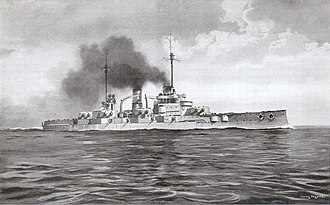
SMS Nassau: Germany’s First Dreadnought Battleship
When HMS Dreadnought entered service in 1906, it changed the nature of naval warfare almost overnight. The British battleship introduced a combination of heavy guns, modern propulsivon, and a design philosophy that made many existing battleships appear obsolete. Germany, already engaged in an increasingly intense naval rivalry with Britain, could not ignore the transformation. The response was the Nassau class, and at its head stood SMS Nassau, the first dreadnought battleship constructed for the Imperial German Navy.
Laid down in July 1907 at the Kaiserliche Werft in Wilhelmshaven, Nassau was a substantial leap forward from Germany’s earlier pre-dreadnought battleships. She was larger, faster, more heavily armed, and designed around a uniform battery of heavy guns. Yet she was also distinctly German in conception. Instead of adopting the steam turbines used by Dreadnought, German designers retained proven triple-expansion engines, while the main battery was distributed among six twin-gun turrets in an unusual hexagonal arrangement. The result was a battleship that looked unconventional but embodied the German emphasis on protection, structural strength, and survivability.
Nassau would go on to serve through the First World War, participate in the Battle of the Gulf of Riga, fight at the Battle of Jutland, and survive the war to become a prize of the victorious Allied powers. Her ultimate fate was less dramatic than that of some famous battleships: she was transferred to Japan in 1920 and soon sold for scrap, being dismantled in the Netherlands. Nevertheless, her historical importance is considerable. She represented Germany’s entry into the dreadnought era and became the foundation for a succession of increasingly sophisticated German battleship designs.
The Birth of the Nassau-Class
A German Response to the Dreadnought Revolution
The origins of Nassau actually predated the appearance of HMS Dreadnought. German naval planners had already been considering larger all-big-gun battleships in the early 1900s, and development work on what became the Nassau design had begun several years before the British ship entered service. The arrival of Dreadnought, however, transformed the strategic context and accelerated the need for Germany to produce a comparable class of modern battleships.
The four ships of the class—Nassau, Westfalen, Rheinland, and Posen—were laid down during 1907–1908 and completed between 1909 and 1910. Nassau herself was laid down on 22 July 1907, launched on 7 March 1908, and commissioned on 1 October 1909. At approximately 146 meters long and nearly 27 meters wide, she was a broad, heavily protected vessel with a design displacement of roughly 18,900 tons and a full-load displacement exceeding 20,000 tons.
The ship’s broad beam was particularly significant. German designers devoted considerable attention to internal protection and underwater defense, producing a hull that sacrificed some of the slenderness associated with certain contemporary British designs in exchange for stability and survivability. This philosophy would become characteristic of German capital ships throughout the dreadnought era. Nassau was not intended merely to carry heavy guns; she was intended to absorb punishment and remain capable of fighting.
An Unusual Main Battery
The most immediately recognizable feature of Nassau was her main armament. She carried twelve 28 cm (11-inch) guns in six twin turrets. Instead of placing the turrets in the familiar centerline arrangement that would become increasingly common, German designers adopted a hexagonal layout. Two turrets were mounted fore and aft on the centerline, while four additional turrets were positioned to either side of the superstructure.
This arrangement provided a formidable broadside, but it came with a limitation: not all twelve main guns could fire directly to one side. Eight guns could be brought to bear in a broadside, while the wing turrets created complications in terms of weight distribution and firing arcs. The design nevertheless reflected the constraints under which German naval architects were working and represented a major improvement over the mixed-caliber batteries of earlier battleships.
The 28 cm guns were supported by twelve 15 cm secondary guns and sixteen 8.8 cm weapons, together with six 45 cm torpedo tubes. In an era when battleships were expected to engage both enemy capital ships and smaller vessels, this layered armament gave Nassau considerable flexibility.
Engineering and Protection
Triple-Expansion Engines Instead of Turbines
One of the most interesting differences between Nassau and HMS Dreadnought was hidden below deck. While the British battleship used steam turbines, Nassau relied on three triple-expansion steam engines driving three propeller shafts. Twelve water-tube boilers supplied steam to the machinery, producing roughly 22,000 metric horsepower and allowing the ship to reach approximately 20 knots.
By the standards of the time, this was respectable performance, but the choice of machinery demonstrated German conservatism. Turbine propulsion offered significant advantages for large warships, particularly in sustained high-speed operation, and Germany would eventually adopt turbines extensively in later battleship classes. The Nassau-class ships therefore occupied an interesting transitional position: they were genuinely dreadnought battleships in their armament and armor philosophy, but retained an older form of propulsion.
The engines nevertheless gave Nassau a useful operational range. At approximately 12 knots, the ship could travel around 8,300 nautical miles, allowing her to operate effectively within the North Sea and participate in longer fleet movements.
Armor as a Core Design Principle
Protection was one of Nassau‘s greatest strengths. Her main belt armor reached approximately 270–300 mm depending on the section and source, while her gun turrets were protected by armor up to roughly 280 mm. The conning tower was extraordinarily well protected, with armor reported at up to 400 mm. Deck protection reached approximately 80 mm in its heaviest areas.
This heavy armor was not simply a matter of making the ship thickly plated. German designers created a comprehensive protective scheme incorporating an armored citadel, internal subdivisions, and underwater protection. The broad hull offered space for extensive internal compartmentation, while the ship’s underwater defenses were designed to reduce the effects of torpedoes and underwater explosions.
The emphasis on survivability would become an important characteristic of German battleship design. Contemporary assessments often contrasted German protection with British approaches that placed greater emphasis on speed and offensive capability. The Nassau-class ships were not perfect, but their robust construction contributed to their ability to survive difficult combat conditions.
Service Before the First World War
Following commissioning in October 1909, Nassau became part of the High Seas Fleet and joined the II Division of the I Battle Squadron alongside her sister ships. The years before 1914 were dominated by training exercises, fleet maneuvers, cruises, and the preparation required to operate a modern battleship force. The German fleet was expanding rapidly, and ships such as Nassau represented the technological foundation of its new battle line.
The ship’s early career was therefore relatively peaceful, but the strategic environment was anything but calm. Britain and Germany were engaged in a naval arms race, and the North Sea had become the potential battlefield for a confrontation between the Royal Navy’s Grand Fleet and Germany’s High Seas Fleet. Every new battleship mattered because the balance of dreadnoughts could influence national strategy, diplomacy, and the willingness of commanders to risk a fleet action.
When war erupted in 1914, Nassau became part of Germany’s principal battle fleet. German strategy generally avoided an immediate full-scale confrontation with the much larger British Grand Fleet. Instead, the High Seas Fleet undertook a series of operations designed to weaken British forces, challenge the British blockade, and create opportunities to engage isolated portions of the enemy fleet.
The Battle of the Gulf of Riga
Fighting in the Baltic
One of Nassau‘s most unusual wartime deployments came in August 1915, when she and other German ships were sent into the Baltic Sea for the Battle of the Gulf of Riga. The operation was intended to force German naval power into the Gulf of Riga, clear Russian naval forces from the area, and support German operations on the Eastern Front.
During the fighting, Nassau and her sister ship Posen engaged the Russian pre-dreadnought Slava. The Russian ship was an older design and therefore significantly outgunned by the German dreadnoughts, but shallow waters, minefields, coastal defenses, and the difficulty of operating large warships in confined waters complicated the German operation. The battle demonstrated that battleship power alone could not eliminate the hazards associated with mines and coastal waters.
Nassau eventually returned to the North Sea, where the main German fleet was preparing for the possibility of a decisive encounter with Britain’s Grand Fleet.
SMS Nassau at the Battle of Jutland
Germany’s Greatest Fleet Engagement
On 31 May and 1 June 1916, Nassau participated in the Battle of Jutland, the largest surface naval battle of the First World War. As a member of the German battle fleet, she formed part of the heavy force that eventually encountered the British Grand Fleet in the North Sea.
Jutland was a confused and extraordinarily violent engagement involving battlecruisers, battleships, cruisers, destroyers, and torpedo attacks. The German fleet inflicted serious losses on the British, but the Royal Navy retained control of the North Sea afterward. The battle therefore failed to deliver the decisive strategic victory Germany had hoped for, although the High Seas Fleet demonstrated that it could fight the British battle fleet effectively.
For Nassau, the battle was a demanding test. She fired her main and secondary batteries and was involved in close-range interactions with British light forces. During the engagement, she collided with the British destroyer HMS Spitfire. The collision caused damage to Nassau, while the destroyer was severely damaged. The battleship also suffered casualties, with 11 men killed and 16 wounded according to commonly cited accounts.
The experience at Jutland illustrated both the strengths and weaknesses of the early German dreadnoughts. Nassau possessed powerful armor and heavy guns, but her relatively modest speed and older propulsion system meant that she was not as fast as some later capital ships. Nevertheless, she remained an effective member of the German battle line.
The Final Years of SMS Nassau
After Jutland, the German High Seas Fleet continued to exist as a major force, but its opportunities for large-scale surface action became increasingly limited. The British blockade remained a fundamental problem, while the German naval command increasingly relied on submarines to attack Allied shipping. Nassau continued to serve with the fleet, but the war’s strategic balance made another engagement on the scale of Jutland increasingly unlikely.
Germany’s defeat in November 1918 brought the battleship’s active career to an end. The surviving German fleet was subjected to strict postwar restrictions. Unlike several newer German battleships that were interned at Scapa Flow, the Nassau-class vessels were considered sufficiently old that they were initially allowed to remain in German waters. The subsequent scuttling of much of the interned German fleet at Scapa Flow nevertheless changed the situation, and Nassau ultimately became one of the German ships surrendered as a replacement for vessels lost by the Allies.
In April 1920, Nassau was ceded to Japan. Japan, however, had little practical need for an aging German dreadnought. The ship was therefore sold to a British shipbreaking company and taken to Dordrecht in the Netherlands, where she was dismantled in 1920. Her sisters met similar fates during the early 1920s, bringing the story of Germany’s first dreadnought class to a quiet conclusion.
The Historical Importance of SMS Nassau
The importance of SMS Nassau lies in what she represented rather than in the number of battles she fought. She was Germany’s first dreadnought battleship and the lead ship of a class that established many of the characteristics that would define German capital ships during the First World War. Her construction demonstrated that Germany was prepared to compete in the new era of heavy-gun battleships, while her service demonstrated how these enormous vessels would be used in the strategic environment of the North Sea and Baltic.
Her design was also a fascinating mixture of innovation and caution. The twelve 28 cm guns made her a true dreadnought, yet their hexagonal arrangement differed markedly from the layouts eventually favored by other navies. Her triple-expansion engines were technologically conservative compared with turbine propulsion, but her protection was extensive and carefully integrated into the hull. The result was a battleship that did not simply copy Dreadnought but instead represented Germany’s own interpretation of what a modern battleship should be.
Nassau also illustrates the extraordinary pace of naval development during the early twentieth century. When she was commissioned in 1909, she was one of the world’s newest and most formidable warships. Within only a few years, however, newer battleships carrying larger guns, improved machinery, better fire control, and more efficient layouts were already entering service. The Nassau class consequently became an important but relatively short-lived stage in the evolution toward the later German battleships of the König, Bayern, and other classes.
Even so, the ship’s legacy endured. The Nassau-class battleships helped establish the German battle fleet as a genuine dreadnought force and contributed to the naval contest that shaped European strategy before and during the First World War. SMS Nassau was therefore not merely Germany’s first dreadnought; she was one of the ships that marked the beginning of a new age in naval warfare.
Technical Specifications of SMS Nassau
| Specification | Details |
|---|---|
| Ship type | Dreadnought battleship |
| Class | Nassau class |
| Builder | Kaiserliche Werft, Wilhelmshaven |
| Laid down | 22 July 1907 |
| Launched | 7 March 1908 |
| Commissioned | 1 October 1909 |
| Length | 146.1 m |
| Beam | 26.9 m |
| Draft | Approximately 8.8–8.9 m |
| Design displacement | Approximately 18,900 tonnes |
| Full-load displacement | Approximately 20,500 tonnes |
| Propulsion | 3 triple-expansion steam engines |
| Boilers | 12 water-tube boilers |
| Propellers | 3 |
| Power | Approximately 22,000 hp / 16,181 kW |
| Maximum speed | Approximately 20 knots |
| Range | Approximately 8,300 nautical miles at 12 knots |
| Main armament | 12 × 28 cm (11 in) SK L/45 guns |
| Main gun turrets | 6 twin turrets |
| Secondary armament | 12 × 15 cm (5.9 in) guns |
| Light armament | 16 × 8.8 cm guns |
| Torpedo armament | 6 × 45 cm torpedo tubes |
| Main belt armor | Up to approximately 270–300 mm |
| Turret armor | Up to approximately 280 mm |
| Deck armor | Up to approximately 80 mm |
| Conning tower armor | Up to approximately 400 mm |
| Crew | Approximately 1,000 personnel |
| World War I service | High Seas Fleet; Gulf of Riga; Battle of Jutland |
| Postwar fate | Ceded to Japan in 1920 |
| Final fate | Sold for scrap and dismantled at Dordrecht, Netherlands, in 1920 |
SMS Nassau occupies a special place in naval history because she stood at the threshold of Germany’s dreadnought era. She combined twelve heavy guns and substantial armor with an unconventional turret arrangement and conservative machinery, creating a battleship that was unmistakably German in character. Her participation in the Gulf of Riga and Jutland gave her a genuine wartime record, while her survival into the postwar period allowed her to become one of the last physical remnants of Germany’s first generation of dreadnoughts. Ultimately, Nassau was scrapped only a little more than a decade after entering service, but her historical significance lasted far longer. She was the ship that announced that the Imperial German Navy had entered the age of the all-big-gun battleship.
