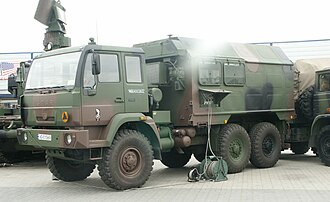
Star 1466: The Last Great Polish 6×6 Truck of the Starachowice Era
The Star 1466 represents one of the final and most fascinating chapters in the long history of Polish truck manufacturing. Developed in Starachowice during the late 1990s as a successor to the legendary Star 266, it was designed primarily for the Polish Armed Forces and combined traditional Polish off-road engineering with modern components supplied by MAN and other European manufacturers. The result was a substantial 6×6 military truck with a 14-ton gross vehicle weight, a six-ton tactical payload and a turbocharged 6.87-litre diesel producing 220 hp. Production lasted from 2001 to 2006, and fewer than 300 examples were built, making the Star 1466 considerably rarer than the Star 266 it was intended to replace.
The model is particularly significant because it appeared during the final transformation of FSC Star from an independent Polish truck manufacturer into part of the MAN Group. The first Star 1466 prototype was presented in 1999, shortly before MAN acquired Star, and the vehicle incorporated major MAN components, including its engine, axles and L2000-derived cab. Consequently, the Star 1466 can be regarded as a bridge between two worlds: its chassis and military purpose came from the Starachowice tradition, while many of its mechanical components reflected the increasingly international nature of the European truck industry.
The Birth of the Star 1466
Searching for a Successor to the Star 266
The Star 266 had been one of Poland’s most successful military trucks. Introduced in the 1970s, its three driven axles, relatively simple construction and excellent off-road ability made it the standard tactical transport vehicle of the Polish Army for decades. By the 1990s, however, the design was approaching the limits of what could reasonably be expected from a truck conceived in the late 1960s.
Starachowice engineers had already attempted to find a successor. The Star 1366, developed toward the end of the 1980s, introduced features such as a tilting cab but remained a prototype. The economic and political transformation of Poland subsequently changed the circumstances in which FSC Star operated. Cooperation with MAN began in 1998, opening access to newer engines, cabins and axles. The Star 1466 emerged from this period of cooperation as a considerably more modern 6×6 platform.
The model designation itself was meaningful. The first two digits referred broadly to its approximately 14-ton permissible gross vehicle weight, while the final two digits indicated its 6×6 configuration. Its tactical payload was six tonnes. This made it heavier and more capable than the Star 266, whose gross vehicle weight was around 11 tonnes, while preserving the basic three-axle military transport concept.
A Modern 6×6 Drivetrain
MAN Power Replaces the Old Star Diesel
One of the biggest differences between the Star 1466 and the Star 266 was under the cab. Instead of the familiar Polish S359 engine, the newer truck used the MAN D0826 LFG15 turbocharged six-cylinder diesel. With a displacement of approximately 6.87 litres, the engine produced 220 hp, or 162 kW, at 2,400 rpm and around 820–825 Nm of torque at 1,500 rpm. This represented a major improvement in performance: the engine delivered about 70 hp more than the 150-hp diesel used in the Star 266, while its torque was almost twice as high.
The increase in torque was especially important for a military all-terrain truck. A vehicle such as the Star 1466 does not need sports-car acceleration; it needs the ability to keep moving when carrying several tonnes over mud, loose ground, steep tracks or damaged roads. The turbocharged MAN engine provided the pulling power necessary for this work while also improving the truck’s road performance.
The engine complied with the Euro 2 emissions standard, reflecting the fact that the vehicle was being developed in a period when European emissions regulations were becoming increasingly important. Even though the Star 1466 was intended primarily for military service, its powertrain was therefore much closer to contemporary European commercial-vehicle technology than the mechanical systems of its predecessor.
The Six-Speed Gearbox and Transfer Case
More Ratios for Road and Off-Road Work
Engine power reached the wheels through a ZF 6S850 six-speed manual transmission with six forward gears and one reverse gear. The gearbox was paired with a Steyr VG750 transfer case incorporating a two-stage off-road reduction system. The normal ratio was 1:1, while the low range reduced the gearing to approximately 1:2. Some documentation identifies the transfer case as a MAN G1000-2 unit, reflecting the variations in component descriptions found in historical technical material.
This arrangement gave the Star 1466 a much wider operating range than the older Star 266. The driver could use the higher gears for normal road travel and select the reduction range when the terrain demanded maximum wheel torque. For a military vehicle expected to move between highways, forest tracks, fields and rough terrain, that flexibility was essential.
The three axles were driven through single-stage axles with a final-drive ratio of approximately 6.33. Differential locks were provided to improve traction when the wheels encountered surfaces with different levels of grip. This mechanical approach remained deliberately straightforward: rather than relying on sophisticated electronic traction systems, the Star 1466 gave the driver physical control over the drivetrain.
A Chassis Designed for Serious Loads
Six Tonnes of Tactical Payload
The Star 1466 had a tactical payload of approximately six tonnes and a permissible gross vehicle weight of about 14 tonnes. This made it roughly one tonne heavier in its basic mass and two tonnes heavier in maximum permitted weight than the Star 266. The additional capacity was important because modern military equipment was becoming heavier, and armies needed trucks capable of transporting larger quantities of supplies and equipment.
The chassis was designed around heavy-duty MAN-derived drive axles rather than simply carrying over the axles of the Star 266. The larger 14.00R20 tires were another visible sign of the new truck’s greater capacity and mobility. They had a larger rim diameter than the tires traditionally used on the Star 266 and contributed to the vehicle’s impressive ground clearance and off-road footprint.
One interesting engineering detail was the arrangement of the drivetrain. The middle axle was a through-drive axle, allowing the transfer case to feed the front and rear sections of the driveline in a way that reduced the number of separate drive shafts. Fewer shafts meant fewer components to maintain and potentially fewer points of mechanical failure. For a military truck expected to operate far from workshops, this was a worthwhile advantage.
The Star 1466 Cab
European Technology Meets Polish Military Design
The Star 1466 could be fitted with several cab configurations. These included a short two-seat day cab, a longer two-seat cab with sleeping accommodation and an extended four-door crew cab capable of carrying approximately four to six people. All versions used a hydraulically tilting arrangement that allowed the cab to be raised forward for easier access to the engine.
The cab came from the MAN L2000 family, making the Star 1466 visually and ergonomically different from the angular cabins associated with classic Star trucks. This was one of the clearest indications that the model belonged to a new generation.
For military operators, the crew-cab configuration was particularly useful. A transport truck might need to carry not only cargo but also a complete working team. The longer cab therefore transformed the Star 1466 from a simple cargo carrier into a flexible platform for command, communications, engineering and other specialist duties.
The use of a tilting cab also improved maintenance. Accessing a large diesel engine from beneath a conventional fixed cab can be difficult, whereas tilting the entire cabin exposes the engine compartment far more effectively. This was increasingly standard practice among European truck manufacturers and represented a considerable ergonomic improvement over older Star designs.
Braking, Electrical Systems and Military Equipment
Built for Military Conditions
The braking system used dual circuits with drum brakes and ABS, while emergency and parking functions operated on the middle and rear wheels. ABS was a significant modernization compared with older Polish military trucks and helped provide better control under braking, particularly on paved surfaces.
The electrical system operated at 24 volts, using waterproof and shielded components adapted for military conditions and driving in darkness. Such details might appear less exciting than engine power or off-road angles, but they were crucial for a vehicle intended to operate reliably in demanding environments.
The Star 1466 was also equipped with a winch capable of approximately 60 kN of pulling force. A winch of this capacity could be invaluable when the truck became immobilized in mud, sand or a steep section of terrain. It could also assist other vehicles, making the truck a useful recovery and logistics platform rather than simply a cargo carrier.
Off-Road Performance
A Truck Built for the Battlefield
The Star 1466 retained the fundamental qualities that had made the Star 266 successful. Its 6×6 drivetrain, low-range transfer case, locking differentials, large tires and substantial ground clearance were designed to keep the truck moving when ordinary road vehicles would have stopped.
The vehicle could ford approximately 1.2 metres of water, while its chassis and drivetrain were designed specifically for off-road operation. Its maximum road speed was approximately 86 km/h, a sensible compromise for a vehicle with a gross weight of around 14 tonnes and a primary role in tactical transport.
The emphasis was clearly on mobility rather than speed. A military truck spends much of its life carrying heavy loads over unpredictable surfaces, where reliability and traction are more valuable than a high top speed. The Star 1466’s engineering therefore followed the same fundamental philosophy as its predecessor while using substantially more modern components.
Specialist Versions
From Cargo Carrier to Weapons Platform
The Star 1466 chassis was designed to accept a wide range of bodies. Cargo boxes, tank bodies, workshops, containers, apparatus bodies and ammunition transport systems could all be installed on the basic platform. A standard cargo body measured approximately 4.44 metres by 2.44 metres and could accommodate up to ten Euro pallets.
The first prototype displayed publicly at the 1999 MSPO exhibition in Kielce was particularly ambitious. It featured an extended crew cab and a BM-21M multiple rocket launcher. Although this configuration did not enter service in that form, it demonstrated the potential of the chassis as a weapons platform.
Other specialist configurations included protected or armored versions. In 2002, a Star 1466 fitted with approximately 450 kg of additional cabin armor was presented. Such experiments reflected the changing requirements of military transport vehicles, which increasingly needed to balance mobility with protection for their crews.
The chassis was therefore not limited to traditional logistics. It could serve as the foundation for communications vehicles, workshops, command platforms, ammunition carriers and other military equipment.
The Star 1466 in Polish Military Service
A Replacement That Arrived Too Late
Despite its capabilities, the Star 1466 never replaced the Star 266 on a large scale. This was partly because the Polish Army already possessed a huge fleet of Star 266s and partly because the country was undergoing a fundamental transformation in defense procurement.
Only 75 Star 1466 vehicles were ultimately delivered to the Polish Armed Forces. The recorded deliveries included two vehicles in 2000, eight in 2003, ten in 2004, five in 2005 and forty in 2006, followed by ten delivered in 2007. This was a tiny fleet compared with the thousands of older Stars already in military service.
This limited procurement is one of the reasons the Star 1466 is so rare today. It was technically capable of becoming the next standard Polish military 6×6, but economic circumstances and changing procurement policies prevented that from happening.
The lighter Star 944 ultimately became more important in replacing the Star 266 for many tactical transport duties, while the Star 1466 occupied a more specialized niche where its greater payload was useful.
International Sales and the Yemen Connection
A Small Truck With a Global Story
Although the Star 1466 was developed largely with Polish military needs in mind, it did find international customers. One of the most notable destinations was Yemen. Historical reporting indicates that approximately 150 Star 1466 trucks were exported there, where they replaced the older Star 266 after production of that model ended.
This is particularly interesting because it demonstrates that the Star 1466’s potential extended beyond Poland. Countries that had previously relied on Star 266s could continue using a familiar Polish 6×6 concept while gaining a more powerful engine and modern drivetrain.
The limited international promotion of the model, however, prevented it from achieving the export success enjoyed by some earlier Star trucks. MAN’s corporate strategy after acquiring Star did not prioritize developing the Star 1466 into a major global military product.
The End of Star Truck Production
The Final Chapter in Starachowice
MAN acquired Star Trucks at the end of 1999, just as the Star 1466 was entering its production career. The change in ownership had profound consequences for the Starachowice factory. The company increasingly integrated its operations into MAN’s broader European manufacturing structure, and truck production was gradually concentrated elsewhere.
In 2006, MAN decided to end truck production in Starachowice. The decision was connected partly with the discontinuation of the relevant cab production and the concentration of truck manufacturing at MAN’s Steyr facility in Austria. The Star 1466 therefore became one of the last Polish-designed trucks to leave the Starachowice assembly lines.
Fewer than 300 examples were reportedly produced. A contemporary industry publication states that the Starachowice factory built less than 300 units, with around 150 exported to Yemen and more than 70 purchased by the Polish military; the remainder largely received specialist bodies.
This makes the Star 1466 not merely a military truck but also an important industrial artifact. Its end effectively marked the closing of the era in which Starachowice designed and manufactured its own family of heavy trucks.
The Star 1466 Today
A Rare Modern Classic
The Star 1466 is considerably rarer than the Star 244 or Star 266, and that rarity has made surviving examples particularly interesting to collectors and off-road enthusiasts. The vehicle offers a unique combination of traditional Star chassis engineering and contemporary European components.
For expedition enthusiasts, the 1466 is an especially attractive platform. A 6×6 chassis with a six-tonne payload, 60-kN winch, large 14.00R20 tires and a powerful turbocharged diesel provides an excellent foundation for a large expedition body. The vehicle is substantial, but that is precisely what makes it capable of carrying substantial equipment, water, fuel and living space.
Its historical importance is equally compelling. A Star 1466 can represent the final stage of the classic Star engineering tradition, the transition to MAN ownership and the changing requirements of the Polish military after the Cold War.
Technical Specifications of the Star 1466
The following figures describe the standard Star 1466 military 6×6 configuration. Specialist bodies, cab arrangements and later modifications could alter dimensions and operating weight.
| Specification | Star 1466 |
|---|---|
| Manufacturer | Star Trucks / MAN Star Trucks & Buses |
| Production | 2001–2006 |
| Assembly | Starachowice, Poland |
| Vehicle class | Medium-duty military all-terrain truck |
| Configuration | 6×6 |
| Predecessor | Star 266 |
| Successor | Star 1444 |
| Engine | MAN D0826 LFG15 |
| Engine type | Turbocharged inline 6-cylinder diesel |
| Displacement | Approximately 6,870 cm³ |
| Emissions standard | Euro 2 |
| Maximum power | 220 hp / 162 kW at 2,400 rpm |
| Maximum torque | Approximately 820–825 Nm at 1,500 rpm |
| Transmission | ZF 6S850, 6-speed manual |
| Transfer case | Steyr VG750, 2-speed reduction |
| Low-range ratio | Approximately 1:2 |
| Drive axles | 3 |
| Axle final-drive ratio | Approximately 6.33 |
| Differential locks | Yes |
| Tires | 14.00R20, single |
| Tactical payload | 6,000 kg |
| Gross vehicle weight | Approximately 14,000 kg |
| Trailer capacity | Approximately 8,500 kg |
| Maximum speed | Approximately 86 km/h |
| Water-fording depth | Approximately 1.2 m |
| Winch | Approximately 60 kN pulling force |
| Length | Approximately 7,400 mm |
| Width | Approximately 2,500 mm |
| Height | Approximately 3,300 mm |
| Wheelbase | Approximately 3,315 + 1,350 mm |
| Electrical system | 24 V |
| Brakes | Dual-circuit drum brakes with ABS |
| Cab options | Day, sleeper and crew cab |
| Crew cab capacity | Approximately 4–6 people |
| Typical bodies | Cargo, tanker, workshop, container, ammunition, specialist |
| Standard cargo body | Approximately 4,440 × 2,440 × 500 mm |
| Production volume | Fewer than 300 reported |
Conclusion
The Star 1466 was a truck caught between eras. Its roots were firmly planted in the Starachowice tradition of building rugged, mechanically straightforward all-terrain vehicles, yet its engine, axles, cab and transmission reflected the growing influence of MAN and the wider European truck industry. It was designed to replace the legendary Star 266, but the economic and political circumstances of the 1990s meant that it never received the large-scale military orders that its capabilities might have justified.
Technically, however, the Star 1466 was a substantial step forward. Its 220-hp MAN diesel produced almost twice the torque of the older Star 266 engine, while the six-speed ZF transmission, two-speed transfer case, locking differentials, large 14.00R20 tires and 60-kN winch gave it the equipment expected of a modern tactical 6×6.
Its rarity today only increases its historical value. Fewer than 300 examples were built, and the vehicle disappeared from production in 2006 when MAN ended truck manufacturing in Starachowice. That decision closed a remarkable chapter that had begun with the first Star trucks in the late 1940s and had produced some of Poland’s most recognizable military and civilian vehicles.
The Star 1466 therefore deserves recognition not simply as the successor to the Star 266, but as the final expression of a uniquely Polish approach to heavy off-road trucks. It combined the toughness demanded by military service with components that belonged to a new European generation of commercial vehicles. In that sense, the Star 1466 was both an ending and a beginning: the last major Polish-designed Star 6×6 and, at the same time, a glimpse of what the Starachowice truck could have become had the industrial circumstances of the early twenty-first century been different.
