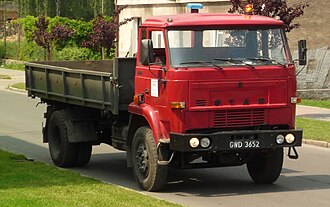
Star 1142: The Polish Truck That Carried the Star Legacy Into a New Era
The Star 1142 occupies a special place in the history of Polish truck manufacturing. Introduced in 1986 as the successor to the long-running Star 200, it was not an entirely new truck in the way a modern manufacturer might understand the term. Instead, it was a deeply redesigned machine that retained some of the familiar architecture of its predecessor while introducing a substantially improved cabin, chassis, braking system, engine and drivetrain. Produced by Fabryka Samochodów Ciężarowych “Star” in Starachowice until 2000, the 1142 became the principal road-going medium-duty truck in the company’s range during the final years of the communist period and the turbulent transformation that followed. More than 15,000 examples were ultimately produced, giving the model an important place in the history of Polish commercial transportation.
At first glance, the Star 1142 can be mistaken for a late Star 200 because the two trucks share a broadly similar visual character. That resemblance, however, hides a remarkable amount of engineering work. The 1142 received the first tilting cab used on a mass-produced Star truck, a modernized six-cylinder diesel, a synchronized five-speed gearbox, stronger axles, improved braking and revised suspension. The payload also increased to approximately 6.35–6.5 tonnes, while the truck could tow a trailer of up to 8.5 tonnes. In many respects, the Star 1142 represented what FSC Star could achieve when it was forced to modernize an established platform rather than replace it completely.
The Origins of the Star 1142
Why the Star 200 Needed a Successor
By the beginning of the 1980s, the Star 200 was becoming increasingly outdated. When it had entered production in the 1970s, it had represented a major step forward for FSC Star, but commercial vehicle technology was moving rapidly. Western European trucks were gaining more comfortable cabins, more efficient engines, improved braking systems and increasingly sophisticated chassis designs. Meanwhile, the economic crisis in Poland made the development of a completely new truck extremely difficult.
FSC Star therefore adopted a pragmatic solution. Rather than abandoning the Star 200 platform and starting from scratch, engineers undertook a deep modernization program. The result was the Star 1142, a truck that looked familiar enough to be manufactured using existing industrial infrastructure but incorporated enough new technology to function as a substantially different vehicle. This approach was typical of the economic realities facing Polish industry during the period: engineering ambition had to be balanced against shortages of investment, materials, components and production equipment.
The development process itself was complicated by difficulties obtaining components. Contemporary accounts describe hundreds of individual parts and semi-finished products that had to be sourced from suppliers, with only a portion of the required deliveries confirmed during the preparation period. Even machinery and tooling were incomplete as production approached. The fact that FSC nevertheless succeeded in launching the 1142 illustrates the importance attached to maintaining domestic truck production at Starachowice.
A New Cabin for a New Generation
The First Tilting Star Cab
One of the most important differences between the Star 1142 and the Star 200 was the driver’s cabin. The 1142 introduced a newly designed tilting cab, the first such arrangement to enter series production on a Star truck. Although its external appearance retained similarities to the previous model, the structure was substantially revised. The number of individual stamped panels and weld points was reduced, anti-corrosion protection was improved and the overall construction became more modular.
The tilting mechanism was particularly important because the engine was mounted beneath the cab. By allowing the entire cab to tilt forward, mechanics gained much better access to the engine and associated components. This was a major practical improvement over older Star trucks, in which engine access could be more awkward. For a commercial vehicle expected to spend years in demanding service, easier maintenance was more than a convenience; it could reduce downtime and simplify repairs.
The cabin also received improved sound insulation, new seats, revised interior trim and better heating and ventilation. The old air intakes above the windshield disappeared, while three windshield wiper arms increased the cleaned area of the panoramic windshield. A redesigned electrical system and improved instrumentation brought the driver’s environment closer to contemporary commercial standards.
The new cabin was also an example of efficient industrial design. Its modular construction allowed versions of the cabin to be produced on the same manufacturing lines for other Star models. This meant that FSC could modernize its product range without requiring an entirely separate production infrastructure.
The S359M Diesel Engine
More Torque From a Familiar Engine
The standard Star 1142 initially used the modernized S359M, a naturally aspirated six-cylinder diesel with a displacement of approximately 6.84 litres. Its power output was around 150 hp, but one of the more significant improvements was the increase in torque compared with the Star 200. The modernized engine produced approximately 467 Nm, giving the truck stronger pulling ability under load.
The S359M retained a conventional mechanical design. Its cast-iron block, forged crankshaft and aluminum pistons reflected the engineering philosophy of the period, emphasizing durability and serviceability. The engine was not intended to be technologically exotic; it was designed to provide dependable power over long working lives.
Several details were specifically altered for the Star 1142. The air compressor mounting was lowered, the exhaust manifold was redesigned and the alternator arrangement was modified. The air filter was positioned centrally behind the cab, with an intake extending above the roof. The exhaust system was also revised to reduce noise. These seemingly small changes were part of the broader effort to make the 1142 a more refined and practical truck than its predecessor.
The Arrival of the Turbocharged T359E
Later in the model’s career, the Star 1142 gained access to a significantly more powerful engine: the turbocharged T359E. This six-cylinder diesel retained the approximate 6.84-litre displacement but increased output to around 170 hp. Contemporary and historical sources identify this engine as an important development for later 1142 versions, including the Star 1142T and tractor configurations.
The turbocharged engine gave the truck noticeably stronger performance and made it more competitive as Polish transport requirements evolved. Torque also increased substantially, with later turbocharged versions reported at approximately 525 Nm. This additional low-speed pulling power was especially useful when carrying the truck’s maximum payload or operating with a trailer.
The transition from naturally aspirated to turbocharged power was more than an increase in horsepower. It reflected the wider transformation of the European truck market, where higher power-to-weight ratios were becoming increasingly important and operators expected better road performance from medium-duty vehicles.
The Synchronized Five-Speed Gearbox
A Major Improvement for Drivers
The Star 1142 used an S5-45 five-speed manual gearbox manufactured by FPS Tczew under license from the German company ZF. Unlike the early transmissions associated with older Star models, this gearbox was synchronized, making gear changes substantially easier and more familiar to drivers accustomed to contemporary trucks.
The transmission represented an important step in the modernization of the truck. Older Star models had developed a reputation for demanding considerable physical effort from the driver, particularly when changing gears. A synchronized gearbox reduced the need for double-declutching techniques and made everyday operation less demanding.
Engineers even tested a ten-speed version of the gearbox equipped with a multiplier during the development process. Although this configuration did not enter production, its evaluation shows that FSC Star was exploring ways to improve the truck’s gearing and road performance. The production five-speed transmission remained a more practical solution for the company’s manufacturing circumstances.
A Stronger Chassis and Axles
More Payload Without Abandoning Simplicity
The Star 1142’s chassis was heavily revised rather than simply carried over from the Star 200. The rear drive axle was redesigned with an increased load capacity of approximately 500 kg while its castings were lightened. The front axle was also redesigned for greater durability and load capacity. These changes were essential because the new truck was expected to carry significantly more cargo than the Star 200.
The standard truck could carry approximately 6.35 tonnes with one tire specification and up to 6.5 tonnes with another. Gross vehicle weight was around 11.5–11.7 tonnes depending on the configuration. The ability to combine this payload with a trailer weighing as much as 8.5 tonnes made the 1142 a useful transport vehicle for both domestic distribution and heavier regional work.
The cargo body itself was redesigned. It used a steel structure with a wooden floor and lighter divided side panels with removable posts. The arrangement allowed operators to adapt the loading area to different types of cargo while reducing unnecessary weight. The standard cargo area measured approximately 5.25 metres long and 2.3 metres wide.
Improved Braking and Suspension
Making a Heavier Truck Safer
Increasing payload capacity also required improvements to the braking system. The Star 1142 introduced a new hydraulic drum-brake control system operating on both axles, with a dual-circuit arrangement assisted by compressed air. The redesign provided more effective control of the heavier vehicle and increased redundancy compared with the earlier system.
The pneumatic system itself was modernized. Instead of the Star 200’s single multi-chamber air reservoir, the 1142 used three separate compressed-air tanks. This arrangement improved the organization of the pneumatic system and supported the truck’s braking and auxiliary functions.
Suspension was also revised. Both axles retained longitudinal semi-elliptical leaf springs, partly because domestic suppliers were initially unable to provide the lighter parabolic springs that engineers would have preferred. Telescopic shock absorbers were installed on the front axle, while the rear axle gained hydraulic dampers and an anti-roll stabilizer. Additional rubber shock-absorbing elements were also modified. Together, these changes improved ride quality and helped control the vehicle under load.
The result was still unmistakably a traditional heavy truck underneath, but one with significantly more sophisticated behavior than the Star 200. The engineers had improved the areas that mattered most without making the vehicle unnecessarily complicated.
The Star 1142 on Polish Roads
A Truck for Transport Companies and Industry
The Star 1142 was primarily a road-going truck, and this shaped its design. Unlike the Star 244 and Star 266, it was not intended to be an extreme off-road machine. Its rear-wheel-drive configuration and relatively long wheelbase made it more appropriate for conventional roads, industrial sites and established freight routes.
Its approximately 3.9-metre wheelbase gave it a stable platform for the cargo body and helped distribute the increased payload. The truck could reach approximately 98 km/h under representative full-load conditions, making it significantly more suitable for road transport than many of the older specialized Star models. Fuel consumption was reported at approximately 15.5 litres per 100 km at 50 km/h and 18.5 litres per 100 km at 70 km/h under specified test conditions.
These figures should be understood as historical test or normative values rather than guaranteed real-world consumption. Actual fuel use depended on payload, road conditions, tire specification, weather and driving style. Nevertheless, they demonstrate the direction in which the Star 1142 was developed: it was a more capable and faster road truck than the models it replaced.
Specialist and Military Versions
More Than a Standard Cargo Truck
Although the Star 1142 was principally a road truck, its chassis provided a useful basis for specialist applications. Various configurations were developed for different organizations, including energy companies and geophysical services. Some received extended crew cabins capable of carrying maintenance personnel and equipment to remote work sites.
The Polish armed forces also purchased the model, although only in relatively small quantities. One documented order in 1999 involved 41 Star 1142 trucks. The modest military numbers reflect the fact that the armed forces already possessed large fleets of Star 266 and other specialized vehicles, but the 1142 could still fill road-transport roles where a heavy 6×6 was unnecessary.
The model also inspired several unrealized derivatives. A four-wheel-drive Star 1144 was developed as a prototype, while a proposed six-wheel-drive Star 1366 was designed in response to Hungarian military interest. The latter incorporated a turbocharged engine and improved payload and off-road characteristics, but neither version entered series production.
These prototypes reveal an interesting aspect of the 1142 platform: engineers regarded it as flexible enough to serve as the foundation for a broader family of trucks, even though economic realities prevented many of those projects from reaching customers.
The Star 1142 During Poland’s Economic Transformation
From the 1980s Into the Market Economy
The Star 1142’s career coincided with one of the most dramatic periods in modern Polish economic history. It entered production in the final years of the communist system and remained in production through the transition to a market economy after 1989.
This created an unusual situation for FSC Star. The company had to modernize its products while facing increasing competition from imported Western trucks. During the 1990s, Polish transport operators could increasingly consider vehicles from manufacturers such as Mercedes-Benz, MAN, Volvo, Scania and other international brands. These competitors often offered more powerful engines, more comfortable cabins and increasingly sophisticated drivetrains.
The Star 1142 nevertheless remained useful because it was familiar, relatively simple and supported by an established domestic service infrastructure. For many operators, especially those working on tight budgets, the truck continued to represent a practical balance between carrying capacity and purchase cost.
Its survival until 2000 therefore says something important about the design. The 1142 was not competitive with every modern European truck in every category, but it remained sufficiently capable to retain customers during a period of extraordinary industrial change.
Production and Legacy
The Final Years of the Classic Star Design
Production of the Star 1142 continued until 2000, by which time the model had been on the market for approximately fourteen years. Historical sources give a total of 15,231 examples produced during its 1986–2000 career.
The truck was eventually succeeded by newer Star models developed in an increasingly internationalized environment. The company’s later products reflected partnerships and technologies that were very different from those available when the 1142 was conceived.
In retrospect, the Star 1142 can therefore be seen as one of the final expressions of the traditional Star engineering philosophy. It still used a domestically produced chassis, familiar mechanical principles and a heavy-duty diesel designed around durability. At the same time, its tilting cab, licensed ZF transmission, improved braking and later turbocharged engine demonstrated that the company was actively trying to modernize.
The result was neither purely old-fashioned nor completely modern. It was a transitional truck in the best possible sense.
The Star 1142 Today
A Forgotten but Important Classic
The Star 1142 is not as immediately famous among enthusiasts as the Star 200, Star 244 or Star 266. Its appearance is relatively restrained, and because many examples spent their lives performing ordinary freight work, fewer have been preserved in highly visible specialist roles.
Yet this makes surviving examples especially interesting. The 1142 represents the everyday side of Polish commercial transport during the late 1980s and 1990s. It was the truck used to move ordinary goods rather than a vehicle associated primarily with military service, firefighting or spectacular off-road work.
Collectors are also attracted to the differences between early and late examples. An early naturally aspirated S359M-powered truck and a later turbocharged 1142T can feel quite different on the road. Cabin details, engines, bodywork and equipment changed during the model’s long career, making the 1142 a rewarding subject for anyone interested in the evolution of Polish trucks.
Its historical importance has also been recognized in Starachowice itself. A Star 1142 is preserved along the city’s “Star Path,” commemorating the heritage of the former FSC factory and the trucks that defined the city’s industrial identity.
Technical Specifications of the Star 1142
The Star 1142 was produced in several configurations and received different engines during its production career. The following table summarizes representative specifications, with the payload and gross-weight figures reflecting documented configurations equipped with 9.00 R20 or 8.25 R20 tires.
| Specification | Star 1142 |
|---|---|
| Manufacturer | FSC Star, Starachowice, Poland |
| Production | 1986–2000 |
| Vehicle class | Medium-duty road truck |
| Predecessor | Star 200 |
| Successor | Later Star 12.155 / modernized Star family |
| Drive configuration | Rear-wheel drive |
| Main engines | S359M, T359E |
| Engine configuration | Inline 6-cylinder diesel |
| Engine displacement | Approximately 6,840 cm³ |
| S359M power | Approximately 150 hp |
| S359M torque | Approximately 467 Nm |
| T359E power | Approximately 170 hp |
| T359E maximum torque | Approximately 525 Nm |
| Transmission | FPS Tczew / ZF S5-45 |
| Transmission type | 5-speed synchronized manual |
| Wheelbase | Approximately 3,900 mm |
| Length | Approximately 7,280 mm |
| Width | Approximately 2,380 mm |
| Height | Approximately 3,300 mm |
| Kerb weight | Approximately 5,150 kg |
| Gross vehicle weight | Approximately 11,500–11,700 kg |
| Payload | Approximately 6,350–6,500 kg |
| Maximum trailer mass | Approximately 8,500 kg |
| Maximum speed | Approximately 98 km/h |
| Fuel consumption at 50 km/h | Approximately 15.5 l/100 km |
| Fuel consumption at 70 km/h | Approximately 18.5 l/100 km |
| Cargo body dimensions | Approximately 5,250 × 2,300 mm |
| Suspension | Longitudinal semi-elliptical leaf springs |
| Brakes | Dual-circuit hydraulic drum brakes with pneumatic assistance |
| Cab | Two-door tilting cab |
| Typical seating | 3 |
| Principal applications | Cargo transport, industry, utilities, military and specialist bodies |
| Production total | Approximately 15,231 vehicles |
Conclusion
The Star 1142 was born out of necessity, but necessity produced a surprisingly sophisticated truck. FSC Star could not simply replace the Star 200 with an entirely new model during the difficult economic conditions of the 1980s, so its engineers transformed the existing concept. They created a new tilting cab, strengthened the axles and chassis, improved the braking and suspension systems, introduced a synchronized ZF-based gearbox and modernized the six-cylinder diesel. Later, turbocharging brought the truck’s performance closer to the expectations of the 1990s.
The Star 1142 therefore deserves to be viewed as much more than a facelifted Star 200. Although the two trucks share a visual family resemblance, the 1142 represented a substantial engineering evolution. Its greater payload, improved driver environment, stronger running gear and better serviceability made it a much more capable road vehicle.
Its story is also inseparable from the history of Poland itself. The truck entered production during the final years of the centrally planned economy, survived the political transformation of 1989 and remained in production while domestic manufacturers faced a completely new competitive environment. Few trucks provide such a clear physical link between two very different periods of Polish industrial history.
Today, the Star 1142 may be overshadowed by the more adventurous Star 244 and Star 266, but its importance should not be underestimated. It was the dependable road-going workhorse of the final Star generation, carrying goods across Poland while its manufacturer struggled to adapt to a rapidly changing world. With its unmistakable cab, six-cylinder diesel and robust mechanical construction, the 1142 remains a fitting symbol of the engineering tradition that made Starachowice one of Poland’s most important truck-producing centers.
