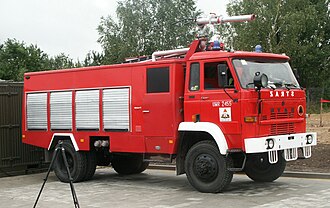
Star 244: The Polish 4×4 Truck That Became an Off-Road Legend
The Star 244 is one of the most distinctive Polish trucks ever produced. Developed as an all-terrain counterpart to the road-going Star 200, it combined the mechanical foundation of a conventional medium-duty truck with a genuine four-wheel-drive system designed for agriculture, forestry, construction, emergency services and difficult terrain. Produced by Fabryka Samochodów Ciężarowych “Star” in Starachowice from 1975 until 2000, the Star 244 survived for an extraordinary 25 years. During that time it became particularly famous as a fire engine, but its working life was far broader: it served farmers, forestry organizations, construction companies, utilities, the military and numerous state institutions.
The Star 244 was not simply a Star 200 with an extra driven axle. Its development required substantial changes to the drivetrain, suspension and chassis so that the truck could operate where ordinary rear-wheel-drive vehicles could not. A two-speed transfer case, front and rear driven axles, differential locking and high ground clearance gave it the ability to cross mud, rough tracks and water obstacles while carrying substantial loads. Its relatively simple mechanical construction also meant that the truck could be maintained in places where sophisticated equipment was unavailable. This combination of practicality and off-road ability explains why the Star 244 developed such a strong reputation in Poland and why surviving examples remain popular with collectors today.
The Origins of the Star 244
From the Star 200 to an All-Terrain Truck
The story of the Star 244 began with the development of the Star 200 family. During the late 1960s, FSC Star engineers were working on a new generation of medium-duty trucks intended to replace older models such as the Star 28 and Star 29. The basic Star 200 was conceived as a road vehicle, but the same platform offered an excellent starting point for a more capable all-terrain machine.
At the turn of the 1960s and 1970s, an experimental Star 244 was developed using Star 200 components. The project was carried out with cooperation from the Military Institute of Armored and Automotive Technology in Sulejówek. The intention was not simply to create another military truck: the vehicle was also expected to meet the needs of agriculture, forestry, construction and energy companies, as well as uniformed services such as the army and fire brigades.
This broad target market was important. Poland needed trucks that could work away from paved roads, but not every customer required the extreme off-road capability of the three-axle Star 266. A two-axle 4×4 offered a useful compromise: it was smaller, lighter and mechanically simpler than a three-axle military truck, while still providing traction that a conventional road truck could not match.
The production Star 244 was presented in 1975 as both a chassis and a dropside cargo truck. An initial trial batch of 50 vehicles was assembled before production developed into a regular model. From the beginning, its specifications showed that this was a serious working vehicle: the S359 six-cylinder diesel produced 150 hp, the truck used a five-speed manual gearbox and a two-speed transfer case, and its nominal payload reached approximately five tonnes.
The S359 Diesel Engine
Six Cylinders for Difficult Work
At the heart of the Star 244 was the S359 diesel engine, a six-cylinder inline power unit with a displacement of approximately 6.84 litres. It produced 150 hp, or about 110 kW, and developed roughly 432 Nm of torque. For a truck of the 1970s, this represented a useful balance between power, simplicity and durability.
The engine was not designed for speed. Its real purpose was to provide dependable pulling power while moving a heavy vehicle through difficult conditions. The Star 244’s maximum road speed was approximately 82 km/h, but its more important characteristics were the torque available at low engine speeds and the ability to combine the engine with low gearing when operating off-road.
Fuel consumption was naturally high by modern standards. Representative figures are around 26 litres per 100 km, although actual consumption could vary significantly depending on the load, terrain, body configuration and driving conditions. In an off-road truck, fuel economy has always been only one part of the equation: the ability to reach the destination can be much more important than the amount of fuel required to do so.
The 4×4 Drivetrain
Two Axles, Four Driven Wheels
The defining feature of the Star 244 was its four-wheel-drive system. Power was transmitted through a five-speed ZF S5-45 manual gearbox and then through a two-speed transfer case. This gave the driver both normal road gearing and a low-range setting for demanding terrain.
The front axle could be engaged when additional traction was needed, while the rear axle was permanently driven in the conventional configuration. A differential lock on the rear axle provided another level of traction when one wheel began to lose grip. These mechanical solutions may look basic compared with modern electronic traction systems, but they were highly effective when combined with suitable tires and a skilled driver.
The low-range gearing was especially important. A truck weighing more than ten tonnes when fully loaded needs substantial wheel torque to climb steep slopes or move through mud. Rather than relying on a very powerful engine, the Star 244 multiplied the available torque through its transmission and transfer case. The driver could therefore move slowly and deliberately through difficult sections while keeping the engine within a useful operating range.
Off-Road Capability
Designed for More Than Dirt Roads
The Star 244 was capable of much more than simply driving on an unpaved road. Its published specifications included the ability to cross water obstacles approximately 1.2 metres deep in standard configuration. It could tackle longitudinal gradients of up to about 45 degrees and transverse slopes of around 26 degrees, figures that demonstrate the seriousness of its off-road design.
Approach and departure angles of approximately 40 and 27 degrees respectively helped the truck negotiate steep changes in terrain without grounding the chassis. Ground clearance was also substantial, with specialist fire-service versions retaining around 230–280 mm of clearance depending on how it was measured.
The suspension used semi-elliptical leaf springs on both axles. This was conventional heavy-truck engineering, but it offered several advantages for a vehicle expected to carry substantial loads and operate away from smooth roads. Leaf springs are comparatively simple, durable and capable of handling large vertical loads. They also suited the repair philosophy of the period because damaged components could be replaced without sophisticated equipment.
The Star 244 as a Fire Engine
The Jelcz 005 Connection
Perhaps the most famous application of the Star 244 was as a fire engine. The extended-wheelbase Star 244L became the foundation for the Jelcz 005 GBA 2.5/16, one of the most recognizable Polish fire appliances of the late communist period. The vehicle combined the Star’s 4×4 chassis with a specialized firefighting body manufactured at the Jelcz automotive works.
The combination made enormous practical sense. Fire brigades, particularly rural units, often had to travel along forest tracks, agricultural roads and poorly maintained surfaces before reaching an emergency. A conventional rear-wheel-drive truck could struggle in mud or snow, whereas the Star 244 could engage four-wheel drive and use its low-range gearing to maintain progress.
The Jelcz 005 carried a crew of six in the documented configuration, together with water and firefighting equipment. One representative vehicle used a 2,500-litre water tank and a 60-litre foam-agent tank, while its pump could deliver approximately 1,600 litres of water per minute.
The first Jelcz 005 vehicles based on the Star 244L were produced in the late 1970s, and the improved 005M continued for many years. The combination became so familiar that many people remember the fire engine primarily as a “Star,” even though the specialized body was manufactured by Jelcz.
The Star 244L
A Longer Chassis for Specialist Bodies
The Star 244L was an extended version developed specifically to accommodate larger specialist bodies. It became particularly important in firefighting applications, but its longer chassis could also support other conversions where additional body length was required.
One preserved Star 244L fire engine demonstrates how dramatically the basic truck could be transformed. A documented example measures approximately 6.85 metres long and 2.66 metres wide, with a crew capacity of six people and a substantial firefighting body. Its own weight is considerably greater than that of a standard cargo truck because of the tanks, pump and specialist equipment.
The Star 244L therefore demonstrates one of the most important characteristics of the entire family: adaptability. FSC supplied the chassis, but different industrial manufacturers and specialist organizations could turn that chassis into a machine designed for a completely different purpose.
Agricultural and Industrial Versions
Beyond the Fire Brigade
Fire engines became the most recognizable Star 244s, but they represented only one part of the model’s working life. Other versions were developed for agriculture and specialist industrial use. The 244RS, for example, was designed specifically for agricultural requirements and incorporated additional solutions intended for operation in dusty and difficult environments.
The Star 244 also appeared in tipper configurations. The 3W244R was a three-way agricultural tipper designed to transport agricultural products, while other variants were used for general construction and industrial work. The ability to combine four-wheel drive with a useful payload made the truck particularly attractive in sectors where heavy materials had to be moved beyond paved roads.
Forestry was another natural application. A truck operating in wooded areas needs more than carrying capacity; it needs traction, clearance and a compact enough footprint to negotiate tracks that ordinary delivery vehicles cannot use. The Star 244’s mechanical layout made it a useful tool for precisely these conditions.
Special Versions and International Interest
The Unusual 244RS
The 244RS deserves special attention because it demonstrates how far engineers could push the basic platform. The vehicle was intended for agricultural work and incorporated sealing and filtration measures that allowed it to operate in very dusty and humid conditions. According to historical descriptions, the special version could negotiate water obstacles as deep as approximately 1.8 metres, considerably beyond the standard vehicle’s capability.
Such variants were produced in much smaller numbers than ordinary Star 244s, making them especially interesting to collectors today. They show that FSC was not merely producing one standardized 4×4 truck but was capable of tailoring the chassis to very specialized operating environments.
The model also attracted attention from specialist body manufacturers. One unusual Rosenbauer firefighting vehicle was built around the Star 244 chassis and displayed at the Poznań International Fair in 1979. The project combined Polish chassis engineering with Austrian specialist firefighting technology and demonstrated the potential of the platform beyond its normal domestic applications.
Driving the Star 244
A Very Mechanical Experience
Driving a Star 244 today is an experience far removed from operating a modern 4×4 truck. The driver sits behind a large steering wheel and controls a conventional manual transmission, while the engine produces a distinctive six-cylinder diesel sound. There are no electronic traction modes to select or computerized systems to compensate for poor driving technique. The driver has to understand the terrain and choose the correct gearing.
This is particularly important off-road. Entering a muddy section in too high a gear can cause the wheels to lose momentum, while using low-range gearing unnecessarily on a firm surface can make progress slower and increase mechanical strain. The Star 244 rewards anticipation and smooth control rather than aggressive driving.
The vehicle’s physical size also requires respect. A loaded Star 244 is a substantial machine, and its brakes, steering and suspension were developed according to standards very different from those of contemporary passenger vehicles. For modern enthusiasts, part of the appeal is precisely this direct mechanical character.
The Star 244 Compared With the Star 266
Two Different Ideas of Off-Road Transport
The Star 244 and Star 266 are often mentioned together because both are associated with Polish all-terrain trucks, but their purposes were different. The Star 244 used two driven axles and was positioned as a versatile medium-duty vehicle for both civilian and specialist applications. The Star 266 used three driven axles and was designed with much more demanding military requirements in mind.
The difference is important. The 244 was often the more practical choice for a fire brigade, farm or construction company that needed 4×4 traction without the size and complexity of a three-axle military truck. The 266, by contrast, prioritized extreme mobility and military logistics.
Together, the two vehicles demonstrate the breadth of FSC Star’s engineering during the period. One basic technological era produced trucks optimized for different environments rather than a single universal vehicle.
Modernization and the End of Production
A Quarter-Century Career
The Star 244 remained in production for an exceptionally long time. Historical sources commonly give 1975–2000 as the production period, although some specialized variants continued in service beyond the period in which the standard model was produced.
The truck received important updates during its career. One of the most visible changes came in 1987, when the vehicle received a modernized tilting cab known as type 678. The update altered the front panel, roof, doors, fenders and dashboard while making engine access easier.
This long production life says much about the Star 244’s usefulness. By the 1990s, the underlying design was clearly old compared with Western trucks, but the vehicle still fulfilled important roles. Its simplicity, familiar service procedures and strong off-road capability gave it a niche that more sophisticated imported vehicles could not immediately eliminate.
The Star 244 Today
From Working Truck to Classic
Today, the Star 244 has become an increasingly desirable historic vehicle. Its most common surviving form is often the fire engine, particularly examples that spent decades with volunteer fire brigades. These vehicles are visually distinctive and often retain their specialist equipment, making them attractive both to collectors and to people interested in the history of emergency services.
A surviving civilian cargo truck or agricultural version can be even more unusual. Such vehicles tend to have lived hard working lives, and many were eventually scrapped when repair costs became greater than their practical value. Consequently, a well-preserved original 244 can be an important piece of Polish industrial history.
The truck’s appeal also comes from its unmistakable appearance. The upright cab, large wheels, exposed mechanical character and substantial chassis immediately communicate its purpose. It looks like a machine designed to work rather than a vehicle designed primarily for comfort.
Technical Specifications of the Star 244
The following figures describe a representative standard Star 244. Specialist versions, particularly the longer 244L fire chassis, differed in dimensions, weight and payload, so the table should be treated as a general technical reference rather than a specification for every vehicle carrying the 244 designation.
| Specification | Star 244 |
|---|---|
| Manufacturer | FSC Star, Starachowice, Poland |
| Production | 1975–2000 |
| Vehicle class | Medium-duty all-terrain truck |
| Basic configuration | 4×4 |
| Related model | Star 200 |
| Successor | Star 744 |
| Engine | S359 / S359.55 diesel |
| Engine configuration | Inline 6-cylinder |
| Displacement | Approximately 6,840 cm³ |
| Maximum power | 150 hp / 110 kW |
| Maximum torque | Approximately 432 Nm |
| Transmission | ZF S5-45, 5-speed manual |
| Transfer case | 2-speed |
| Drive | Four-wheel drive |
| Differential lock | Rear axle |
| Suspension | Semi-elliptical leaf springs |
| Typical payload | Approximately 5,000 kg |
| Representative GVW | Approximately 11,050 kg |
| Maximum speed | Approximately 82 km/h |
| Typical fuel consumption | Approximately 26 l/100 km |
| Standard wheelbase | Approximately 3,400 mm |
| 244L wheelbase | Approximately 3,900 mm |
| Typical standard length | Approximately 5.2 m |
| 244L length | Approximately 6.85–6.93 m |
| Width | Approximately 2.49–2.66 m, depending on version |
| Ground clearance | Approximately 230–280 mm |
| Standard water-fording capability | Approximately 1.2 m |
| Approach angle | Approximately 40° on standard specification |
| Departure angle | Approximately 27° on standard specification |
| Main body styles | Dropside, tipper, chassis, specialist |
| Major specialist version | Star 244L / Jelcz 005 fire engine |
| Main applications | Firefighting, agriculture, forestry, construction, military, utilities |
Conclusion
The Star 244 was one of those rare commercial vehicles whose basic design was simple enough to survive for a quarter of a century while being capable enough to remain genuinely useful throughout that period. Developed from the Star 200 family, it added the essential ingredient of four-wheel drive and turned an ordinary medium-duty truck into a capable all-terrain machine. Its 6.84-litre S359 diesel, two-speed transfer case, mechanical drivetrain and leaf-spring suspension gave it the ability to transport heavy loads through conditions that would have stopped conventional road trucks.
Its greatest legacy, however, may be its role in Polish firefighting. The Star 244L chassis became the foundation for the Jelcz 005, a vehicle that served generations of firefighters and became one of the defining emergency vehicles of rural Poland. The combination of Polish 4×4 engineering and specialist firefighting equipment created a truck that could carry a crew, water and firefighting machinery into locations where road access was far from ideal.
But the Star 244 was never only a fire engine. It worked in agriculture, forestry, construction, utilities and specialist transport, demonstrating the adaptability of the Star platform. Even today, its mechanical simplicity and unmistakable appearance make it a fascinating classic.
The Star 244 represents a particular kind of engineering philosophy: build a strong chassis, provide dependable mechanical traction, make the vehicle adaptable and ensure that it can be repaired in the field. Modern trucks may be faster, quieter, safer and vastly more sophisticated, but few have the same direct relationship between driver, machine and terrain. That is why the Star 244 remains one of Poland’s most memorable working trucks—and why its reputation as a legend of Polish roads and off-road tracks continues long after production has ended.
