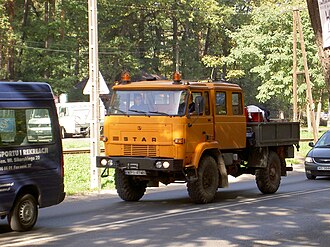
Star 744: The Polish 4×4 Truck That Bridged Two Generations
The Star 744 is a fascinating chapter in the history of Polish truck manufacturing because it arrived at precisely the moment when the country’s automotive industry was entering a completely new economic era. Produced by Fabryka Samochodów Ciężarowych “Star” in Starachowice from 1992 to 2000, the Star 744 was developed as a successor to the successful Star 244 and was also intended to take over some of the duties performed by the larger 6×6 Star 266. It was a medium-duty four-wheel-drive truck designed for military logistics, energy companies, rescue services and other specialist applications where road transport capability had to be combined with genuine off-road mobility. Although its production numbers were relatively small, the Star 744 became an important transitional vehicle, linking the classic Polish Star engineering tradition with the company’s final generation of domestically developed trucks.
The Star 744 was unusual because it was neither a simple modernization of the Star 244 nor a completely clean-sheet design. Its architecture drew upon the experience gained from earlier Star off-road trucks while introducing newer engines, transmissions, cabins and specialist configurations. It could be ordered with different cab arrangements, and its chassis was adaptable enough to carry winches, rescue equipment, communications systems and other specialized bodies. One surviving example operated for Poland’s Maritime Search and Rescue Service, where its 4×4 drivetrain and specialist equipment made it particularly useful in demanding coastal rescue work.
The Origins of the Star 744
A Successor to the Star 244
By the beginning of the 1990s, the Star 244 had already established itself as one of Poland’s best-known medium-duty 4×4 trucks. Its rugged construction made it useful for agriculture, forestry, construction, firefighting and military work, but the design was becoming increasingly old-fashioned. The Polish market was changing rapidly after the political and economic transformation of 1989, and domestic manufacturers were facing competition from increasingly sophisticated Western trucks.
FSC Star therefore needed a vehicle that could preserve the strengths of its established off-road trucks while offering a more modern powertrain and greater versatility. The Star 744 appeared in 1992 as the successor to the Star 244 and was also intended to partially replace the Star 266 in applications where a two-axle 4×4 truck was sufficient. That positioning made the model especially interesting: it occupied the space between a conventional medium-duty truck and the larger military-oriented 6×6 machines that had traditionally dominated difficult-terrain transport.
The new truck retained a front-mounted longitudinal engine and permanent four-wheel drive, but the chassis and powertrain were adapted to newer requirements. The result was a vehicle that could still be maintained using relatively straightforward mechanical methods while offering considerably more flexibility than some of the older Star models.
A Compact but Capable 4×4
Why Four-Wheel Drive Mattered
The defining characteristic of the Star 744 was its 4×4 drivetrain. Both axles were driven, giving the truck substantially more traction than the rear-wheel-drive Star 200 and making it suitable for roads, fields, forest tracks, construction sites and other surfaces where traction could become unpredictable.
Four-wheel drive was especially valuable for the specialist customers targeted by FSC Star. Energy companies, for example, often had to reach remote infrastructure away from paved roads. Forestry operations faced mud, steep tracks and loose surfaces, while rescue organizations could be required to reach locations inaccessible to ordinary road vehicles. The Star 744’s all-wheel-drive configuration allowed one basic truck to address all of these requirements.
The truck also incorporated a reduction gearbox and differential locking, further increasing its ability to operate on difficult ground. Some examples were fitted with an electrically powered winch capable of approximately 45 kN of pulling force. Such equipment could turn the Star 744 from a simple transport vehicle into a self-recovery and specialist work platform.
The relatively compact two-axle configuration was another advantage. Compared with a three-axle Star 266, the 744 was lighter and more maneuverable. It could therefore be a better choice when the operator needed off-road capability without the additional size and mechanical complexity of a 6×6.
The T359E Diesel Engine
A Different Approach to Power
One of the principal engines associated with the Star 744 was the T359E diesel. The engine was a four-cylinder, turbocharged diesel with a displacement of approximately 4.56 litres. It produced about 109 hp, or 80 kW, at 2,400 rpm and approximately 400 Nm of torque at 1,400 rpm. Those figures reveal an interesting characteristic of the truck: although the engine’s horsepower was modest, its turbocharging and substantial low-speed torque were well suited to an off-road vehicle.
For an all-terrain truck, maximum horsepower is only part of the story. When climbing a steep track, moving through mud or pulling away with a heavy load, the availability of torque at low engine speeds can be more important. The T359E’s torque peak at around 1,400 rpm suited precisely this kind of work.
The engine was also relatively compact for a medium-duty 4×4, leaving useful space for specialist bodywork and helping keep the overall vehicle weight under control. The Star 744 could therefore provide respectable payload capacity without becoming as large as the heavier 6×6 trucks in the Star range.
Later Engine Developments
The Star 744’s long production period also means that not every vehicle encountered today has exactly the same specification. Sources identify the T370E as another engine associated with the model, while later examples could receive different powertrain configurations. Some historical technical listings also mention the larger turbocharged six-cylinder T359 family in connection with later or specialized configurations.
This variation is important when examining surviving Star 744s. Unlike a modern vehicle with a tightly standardized specification, a late-production Polish specialist truck could be modified during its working life, particularly when an organization needed to extend the service life of an existing vehicle.
Transmission and Off-Road Mechanics
Five Speeds and a Reduction Gear
The standard Star 744 concept combined its diesel engine with a five-speed manual transmission and a reduction gearbox. This arrangement gave the driver a useful range of ratios for both road and off-road work. The normal gears could be used during ordinary transport, while lower gearing multiplied torque when the truck encountered difficult terrain.
The transmission was manually controlled, keeping the driver directly involved in the operation of the vehicle. This was characteristic of Star trucks of the period. There was no electronic terrain-management system to decide when to engage low range or compensate automatically for wheel slip. The driver had to assess the surface, choose the appropriate gear and use the drivetrain’s mechanical capabilities effectively.
This approach had advantages. The systems were relatively understandable, and a trained mechanic could diagnose many problems without the sophisticated diagnostic equipment required by modern commercial vehicles. For military and specialist operators, that simplicity remained valuable.
Chassis and Suspension
Built Around Rigid Axles
The Star 744 used rigid driven axles suspended on leaf springs, following a traditional Star engineering philosophy. Depending on specification, the suspension could use semi-elliptical or parabolic springs, together with telescopic shock absorbers and anti-roll stabilizers.
This arrangement was well suited to a truck expected to carry significant loads while also operating away from paved roads. Leaf springs are comparatively simple and robust, and rigid axles provide considerable strength in difficult conditions. The design also makes the vehicle relatively straightforward to repair compared with more sophisticated independent suspension systems.
The Star 744 was not intended to provide the refined ride quality of a modern highway truck. Its suspension was designed first and foremost to survive hard use. When loaded and driven over uneven ground, the chassis could absorb substantial punishment while keeping the driven wheels in contact with the terrain.
That mechanical durability was particularly important for specialist customers. A utility company operating in remote terrain or a rescue organization working far from a workshop could not afford a truck that became unusable after every difficult journey.
Different Cab Configurations
A Truck Adapted to Its Operator
One of the most interesting features of the Star 744 was the availability of different cab arrangements. The basic version used a relatively compact two-person cab, while a configuration intended for energy companies incorporated an additional cabin capable of carrying six people. A version developed for the Geophysics organization featured a larger cabin and luggage space.
These arrangements demonstrate how the Star 744 was designed around specific working environments rather than a single standardized transport mission. An ordinary cargo operator did not need a large crew compartment, while an electrical utility company might need to transport an entire maintenance team and its equipment to a remote installation.
The specialist cab configurations also helped distinguish the Star 744 from conventional commercial trucks. The vehicle was effectively a platform on which different organizations could build their own working machines.
The Star 744 in the Energy Industry
Reaching Remote Infrastructure
Energy companies were among the most important intended users of the Star 744. Electricity infrastructure, pipelines, substations and other installations are not always located next to paved roads. Maintenance teams therefore need vehicles capable of carrying people and equipment while traveling across fields, forests and poorly maintained tracks.
The extended crew-cab version was particularly well suited to this task. It allowed a team to travel together rather than requiring a separate personnel vehicle and equipment truck. Combined with four-wheel drive and optional winch equipment, the Star 744 could function as a practical mobile service platform.
This application also explains why a truck with modest engine power could still be valuable. Its purpose was not to cover hundreds of highway kilometers at high speed but to reach a specific location carrying a team and the equipment required to complete a job.
Rescue and Emergency Service
The Maritime Search and Rescue Connection
Perhaps one of the most interesting surviving applications is the Star 744 used by Poland’s Maritime Search and Rescue Service. The organization still documents a specialist Star 744 rescue vehicle, demonstrating that the model found a place in a demanding emergency-service environment.
The vehicle was equipped with a SAILOR COMPACT VHF RT-2048 communications system, a PSP R-1 medical rescue kit, rescue-line launchers, clothing and food supplies for survivors, a generator with floodlights for nighttime operations, signal and illumination rockets and a fuel supply for a rescue boat.
This equipment illustrates how different the Star 744 could look depending on its mission. Underneath the specialist equipment was still the same basic 4×4 truck, but the body transformed it into a dedicated rescue platform. Its off-road drivetrain allowed the vehicle to operate around difficult coastal terrain while its specialist equipment supported the rescue team.
The continued preservation and use of such vehicles also demonstrate that the Star 744’s practical qualities remained relevant long after production ended.
Military Service
A Late Entry Into the Polish Army
Although the Star 744 was designed partly with military requirements in mind, it arrived at a difficult time for Polish defense procurement. The early 1990s were marked by major political and economic changes, and the armed forces were restructuring rather than rapidly expanding their vehicle fleets.
Nevertheless, the Polish Army eventually acquired Star 744s. Historical records indicate that 32 vehicles were delivered in 1999 and another 50 in 2000, the final year of production.
The quantities were small compared with the enormous fleets of Star 266s accumulated during the previous decades, but the purchases are significant because they show that the Star 744 was still considered useful by the military at the end of its production career.
Its 4×4 configuration made it suitable for applications where the full capabilities of a three-axle 6×6 truck were unnecessary. In this sense, it complemented rather than completely replaced the Star 266.
The Star 744 Compared With the Star 244
Evolution Rather Than Revolution
The Star 744’s relationship with the Star 244 is particularly important. The 244 had been one of Poland’s most successful medium-duty 4×4 trucks, and the 744 inherited much of the philosophy that had made its predecessor successful: four-wheel drive, rigid axles, leaf springs, mechanical simplicity and adaptability.
The newer truck, however, reflected the changing automotive environment of the 1990s. It could be equipped with newer powertrains, more varied cabin configurations and specialist equipment. Its design also provided a platform that could be developed further as FSC Star attempted to remain competitive in the post-communist market.
In practical terms, the 744 was intended to offer a more modern solution without abandoning the qualities that customers associated with Star. It was therefore an evolutionary truck, but one arriving at a very important point in Polish industrial history.
Production and the End of the Star 744
A Short but Significant Career
The Star 744 was produced from 1992 until 2000. Compared with the Star 266’s exceptionally long career, this was a relatively short production period, but it coincided with perhaps the most turbulent decade in the history of Polish commercial vehicle manufacturing.
The number of vehicles produced was small. One historical listing gives approximately 302 examples, although surviving documentation and different definitions of production variants can lead to variations in reported totals.
By the end of the 1990s, FSC Star was increasingly moving toward cooperation with foreign manufacturers and more modern truck designs. The Star 944, which appeared around 2000, succeeded the 744 and offered a more powerful engine, updated architecture and greater payload capacity.
The end of Star 744 production therefore represented more than the retirement of one model. It marked the closing stages of an era in which Starachowice had developed its own distinctive family of Polish trucks.
The Star 744 Today
A Rare Polish 4×4 Classic
Today, the Star 744 is much less common than the famous Star 244 and Star 266. Its relatively low production volume and specialist applications mean that surviving examples are often associated with former government organizations, rescue services, utilities or collectors.
This rarity has made the model increasingly interesting to enthusiasts of Polish commercial vehicles. A surviving 744 can represent several different aspects of automotive history at once: the final evolution of the traditional Star 4×4, the transition from the communist-era industrial system to a market economy, and the growing specialization of commercial vehicles in the 1990s.
Some examples have also found new lives after retirement. Specialist bodies can be retained or removed, while expedition enthusiasts may see the 4×4 chassis as an attractive basis for a recreational or overland vehicle. Its relatively simple drivetrain and strong suspension make it well suited to this kind of transformation.
Technical Specifications of the Star 744
Because the Star 744 existed in several configurations and some surviving vehicles have been modified during their service lives, specifications vary. The following table summarizes representative figures for the model, with the T359E/T370E-powered configurations treated separately where appropriate.
| Specification | Star 744 |
|---|---|
| Manufacturer | FSC Star, Starachowice, Poland |
| Production period | 1992–2000 |
| Vehicle class | Medium-duty off-road truck |
| Drive configuration | 4×4 |
| Predecessor | Star 244 |
| Successor | Star 944 |
| Main applications | Military, energy, rescue, specialist transport |
| Engine | T359E / T370E diesel, depending on version |
| T370E configuration | 4-cylinder, turbocharged diesel |
| T370E displacement | 4,560 cm³ |
| T370E power | 109 hp / 80 kW at 2,400 rpm |
| T370E maximum torque | Approximately 400 Nm at 1,400 rpm |
| Transmission | 5-speed manual |
| Drive system | Permanent 4×4 |
| Reduction gearbox | Yes |
| Differential lock | Yes |
| Optional winch | Electrically powered, approximately 45 kN |
| Representative length | 6,690 mm |
| Representative width | 2,350 mm |
| Representative height | 2,790 mm |
| Typical empty weight | Approximately 4,100–5,000 kg |
| Typical payload | Approximately 2,600–3,500 kg |
| Gross vehicle weight | Approximately 7,500–7,600 kg in representative configurations |
| Fuel tank | Approximately 150 litres |
| Maximum speed | Approximately 86 km/h |
| Fuel consumption | Approximately 17 l/100 km at 70 km/h in one documented configuration |
| Suspension | Rigid axles with leaf/parabolic springs |
| Typical crew configurations | 2-person basic cab; specialist multi-person versions |
| Specialist variants | Energy, geophysics, rescue and other body configurations |
Conclusion
The Star 744 occupies a unique position in Polish truck history. It was introduced just as the old industrial order was disappearing and the country’s vehicle manufacturers were being forced to adapt to a radically different market. Rather than abandoning the traditional Star approach, FSC Star attempted to update it with a modernized 4×4 platform that could serve military, industrial and emergency-service customers.
Its combination of four-wheel drive, reduction gearing, rigid axles, leaf-spring suspension and a relatively compact medium-duty chassis gave it the versatility required by organizations operating beyond paved roads. The optional 45-kN winch further expanded its capabilities, while different cab arrangements allowed the same basic truck to transport either a small crew or a larger specialist team.
The Star 744 never achieved the enormous production numbers or legendary military status of the Star 266, nor did it become as widespread as the Star 244. Yet that relative rarity is precisely what makes it interesting today. It was a truck of transition: mechanically rooted in the rugged Polish Star tradition, but developed for a new economic and technological environment.
Its story also shows that a truck does not need enormous production numbers to leave a meaningful legacy. From Polish military service to electricity infrastructure and maritime rescue operations, the Star 744 demonstrated that a well-designed 4×4 platform could be adapted to very different tasks.
For enthusiasts, the Star 744 represents the final generation of the classic Starachowice off-road truck before newer designs and international partnerships transformed the company. Its angular body, mechanical drivetrain and unmistakable 4×4 stance preserve a small but important piece of Polish automotive history. The Star 744 may have had a comparatively short production career, but it remains a compelling example of how Polish engineers attempted to carry decades of proven truck-building experience into the modern era.
