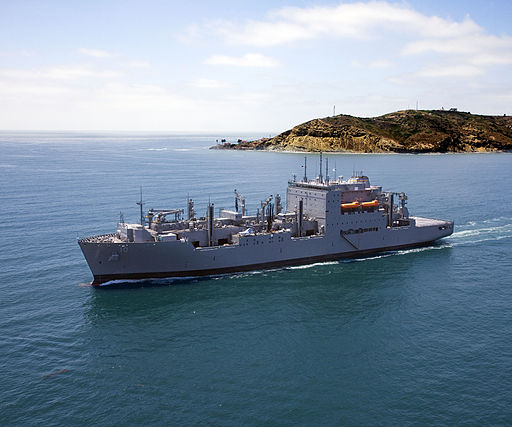
The USNS Charles Drew (T-AKE-10) is a Lewis and Clark-class dry cargo and ammunition ship operated by the United States Navy’s Military Sealift Command (MSC). As part of the Combat Logistics Force, this vessel provides underway replenishment of ammunition, food, spare parts, and other dry and refrigerated cargo to U.S. Navy ships operating at sea. The ship enables continuous naval operations without requiring combatant vessels to return to port for supplies.
Named in honor of Dr. Charles Richard Drew, a pioneering African American physician and medical researcher known for developing large-scale blood storage and transfusion techniques, the USNS Charles Drew exemplifies both technological advancement and a legacy of innovation in service to humanity.
Design and Construction
USNS Charles Drew was constructed by National Steel and Shipbuilding Company (NASSCO), a division of General Dynamics, based in San Diego, California. The ship’s keel was laid down on April 18, 2008, it was launched on February 27, 2009, and delivered to the Military Sealift Command on July 14, 2010.
The Lewis and Clark-class design is based on a commercial container ship hull modified to meet U.S. Navy operational requirements. This approach combines cost-efficiency with proven seakeeping capabilities and long-term maintainability. The ship features advanced automation and energy-efficient propulsion systems, making it one of the most reliable logistics platforms in the U.S. Navy’s auxiliary fleet.
Technical Specifications
-
Class and Type: Lewis and Clark-class dry cargo and ammunition ship
-
Hull Number: T-AKE-10
-
Builder: General Dynamics NASSCO, San Diego, California
-
Operator: Military Sealift Command (MSC)
-
Displacement: Approximately 41,000 tons (full load)
-
Length: 689 feet (210 meters)
-
Beam: 106 feet (32 meters)
-
Draft: 29.9 feet (9.1 meters)
-
Propulsion System:
-
Four MAN B&W 9L48/60 diesel generators
-
Combined power output of approximately 35.7 megawatts (47,900 horsepower)
-
Two electric propulsion motors driving a single shaft
-
Fixed-pitch propeller with a bow thruster for maneuverability
-
-
Speed: 20 knots (maximum sustained)
-
Range: 14,000 nautical miles at 20 knots
-
Complement:
-
Approximately 124 civilian mariners (MSC)
-
Up to 11 active-duty Navy personnel for communications and coordination
-
-
Endurance: 45 days of operational autonomy
Cargo Handling and Replenishment Systems
The USNS Charles Drew was specifically designed to support underway replenishment (UNREP) and vertical replenishment (VERTREP) operations. Its configuration allows the transfer of dry and refrigerated cargo, ammunition, and other supplies while underway, even in challenging sea conditions.
-
Cargo Capacity:
-
6,675 metric tons of dry cargo
-
Approximately 23,500 square feet of cargo storage area
-
1,800 tons of refrigerated and frozen goods storage
-
-
Cargo Types:
-
Ammunition
-
Food provisions
-
Spare parts and consumables
-
Repair materials
-
Limited potable water
-
-
Replenishment Stations:
-
Two replenishment stations on each side (total of four)
-
Dual tensioned highline systems for safe and steady transfer of loads
-
-
Cargo Handling Equipment:
-
Electro-hydraulic cranes
-
Elevators and conveyors for below-deck cargo movement
-
Automated pallet transfer system
-
-
VERTREP Operations:
-
Flight deck capable of supporting MH-60S Seahawk helicopters
-
Certified for day and night operations
-
No hangar facility but full aviation refueling and landing support systems
-
Automation and Technology
Like other vessels in its class, the USNS Charles Drew integrates advanced control and monitoring systems to enhance efficiency and reduce manning requirements.
-
Integrated Platform Management System (IPMS):
Centralized monitoring and control of propulsion, power generation, auxiliary machinery, and damage control systems. -
Cargo Management System:
Uses digital inventory tracking to manage the location, condition, and transfer of thousands of cargo items, ensuring precision during replenishment missions. -
Dynamic Positioning System (DPS):
Enables the ship to maintain precise station-keeping during replenishment using thrusters and automated control, even in high sea states. -
Environmental Systems:
Compliant with MARPOL and U.S. Navy environmental standards, featuring ballast water treatment, waste heat recovery, and emissions control systems to minimize ecological impact.
Accommodation and Crew Facilities
The USNS Charles Drew provides comfortable living conditions for its civilian and Navy crew members, consistent with MSC standards.
-
Private and semi-private berthing compartments
-
Modern galley and dining facilities
-
Recreational lounges and fitness center
-
Satellite communications and internet access
-
Medical and dental treatment spaces
These features are designed to maintain high morale and operational readiness during long deployments in remote maritime environments.
Mission Role
The primary mission of the USNS Charles Drew is to deliver dry and refrigerated cargo, ammunition, and supplies to ships operating in forward-deployed areas. By doing so, it sustains continuous naval operations without the need for combat vessels to enter port for resupply.
In operational contexts, T-AKE-10 serves within the Combat Logistics Force (CLF), working alongside fleet oilers (T-AO class) and fast combat support ships (T-AOE class). Together, they form the logistical backbone of the Navy’s global fleet support architecture.
Secondary missions for the vessel include:
-
Humanitarian assistance and disaster relief (HADR)
-
Joint logistics support for Marine and Army operations
-
Theater resupply for forward-deployed task forces
Operational History
Since entering service in 2010, the USNS Charles Drew has operated extensively across the Pacific Ocean, Indian Ocean, and Middle East, supporting U.S. Seventh Fleet and U.S. Fifth Fleet operations. The ship has participated in numerous multinational exercises, such as RIMPAC and Pacific Partnership, and provided logistical support during both routine patrols and humanitarian missions.
Its operational record highlights the reliability and endurance of the Lewis and Clark-class design, enabling sustained global presence for U.S. naval forces.
Namesake Significance
Dr. Charles Richard Drew (1904–1950) was a pioneering surgeon, educator, and researcher who revolutionized the storage and transfusion of blood plasma. His innovations led to the creation of large-scale blood banks during World War II, saving countless lives. Naming the ship after Dr. Drew honors his contributions to medicine, science, and humanity—reflecting the Navy’s recognition of individuals who have advanced the welfare of mankind.
Strategic Importance
As part of the Lewis and Clark-class logistics fleet, USNS Charles Drew is a critical enabler of sustained naval power projection. Its combination of cargo flexibility, range, and automation allows it to support naval strike groups, amphibious operations, and independent deployments anywhere in the world.
In a modern maritime environment defined by distributed operations and persistent presence, ships like the Charles Drew provide the logistical endurance necessary to maintain forward-deployed forces. They ensure that U.S. Navy ships can remain on station longer, respond faster, and operate farther from home ports.
Summary
The USNS Charles Drew (T-AKE-10) represents a vital component of the U.S. Navy’s global logistics infrastructure. Blending advanced maritime engineering with a legacy of service and innovation, the ship embodies the spirit of resilience and progress symbolized by its namesake. Through its technical sophistication, operational reliability, and humanitarian potential, the Charles Drew continues to ensure that the Navy’s combat and support ships remain mission-ready across the world’s oceans.
