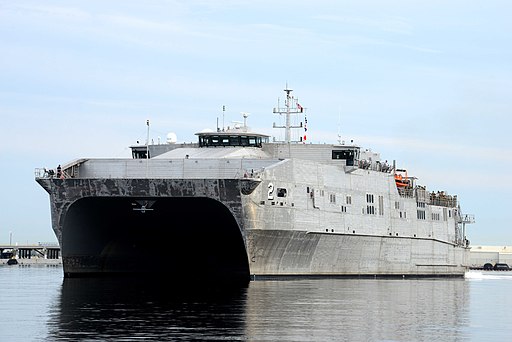
The USNS Choctaw County (JHSV-2/T-EPF-2) is a Spearhead-class expeditionary fast transport (EPF) operated by the United States Navy’s Military Sealift Command (MSC). Designed for high-speed intra-theater transport of troops, military vehicles, and equipment, the Choctaw County provides a flexible and efficient sealift capability for rapid deployment and logistical support.
This vessel represents a key element of the U.S. Navy’s modern expeditionary logistics strategy, bridging the gap between large, deep-draft sealift ships and smaller, shallow-draft coastal vessels. The EPF class combines commercial ferry design with military functionality, allowing it to operate in austere environments and unimproved ports where larger ships cannot.
Named after Choctaw County, which exists in three U.S. states—Alabama, Mississippi, and Oklahoma—the ship honors the contributions of the Choctaw people and their long-standing military service to the United States.
Design and Construction
The USNS Choctaw County was built by Austal USA, located in Mobile, Alabama, under a contract from the U.S. Navy to develop a fleet of expeditionary fast transports. The ship’s keel was laid on November 8, 2011, it was launched on October 1, 2012, and delivered to the Military Sealift Command on June 6, 2013.
The vessel’s design is based on the Austal Auto Express high-speed catamaran, modified for military use. The aluminum-hulled twin-body structure provides exceptional speed, maneuverability, and shallow-water access. This design also allows for a large, open mission deck capable of carrying vehicles, containers, and cargo for diverse missions ranging from combat logistics to humanitarian relief.
Technical Specifications
-
Class and Type: Spearhead-class Expeditionary Fast Transport (EPF)
-
Hull Number: JHSV-2 / T-EPF-2
-
Builder: Austal USA, Mobile, Alabama
-
Operator: Military Sealift Command (MSC)
-
Displacement: Approximately 2,400 tons (light), 2,700 tons (full load)
-
Length: 338 feet (103 meters)
-
Beam: 93.5 feet (28.5 meters)
-
Draft: 12.5 feet (3.8 meters)
-
Hull Type: Aluminum twin-hull catamaran
-
Propulsion System:
-
Four MTU 20V8000 M71L diesel engines
-
Combined output of 36,000 horsepower (26.8 megawatts)
-
Four Wärtsilä waterjets for propulsion and steering
-
-
Speed: 35–40 knots (maximum sustained speed, depending on load)
-
Range: 1,200 nautical miles at 35 knots, up to 5,600 nautical miles at economical speeds
-
Crew Complement:
-
22 civilian mariners (MSC crew)
-
Up to 104 mission personnel (troops, support staff, or embarked units)
-
-
Endurance: 14 days (without resupply)
Cargo and Transport Capabilities
The USNS Choctaw County was designed to support rapid intra-theater logistics, meaning it can quickly move personnel and cargo between ports, islands, and coastal areas. Its internal cargo systems and loading ramps are optimized for rapid roll-on/roll-off operations.
-
Cargo Deck Area: 20,000 square feet (1,858 square meters)
-
Cargo Capacity: 600 short tons of vehicles, containers, or equipment
-
Vehicle Accommodation:
-
Capable of carrying a company-sized armored unit
-
Configurable for trucks, Humvees, light armored vehicles, or engineering equipment
-
-
Ramp System:
-
Stern-mounted vehicle ramp rated for M1A2 Abrams tank loading
-
Adjustable ramp allows access to austere and unimproved port facilities
-
-
Containerized Cargo:
-
Supports standard 20-foot and 40-foot ISO containers
-
Equipped with tie-downs and cargo-handling gear for modular payloads
-
Aviation and Deck Facilities
The ship features a flight deck capable of supporting day and night operations of medium-lift helicopters such as the MH-60 Seahawk or CH-53E Super Stallion. Though it lacks a hangar for long-term aircraft maintenance, it can refuel and rearm helicopters for short-term operations.
-
Flight Deck Size: Suitable for one medium helicopter or two smaller UAVs simultaneously
-
Helicopter Support: Day and night certified
-
Aviation Facilities:
-
JP-5 refueling system
-
Portable firefighting and crash-rescue systems
-
Automation and Technology
The USNS Choctaw County integrates commercial ship automation with military-grade command and control systems. These technologies ensure reliability, operational efficiency, and reduced crew requirements.
-
Integrated Bridge System (IBS):
Combines radar, navigation, and propulsion control into a unified interface for reduced crew workload and improved situational awareness. -
Ship Control and Monitoring System (SCMS):
Manages propulsion, power generation, and auxiliary systems with real-time diagnostics and fault detection. -
Communications Suite:
Equipped with military and commercial satellite communications systems for joint operations, data exchange, and command coordination. -
Defensive Systems (Modular):
While not permanently armed, the ship is fitted for Small Arms Defensive Mounts and can accommodate modular self-defense systems depending on mission requirements.
Mission Roles
The USNS Choctaw County supports a wide range of missions under the U.S. Navy and joint military commands. Its modular design allows rapid reconfiguration to meet different operational needs.
-
Primary Mission: Rapid intra-theater transport of troops, vehicles, and equipment
-
Secondary Missions:
-
Humanitarian assistance and disaster relief (HADR)
-
Medical evacuation and casualty transport
-
Special operations support
-
Maritime security and logistics resupply
-
Partner nation engagement and theater security cooperation
-
The vessel can load and unload in austere locations, making it highly valuable in regions where port infrastructure is limited or damaged—an essential capability for expeditionary operations.
Habitability and Crew Facilities
Despite its utilitarian purpose, the USNS Choctaw County provides comfortable accommodations for its embarked personnel. The ship’s interior is designed with modular living spaces, allowing rapid reconfiguration for different missions.
-
Berthing Capacity: 312 personnel maximum (crew, troops, or support staff combined)
-
Facilities Include:
-
Climate-controlled sleeping quarters
-
Galley and mess facilities
-
Recreation lounges and fitness area
-
Medical treatment spaces
-
Secure communications and operations room
-
Operational History
Since its commissioning in 2013, the USNS Choctaw County has supported operations in multiple regions, including the U.S. Fifth Fleet (Middle East) and U.S. Sixth Fleet (Europe and Africa) areas of responsibility.
The vessel has participated in multinational maritime exercises, humanitarian missions, and joint logistics operations, showcasing its versatility. Notably, it has operated in shallow-draft ports across Africa and the Arabian Gulf, validating its design as a high-speed, adaptable logistics platform.
The Choctaw County also frequently participates in Africa Partnership Station and Southern Partnership Station exercises, promoting interoperability and maritime capacity-building with partner nations.
Namesake Significance
The ship honors Choctaw County, a name shared by counties in Alabama, Mississippi, and Oklahoma, regions historically associated with the Choctaw Nation—one of the first Native American tribes to integrate their language and service into U.S. military communications during wartime. The naming pays tribute to the enduring legacy of the Choctaw people and their contributions to American history and defense.
Strategic Importance
The USNS Choctaw County (JHSV-2/T-EPF-2) is part of a new generation of naval support vessels that emphasize speed, modularity, and adaptability. It bridges the operational gap between sealift and littoral operations, allowing rapid response to crises and flexible deployment across multiple theaters.
The ship’s shallow draft, high speed, and multi-mission capability make it ideal for modern expeditionary warfare, humanitarian operations, and joint-force mobility. In an era defined by agile operations and distributed maritime strategies, the Choctaw County ensures that the U.S. Navy and its partners can move fast, sustain effectively, and operate anywhere.
Summary
The USNS Choctaw County (JHSV-2/T-EPF-2) exemplifies innovation in naval logistics and maritime engineering. With its high-speed catamaran design, large mission deck, and adaptable systems, it represents a cornerstone of the U.S. Navy’s expeditionary fast transport fleet.
