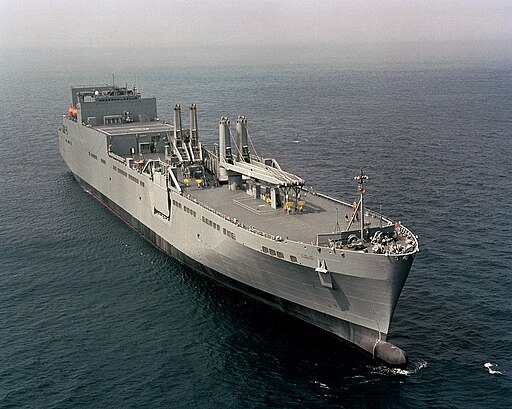
The USNS Charlton (T-AKR-314) is a Bob Hope-class roll-on/roll-off (Ro-Ro) vehicle cargo ship operated by the United States Navy’s Military Sealift Command (MSC). It is one of several large, medium-speed Ro-Ro (LMSR) vessels designed to rapidly transport U.S. Army and Marine Corps vehicles, equipment, and supplies to global theaters of operation. These ships form a critical component of the Strategic Sealift Force, ensuring the rapid deployment and sustainment of U.S. military forces worldwide.
The USNS Charlton plays a vital role in supporting prepositioning and sealift operations, allowing the U.S. Department of Defense to project power globally. As part of the Surge Sealift Fleet, it can be activated on short notice to move heavy combat and support equipment to forward-deployed forces, particularly during major contingencies or humanitarian crises.
Design and Construction
The USNS Charlton was built by Avondale Industries in New Orleans, Louisiana, under contract with the U.S. Department of Defense’s Maritime Administration (MARAD). The ship’s keel was laid on June 3, 1996, and it was launched on December 20, 1997. The vessel was delivered to the Military Sealift Command and entered service in 1999.
The Bob Hope-class design incorporates commercial Ro-Ro ship technology combined with specialized military cargo-handling systems. Its primary design objective is to enable the rapid loading and unloading of wheeled and tracked vehicles directly onto port facilities or floating causeways. The ship’s interior decks and ramps are configured for heavy military vehicles, including main battle tanks, armored personnel carriers, and trucks.
Technical Specifications
-
Class and Type: Bob Hope-class roll-on/roll-off vehicle cargo ship
-
Hull Number: T-AKR-314
-
Builder: Avondale Industries, New Orleans, Louisiana
-
Operator: Military Sealift Command (MSC)
-
Displacement: Approximately 62,000 tons (full load)
-
Length: 951 feet (290 meters)
-
Beam: 106 feet (32.3 meters)
-
Draft: 34 feet (10.4 meters)
-
Propulsion System:
-
Two General Electric LM2500 gas turbines
-
Combined power output of approximately 64,000 shaft horsepower
-
Twin shafts with controllable-pitch propellers
-
-
Speed: 24 knots (maximum sustained)
-
Range: 13,800 nautical miles at 20 knots
-
Crew Complement:
-
Approximately 30 to 50 civilian mariners (MSC crew) when in reduced operating status
-
Up to 100 personnel when fully activated for operations
-
-
Cargo Capacity:
-
380,000 square feet (35,300 square meters) of cargo space
-
Equivalent to approximately 58 M1A1 Abrams tanks, 48 Bradley fighting vehicles, or hundreds of tactical trucks and support vehicles
-
-
Endurance: 45 days at sea without replenishment
Cargo Handling Systems
The cargo-handling system of the USNS Charlton is designed for efficiency, flexibility, and speed. Its Ro-Ro configuration allows for both roll-on/roll-off loading of wheeled vehicles and lift-on/lift-off (Lo-Lo) operations for containerized or heavy cargo.
-
Cargo Decks:
-
Multiple internal decks interconnected by ramps
-
Adjustable deck heights for vehicle clearance
-
Heavy-duty flooring to support tracked and armored vehicles
-
-
Ramps and Doors:
-
Stern ramp for direct pier access
-
Side ramp for flexibility in loading at various port configurations
-
Internal ramps between decks for rapid movement of cargo
-
-
Cranes:
-
Two electro-hydraulic cranes with a lifting capacity of 110 tons each
-
Capable of handling heavy containers or outsized cargo when port infrastructure is limited
-
-
Cargo Elevators:
-
Heavy-lift elevators connecting decks to facilitate internal cargo movement
-
Automated and manually controlled systems for efficient vehicle stowage
-
Automation and Technology
The USNS Charlton incorporates advanced automation and ship-control systems to minimize crew requirements and maximize reliability.
-
Integrated Bridge System (IBS):
Provides centralized control of navigation, propulsion, and steering systems. -
Ship Automation System:
Monitors propulsion, power generation, fuel management, and auxiliary systems in real time. -
Cargo Management System:
Tracks and monitors all loaded vehicles and equipment to ensure optimal stowage and balance. -
Dynamic Positioning System (DPS):
Assists in maintaining position during complex loading and unloading operations, especially in austere port conditions. -
Environmental Control Systems:
Includes ballast water management, emissions control, and waste processing systems compliant with international maritime standards (MARPOL).
Mission Profile
The primary mission of the USNS Charlton is to transport combat equipment and sustainment cargo for the U.S. Army and Marine Corps. It serves as a key element of the Maritime Prepositioning Force (MPF) and the Surge Sealift Fleet.
When activated, the vessel can move large quantities of vehicles and equipment to forward operating bases, ports, or joint logistics hubs. It is designed for operations both in major seaports and in austere environments where port infrastructure may be damaged or unavailable.
The ship supports a variety of missions, including:
-
Rapid strategic deployment of Army and Marine Corps units
-
Sustainment resupply for forward-deployed forces
-
Humanitarian assistance and disaster relief (HADR)
-
Support for joint and multinational military exercises
-
Emergency evacuation and relief operations
Accommodation and Crew Facilities
The USNS Charlton features modern accommodation facilities for both its civilian and active-duty personnel.
-
Private or semi-private staterooms
-
Galley and dining areas
-
Recreational lounges and fitness facilities
-
Medical treatment and office spaces
-
Secure communications and operations centers
These facilities are designed to maintain crew readiness and comfort during long-duration missions and standby periods.
Operational Status and Service History
Since its delivery in 1999, the USNS Charlton (T-AKR-314) has served primarily within the Surge Sealift Force, under the management of the Military Sealift Command. The ship is maintained in Reduced Operating Status (ROS-5), meaning it can be fully activated and ready to deploy within five days when required.
The vessel has participated in multiple logistics and sealift missions, including deployments in support of Operation Enduring Freedom and Operation Iraqi Freedom, where it transported essential vehicles and equipment to the Persian Gulf region.
It has also been involved in humanitarian operations, providing rapid response capabilities for disaster relief missions worldwide.
Namesake Significance
The ship is named in honor of Specialist Fourth Class Raymond Murphy Charlton Jr., a United States Army soldier who was posthumously awarded the Medal of Honor for his heroic actions during the Vietnam War. On May 8, 1968, Charlton sacrificed his life to save his fellow soldiers, demonstrating extraordinary courage under fire. The vessel’s name serves as a lasting tribute to his bravery and dedication to duty.
Strategic Importance
The USNS Charlton is a cornerstone of the U.S. Navy’s sealift capability and represents a crucial element of the nation’s ability to rapidly deploy military power anywhere in the world. Together with its sister ships in the Bob Hope class, it provides the capacity to deliver the heavy vehicles and equipment required for sustained combat and humanitarian operations.
By combining high-speed transoceanic capability with massive cargo volume, the ship ensures the logistical agility and strategic reach necessary for modern expeditionary warfare. It allows the United States to project force, deliver aid, and maintain readiness across multiple theaters simultaneously.
Summary
The USNS Charlton (T-AKR-314) exemplifies the engineering excellence and strategic foresight that define the Bob Hope-class roll-on/roll-off cargo ships. With its enormous cargo capacity, rapid deployment capability, and advanced automation systems, the ship remains a key enabler of U.S. military logistics operations.
.jpg)