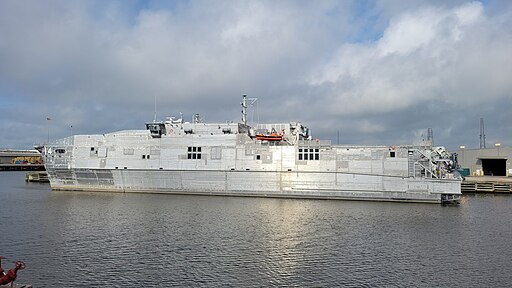
The USNS Cody (T-EPF-14) represents a significant evolution in the U.S. Navy’s Expeditionary Fast Transport (EPF) program, introducing a new Flight II configuration tailored for enhanced medical and operational support. As the fourteenth ship in the EPF series and the lead ship of its subclass, Cody brings advanced design improvements, expanded mission capabilities, and modernized systems that enhance its utility in both military and humanitarian operations.
Overview and Background
The USNS Cody was built by Austal USA at its Mobile, Alabama shipyard, a facility known for its production of aluminum-hulled naval vessels. Named after Cody, Wyoming, the ship honors the city’s contributions to the U.S. armed forces. The vessel follows in the wake of earlier EPFs, but it marks a transition toward a more versatile role — blending the high-speed transport functionality of the original Spearhead-class with enhanced medical, command, and logistics capabilities.
The Cody was launched in March 2023 and delivered to the Military Sealift Command (MSC) for non-combatant service operations. As a civilian-crewed auxiliary ship, it supports joint operations, rapid deployment of troops and equipment, and humanitarian missions, particularly in austere or damaged port environments.
Design and Hull Configuration
The USNS Cody maintains the core catamaran hull design that defines the EPF class, allowing for superior stability, shallow draft operation, and high-speed transit. The hull is constructed entirely from marine-grade aluminum alloy, reducing overall weight while maintaining structural integrity in rough sea conditions.
-
Length Overall: 103 meters (338 feet)
-
Beam: 28.5 meters (93.5 feet)
-
Draft: 3.83 meters (12.6 feet)
-
Displacement: Approximately 2,400 metric tons (light), 2,700+ tons full load
The catamaran structure provides excellent maneuverability, enabling the vessel to operate in shallow littoral waters and access small ports or beaches without the need for major port facilities — a crucial advantage for rapid-response operations and disaster relief missions.
Propulsion and Performance
USNS Cody is powered by a diesel-powered waterjet propulsion system, offering high thrust, exceptional maneuverability, and low vibration levels — a vital feature for a ship with medical treatment functions.
-
Propulsion System: 4 × MTU 20V 8000 M71L diesel engines
-
Power Output: Approx. 9,100 kW (12,200 hp) per engine
-
Propulsion Type: 4 steerable waterjets (Rolls-Royce or Wärtsilä)
-
Maximum Speed: 35–45 knots (depending on load)
-
Cruising Range: ~1,200 nautical miles at 35 knots or 5,600 nautical miles at 12 knots
-
Fuel Capacity: 600 cubic meters (approx. 158,000 gallons)
This propulsion system allows for rapid point-to-point transport of personnel and cargo, ensuring that the vessel can sustain high-tempo logistical operations or respond quickly to emergencies across wide operational theaters.
Flight II Enhancements
Unlike its predecessors in the Flight I series, the Cody and subsequent Flight II EPFs are designed with expanded medical and command capabilities, making them hybrid assets suitable for humanitarian assistance, disaster response, and casualty evacuation.
Key Flight II modifications include:
-
Enhanced Medical Facilities:
-
Two operating rooms
-
20-bed hospital ward
-
Radiological suite
-
Laboratory and pharmacy
-
Patient receiving area with triage capability
-
-
Command and Control Spaces:
-
Dedicated mission planning and coordination rooms
-
Enhanced communications and data-sharing networks
-
Secure SATCOM systems for coordination with joint forces
-
-
Improved Berthing and Habitability:
-
Accommodation for 150 passengers (troops, evacuees, or medical staff)
-
Expanded galley and medical staff quarters
-
Modifiable cargo bay for medical or logistics support
-
These improvements transform the EPF from a pure transport vessel into a multi-mission platform, capable of acting as a forward medical staging unit, temporary hospital ship, or disaster relief hub.
Cargo and Vehicle Handling Capabilities
Like earlier EPFs, USNS Cody features a large mission bay and a stern ramp capable of launching vehicles and cargo directly onto roll-on/roll-off (Ro-Ro) docks or unimproved shorelines.
-
Mission Deck Area: ~1,900 square meters (20,000 sq. ft.)
-
Cargo Capacity: 600 short tons of vehicles, containers, and supplies
-
Ramp Capacity: Up to M1A2 Abrams main battle tank weight (~70 tons)
-
Flight Deck: Supports CH-53E, MH-60, and V-22 Osprey operations
-
Cargo Handling: 20- and 40-foot container handling capability
The flight deck’s expanded aviation support facilities make it possible to conduct aeromedical evacuations, aerial resupply missions, and vertical replenishment operations.
Navigation and Communication Systems
The vessel’s bridge and navigation systems integrate state-of-the-art technologies for global deployment and autonomous navigation support:
-
Navigation Suite: Integrated bridge system (IBS) with ECDIS
-
Radar: X-band and S-band navigation radar arrays
-
Communication: Military and commercial SATCOM, HF/VHF/UHF radios
-
Automated Control: Dynamic positioning and autopilot systems
-
Sensors: Weather and sea-state monitoring sensors for coastal operations
These systems enhance the ship’s ability to operate independently in remote or underdeveloped areas, ensuring continuous communication with fleet and joint force command elements.
Crew and Operations
Operated by the Military Sealift Command, the Cody’s complement consists primarily of civilian mariners with military personnel embarked as mission-specific specialists.
-
Core Crew: ~26 civilian mariners
-
Mission Crew Capacity: Up to 100+ personnel (medical staff, troops, relief teams)
-
Operational Endurance: Up to 14 days at sea without replenishment
This flexible crew structure allows the ship to support diverse missions — from high-speed logistics support to mobile hospital operations and maritime security assistance.
Mission Profile and Strategic Role
The USNS Cody (T-EPF-14) plays a pivotal role in distributed maritime operations, expeditionary logistics, and humanitarian response missions. Its hybrid role allows it to bridge the operational gap between combat logistics ships and large hospital ships like the USNS Mercy (T-AH-19).
Potential mission sets include:
-
Rapid intra-theater transport of troops and supplies
-
Medical evacuation and treatment during humanitarian crises
-
Forward-deployed casualty care platform
-
Disaster relief and logistics resupply
-
Command and control support in remote regions
Cody’s flexibility supports the U.S. Navy’s emphasis on agile, distributed operations, ensuring rapid response across both combat and peacetime scenarios.
Technical Summary
| Specification | USNS Cody (T-EPF-14) |
|---|---|
| Class & Type | Expeditionary Fast Transport (Flight II) |
| Builder | Austal USA, Mobile, Alabama |
| Hull Type | Aluminum Catamaran |
| Length | 103 m (338 ft) |
| Beam | 28.5 m (93.5 ft) |
| Draft | 3.83 m (12.6 ft) |
| Displacement | ~2,700 tons (full load) |
| Propulsion | 4 × MTU 20V 8000 M71L diesel engines |
| Propulsors | 4 steerable waterjets |
| Max Speed | 35–45 knots |
| Range | 1,200–5,600 nm (speed-dependent) |
| Crew | 26 civilian mariners + mission personnel |
| Medical Facilities | 2 ORs, 20 beds, triage, lab, radiology |
| Flight Deck | Supports CH-53, MH-60, and V-22 aircraft |
| Cargo Capacity | 600 short tons |
| Ramp Load Limit | 70 tons |
Conclusion
The USNS Cody (T-EPF-14) marks a turning point in the evolution of the EPF fleet, blending the speed and agility of a high-performance transport ship with the humanitarian and medical capabilities of a hospital vessel. Its Flight II configuration demonstrates how modern naval auxiliaries are adapting to multi-domain operational demands — capable of delivering aid, command support, and medical care wherever global events require rapid response.
.jpg)