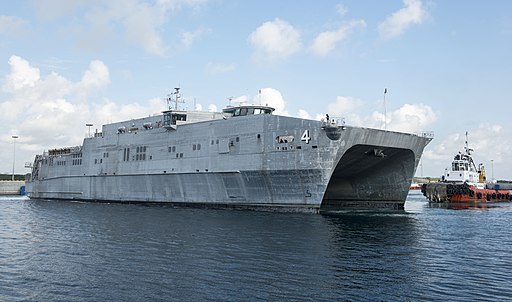
The USNS Fall River (JHSV-4 / T-EPF-4) was the fourth vessel in the U.S. Navy’s Spearhead-class of Expeditionary Fast Transports (EPF). Operated by the U.S. Military Sealift Command (MSC), it was designed for rapid intra-theater transport of personnel, vehicles, and equipment. Built by Austal USA in Mobile, Alabama, Fall River entered service in 2014 and was removed from the Naval Register in mid-2025.
Named after the city of Fall River, Massachusetts, the vessel sought to provide the U.S. Navy, Marine Corps, and Army with a fast, flexible transport asset — bridging the gap between high-speed airlift and conventional heavy sealift.
Design and Hull Architecture
Spearhead-class ships like Fall River are based on a catamaran hull form, featuring twin aluminum hulls supporting a broad, shallow-draft structure.
- Length overall: 103.0 meters (approximately 338 ft)
- Beam: 28.5 meters (about 93.5 ft)
- Draft: Approximately 3.83–3.92 meters (12.5–13 ft), giving a shallow-draft form suitable for littoral waters and minor ports.
- Displacement / Full-load tonnage: ~2,460 metric tons when fully loaded.
The catamaran design offers reduced hydrodynamic resistance compared to a conventional monohull, enabling higher speeds with less power. This hull form also gives a wide deck area and improved stability (within certain sea-state limits), but it comes with trade-offs, particularly in rough seas or open-ocean conditions — a limitation recognized in the vessel’s operational doctrine.
Propulsion, Performance, and Motion-Control Systems
The propulsion system of Fall River is robust and optimized for speed and efficiency — central to the EPF concept.
- The ship is powered by four MTU 20V8000 M71L diesel engines. Each engine feeds through ZF 60000NR2H reduction gears to drive four Wärtsilä WLD 1400 SR water-jets.
- This configuration enables a maximum speed of about 43 knots (under favorable conditions, without heavy payload).
- The official operational speed range is often cited as 35–40 knots for loaded transit.
- The vessel’s unrefueled range is approximately 1,200 nautical miles at cruising speed, making it suitable for rapid transport between theaters or coastal regions.
Additionally, the EPF design incorporates an active motion control system with control surfaces to improve seakeeping and ride quality — a feature particularly important given the high speeds and catamaran hull form.
Capacity, Cargo Deck & Mission Bay
One of the defining attributes of Fall River and its sister ships is flexibility. The main deck is a large, unobstructed mission bay, with a usable cargo area of over 20,000 ft² — roughly 1,860 m², with a clear height of about 4.75 meters and a turning diameter inside the bay of approximately 26.2 meters.
This bay can be configured in multiple ways depending on mission needs:
- Transport of vehicles, equipment, and supplies: The EPF’s stern ramp supports roll-on / roll-off (RO/RO) operations, facilitating fast loading and unloading of wheeled or tracked vehicles directly onto austere piers. It is capable of accommodating heavy military vehicles — even M1A2 Abrams main battle tanks.
- Troop transport: The vessel offers airline-style seating for up to 312 embarked forces, useful for rapid deployment or redeployment of infantry companies.
- Alternatively, the space can be used for equipment, humanitarian aid, disaster relief cargo, or general logistics support, including supply, sustainment, or disaster-response missions in small or damaged ports.
In effect, Fall River was designed to be a “jack-of-all-trades” transport — bridging between high-speed air delivery and slower, heavy sealift, while maintaining access to ports that larger amphibious or cargo ships cannot reach.
Aviation & Boat Operations
While Fall River was not an aircraft carrier or a full-scale amphibious assault ship, it retained modest aviation and boat-insertion capabilities that increased its operational flexibility.
- It has a flight deck certified to Navair Level 1, Class 2 standards — able to support a single medium or heavy helicopter, such as the CH-53E Super Stallion.
- The design also includes a helicopter parking / parking-and-storage area, capable of accommodating smaller naval helicopters (e.g., MH-60 Seahawk) for missions such as personnel transfer or vertical replenishment.
- For small-boat operations (e.g., fast-roping, rigid-hulled inflatable boats, or maritime security insertions), the open mission bay and wide deck allow flexible deployment of RHIBs (rigid-hull inflatable boats).
These capabilities make Fall River useful not only for logistics and transport, but also as a support platform for littoral operations, humanitarian assistance, and disaster relief — where helicopter vertical lift or small-boat insertion might be needed.
Crew, Accommodation, and Embarked Forces
As a non-combatant auxiliary vessel operated by MSC, Fall River was crewed by civilian mariners rather than a traditional Navy crew. According to the builder fact sheet, the EPF class is designed for a core crew of about 26 civilian mariners.
Accommodation and embarked force capacity:
- Airline-style seating for up to 312 embarked troops — typically ground forces being transported.
- Fixed berthing (long-term sleeping quarters) for a smaller number, plus temporary berths — giving flexibility for mixed missions (troop transport, equipment transfer, humanitarian aid).
In standard operational configurations, the number of committed crew aboard was often fewer than the maximum accommodation capacity — reflecting the auxiliary, non-combatant nature of the vessel.
Armament and Defensive Posture
As an EPF, Fall River was not intended for frontline combat. Accordingly, its armament was minimal: typically four mounts for M2 .50 caliber machine guns (generally two forward and two aft) for basic self-defense.
The EPF’s doctrine calls for operation in permissive environments or under the protection of other combatant assets. It lacks a well deck for amphibious vehicles, has no heavy weapons systems, no surface-to-air missiles, and limited survivability features — underscoring that it is primarily a logistics and transport platform, not a combat ship.
Intended Mission Profile and Operational Role
The overarching purpose of the EPF program — and by extension Fall River — is to provide the U.S. Navy and other branches with high-speed, shallow-draft sealift that can reach austere or degraded ports, littoral zones, or undeveloped coastal infrastructure. This enables:
- Rapid intra-theater transport of personnel, vehicles, and equipment — especially useful for brigade-level deployments, quick repositioning, or surge operations.
- Flexible logistics support — including supply, sustainment, or replenishment in littoral regions where larger ships cannot dock.
- Humanitarian assistance / disaster relief (HA/DR) operations — thanks to the large cargo bay, ability to operate in shallow or damaged ports, and helicopter / small craft support for aid delivery.
- Theatre security cooperation and presence missions — EPFs like Fall River have been deployed forward to support fleet logistics and cooperation with allied and partner navies, demonstrating flexibility and speed.
Given these traits, Fall River and her sister ships filled a critical niche between slower, heavy lift sealift ships and rapid but limited-capacity airlift.
Construction, Commissioning, and Service History
- The contract for what would become Fall River was awarded to Austal USA in October 2010.
- The keel was laid on 20 May 2013.
- The ship was christened on 11 January 2014, and launched on 16 January 2014.
- After successful acceptance and final contract trials, Fall River was delivered to Military Sealift Command and placed into service on 15 September 2014.
During its service life, Fall River deployed in various capacities. For example, in early 2018, she underwent a 28-day “voyage repair availability” in Laem Chabang, Thailand — part of maintenance to sustain readiness while forward-deployed in the U.S. 7th Fleet area of responsibility.
However, not all operations went smoothly. A pre-deployment inspection in March 2018 identified the need for additional maintenance, leading to Fall River being withdrawn from a planned deployment for the humanitarian-focused Pacific Partnership mission and replaced by a sister ship.
Eventually, after roughly a decade of service, Fall River was placed in reduced operating status (ROS-45) — meaning it could be reactivated within 45 days if needed. On 9 June 2025, the ship was formally deactivated and stricken from the Naval Register. (Navysite)
Strengths and Limitations of the EPF Concept (as realized in Fall River)
Strengths
- High speed and rapid transit: With a top speed up to 43 knots and a range of 1,200 nautical miles, Fall River could reposition forces and equipment much faster than conventional sealift.
- Shallow-draft design: Its draft under 4 meters allowed access to ports and littoral areas that are off-limits to deeper-draft warships or logistics vessels.
- Flexible cargo / troop capacity: The large, open mission bay could accommodate vehicles (including heavy armor), supplies, or hundreds of troops, depending on mission needs.
- Ease of loading/unloading: The stern ramp and RO/RO capability accelerated offloading — especially crucial when time or port infrastructure was limited.
- Modularity and adaptability: The EPF’s design allowed quick reconfiguration, and the vessel could serve in logistics, troop transport, humanitarian assistance, or support roles.
- Lower operating cost: With diesel engines, waterjets, and civilian mariners under MSC, the EPF was more cost-effective per ton-mile than some alternatives.
Limitations
- Limited seakeeping in rough waters: The catamaran hull and high-speed design mean that EPFs are best suited to calm seas or littoral environments. Larger waves or higher sea states degrade stability, speed, and safety.
- Minimal defensive capabilities: The small number of .50 cal machine guns provides only basic self-defense; the ship lacks any substantial armor, air-defense, or anti-ship weaponry. It is not intended for contested combat operations.
- No well deck or amphibious splash capability: Without a well deck, the EPF cannot launch traditional amphibious landing craft or deploy vehicles directly into the water. This limits its use in amphibious assaults.
- Structural and seakeeping constraints: The aluminum hull, while lightweight, may be more vulnerable to structural stress, especially when subjected to repeated heavy loading, high speeds, or rough seas. There have been class-wide concerns about bow structural integrity under heavy-wave impact loads.
- Operational doctrine limited to permissive environments: Because of its non-combatant status, limited defenses, and sea-state constraints, Fall River was best used in stability- and control-limited environments — littorals, calm seas, or forward logistics under cover of other assets.
The Strategic Role of Fall River in Modern Naval Logistics
When conceptualized in the mid-2000s as the Joint High Speed Vessel (JHSV) program, the goal was to deliver a high-speed, flexible transport that could respond quickly to shifting operational demands — especially for expeditionary forces, humanitarian missions, or crisis response.
Fall River, as an EPF, embodied this vision: a vessel that could rapidly shuttle troops or gear from established bases to forward areas, or deliver humanitarian aid to damaged or underdeveloped ports — with minimal infrastructure required. The large cargo bay, RO/RO ramp, helicopter pad, and shallow draft made such missions practical. Furthermore, because the ships are operated by MSC with civilian crews and modest maintenance requirements, they offered a cost-effective transport solution compared with deploying larger amphibious or sealift ships for every mission.
In many respects, Fall River represented a transitional logistics concept bridging air and sea — offering speed and flexibility not found in traditional sealift, while carrying much larger loads than airlift. For scenarios such as rapid deployment of Marine or Army companies with light vehicles, humanitarian assistance, disaster response, or logistical support in littoral theaters, the EPF was particularly well-suited.
Conclusion: The Legacy and Limitations of USNS Fall River
The USNS Fall River (T-EPF-4) was a bold experiment in modern naval logistics. Its high-speed catamaran design, shallow draft, and versatile cargo configuration represented a new paradigm for intra-theater and littoral transport. During its roughly ten years of service, it demonstrated the flexibility and speed advantages that an EPF could deliver — whether moving troops, supplying forces, or conducting humanitarian support.
However, the same design choices that gave Fall River its strengths also imposed significant limitations. Its shallow draft and catamaran hull made it unsuitable for rough seas or open-ocean operations, and its minimal armament and lack of a well deck limited its utility in contested or amphibious environments. Moreover, structural concerns inherent to aluminum-hulled, high-speed craft exposed some risk when operating near the edge of its design envelope.
