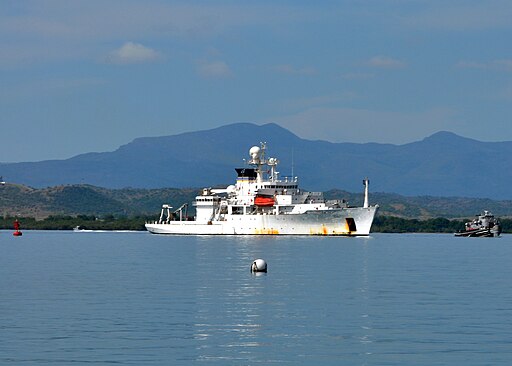
USNS Henson (T-AGS-63) is a dedicated oceanographic survey ship operated by the Military Sealift Command (MSC) for the United States Navy. As part of the “Pathfinder-class” of hydrographic and oceanographic survey vessels, Henson’s mission involves collecting detailed data about the world’s oceans — from bathymetry (sea-floor mapping) to acoustic, geological, physical, chemical, and biological oceanographic data. Such information is critical for a wide range of naval operations, including submarine navigation, mine warfare, anti-submarine warfare, environmental assessment, and safe transit in both coastal and deep-water regions. The ship offers a flexible, multipurpose platform capable of supporting deep-ocean and coastal surveys, often in far-reaching global waters.
Henson was constructed by Halter Marine at Moss Point, Mississippi. The keel was laid on 13 October 1995, it was launched on 21 October 1996, and delivered to service on 20 February 1998. Since then, Henson has remained active and forms a crucial part of the U.S. Navy’s oceanographic survey fleet. Its design reflects a balance: built to commercial-style standards for cost-efficiency and reliability, yet outfitted with specialized scientific and hydrographic systems required for modern naval requirements.
Over the decades, Henson and her sister ships have contributed to oceanographic mapping, underwater terrain analysis, acoustic environment characterization, and data gathering that supports not only routine naval operations but also strategic tasks like mine warfare planning, submarine route charting, and environmental assessments. Henson continues to represent a quietly essential, but often overlooked, pillar in the Navy’s ability to “see beneath the sea” — enabling safer and more informed maritime operations worldwide.
Technical Specifications — Dimensions, Propulsion & Crew
Henson belongs to the Pathfinder-class survey ships (T-AGS 60–65). The ship’s overall length is approximately 329 feet (about 100.1 meters), with a beam (width) of 58 feet (≈17.7 meters). Its draft, when loaded, is around 19 feet (≈5.8 meters).
Displacement values vary depending on load and configuration: full-load displacement is approximately 4,762 long tons (about 4,838 metric tons), while light-ship displacement is lower, reflecting the mass without cargo, fuel, and supplies.
Propulsion is provided by a diesel-electric drive system. Specifically, Henson carries four diesel generator sets (EMD/Baylor) generating a combined power rating on the order of 8.52 MW (≈ 11,425 horsepower equivalent). These supply electric power to two General Electric CDF 1944 electric motors that drive twin shafts, which in turn rotate the propellers (or Z-drive pods, depending on system configuration). To aid maneuvering, especially during survey operations, a bow thruster is also fitted.
With this propulsion setup, Henson can sustain a speed of about 16 knots (≈ 18.4 mph / 29.6 km/h) — fast enough for transit between survey zones, but also allowing slow, careful movement when conducting oceanographic work. The vessel’s crew complement typically includes around 28 civilian mariners (CIVMARS) plus additional scientific and mission-specialist personnel — frequently around 27 scientists or support staff — bringing total embarked personnel together.
This configuration — diesel-electric drive, moderate size, and mixed civilian/scientific crew — is emblematic of the Pathfinder-class philosophy: robust enough for ocean-going service, yet flexible to support specialized survey missions worldwide, with lower operating costs than a full warship.
Survey Systems, Equipment and On-board Capabilities
The core purpose of USNS Henson is to conduct detailed oceanographic and hydrographic surveys. Accordingly, the ship is fitted with a suite of specialized scientific, acoustic, and geophysical instrumentation rather than offensive weaponry. She is unarmed, reflecting her non-combatant, support-oriented role.
On deck, Henson carries multiple multipurpose cranes (typically three) and several winches (e.g., five) used for deploying and recovering survey gear, sonar arrays, towed bodies, hydrographic launches, buoys, and other instrumentation. These handling systems allow the ship to launch small survey craft, lower multi-beam sonar arrays, and tow deep-water acoustic sensors — all necessary for tasks such as bathymetric mapping, sub-seafloor profiling, and acoustic environment characterization.
Henson’s onboard scientific equipment includes multi-beam echo-sounders, towed sonar arrays, and support for hydrographic survey launches (HSLs) — small boats or craft capable of operating in shallower coastal zones, enabling detailed mapping where the mothership cannot safely navigate. These launches often carry high-frequency side-scan or hull-mounted sonar systems (e.g., from sonar manufacturers such as SIMRAD), enabling the mapping of seafloor features, wrecks, submerged obstacles, and variation in seabed composition.
Furthermore, Henson supports a wide range of oceanographic disciplines: physical oceanography (temperature, salinity, current profiles), biological oceanography, marine geology/geophysics, bathymetry, magnetometry, and acoustic surveys. This capability makes the ship a multipurpose platform, useful not only for charting and mapping but also for environmental assessments, undersea navigation support, mine-warfare preparation, and submarine route surveying. According to official descriptions, the ship is capable of satisfying broad spectrum oceanographic requirements in both coastal and deep-water areas.
In short, Henson serves as a floating research base — with scientific laboratories, data processing facilities, equipment handling systems, and accommodations for scientists — enabling long-duration missions across remote ocean regions.
Mission Profile and Operational Use
USNS Henson’s mission profile revolves around gathering oceanographic, hydrographic, geophysical, and acoustic data for the U.S. Navy and associated defense/marine science agencies. Its work supports a variety of naval and strategic tasks: charting deep ocean bathymetry, mapping seafloor features, producing undersea navigation charts, collecting acoustic data critical for submarine and anti-submarine operations, and generating environmental databases for mine warfare, amphibious operations, and safe transits. This makes Henson a critical enabler for undersea and surface fleet operations. (Naval Today)
Because of its mixed civilian-scientific crew and non-combatant status, Henson can carry out extended missions worldwide, often in areas where combatant ships might be less suitable or not permitted. The use of hydrographic launches, towed sensor arrays, and onboard laboratories allows detailed, fine-grained surveys — even in shallow coastal waters, littoral zones, or disputed maritime regions. These missions often support not only defense needs but also humanitarian, environmental, and scientific applications.
Over time, Henson and her sister ships have been deployed in multiple theaters; for example, Henson has supported survey operations for the U.S. 7th Fleet, collecting data that informs mine-warfare planning and acoustic environment characterization. In such roles, the data gathered by Henson is processed and turned into maps, acoustic profiles, charts, and environmental assessments that are distributed to fleet units, navies, and allied partners — influencing planning and operations at strategic and tactical levels. (Naval Today)
Because of this, Henson’s work rarely makes headlines, but it underpins much of the Navy’s “undersea awareness” — knowledge of ocean terrain, seafloor conditions, and acoustic environments essential for safe navigation, submarine movement, mine avoidance, and overall maritime security.
Design Philosophy and Class Context
USNS Henson belongs to the Pathfinder-class survey ship (T-AGS 60–65), a group of specialized hydrographic and oceanographic survey vessels built in the 1990s to meet the broad ocean-mapping needs of the U.S. Navy. These ships were constructed to commercial-style standards — meaning cost-effective, simplified hull and structure design — but modified with necessary reinforcements and outfitting for oceanographic tasks. This reflects a design philosophy prioritizing flexibility, economy, and specialized mission capability rather than combat survivability.
This class replaced older survey and hydrographic ships, offering more modern sensor suites, better electric-drive propulsion for quieter acoustic signature (important during sonar or acoustic surveys), and improved endurance and stability for long-duration missions. The diesel-electric drive reduces noise, which is beneficial for acoustic data collection, and allows for flexible power distribution to scientific equipment, winches, cranes, and other mission systems.
Although built to meet civilian regulatory standards (e.g., hull strength, structural stability, compliance with maritime safety regulations), the ships are robust enough for global ocean service — capable of deep-ocean operations, extended deployments, and handling challenging sea conditions during survey missions. For scientific and naval support tasks that do not require heavy armament or combat readiness, this design strikes an effective balance between cost, capability, and sustainability.
Thus, Henson exemplifies a type of auxiliary vessel optimized for “soft power”: surveying, data gathering, environmental mapping — supporting other naval and maritime missions with knowledge rather than firepower.
Limitations, Challenges and Future Relevance
While USNS Henson offers valuable capabilities, the nature of a survey ship also imposes certain limitations. As a non-combatant, unarmed vessel with limited speed (16 knots) and modest draft, it cannot match the flexibility of multipurpose warships when rapid redeployment or high-speed maneuver is required. Survey missions require careful, slow navigation; thus, Henson is not suited for frontline tasks or rapid-response combat operations.
The reliance on diesel-electric propulsion, while beneficial for acoustic quietness and survey operations, also constrains top speed and may limit transit flexibility. Additionally, survey operations — particularly deep-ocean or remote area tasks — often require long durations at sea, with associated logistical challenges (resupply, maintenance, crew endurance). The balance between scientific crew and civilian mariners means the ship must carry enough support for both operational and mission-specific needs.
As naval and marine science evolves, new demands arise: autonomous underwater vehicles (AUVs), remotely operated vehicles (ROVs), enhanced sonar arrays, sea-floor mapping at higher resolution, and integration with satellite and remote sensing data. While the Pathfinder-class (including Henson) has proven capable, future demands may push for newer vessels with larger payload capacity, more power, advanced launch and recovery systems, and greater endurance. The Navy’s evolving needs for undersea domain awareness — including seafloor mapping, acoustic modeling, mine detection, and undersea infrastructure monitoring — may eventually lead to updated designs or replacements.
Nevertheless, as of now, Henson continues to play an essential role: delivering detailed, high-quality oceanographic data that supports both military and scientific maritime operations.
Conclusion
USNS Henson (T-AGS-63) represents a vital, if often unseen, asset in the United States Navy’s fleet — a specialized survey ship blending scientific capability with naval logistical support. With its diesel-electric drive, moderate size, multipurpose cranes and winches, hydrographic launches, and advanced sonar and oceanographic instrumentation, Henson enables detailed mapping and understanding of the world’s oceans.
By gathering bathymetric, acoustic, geophysical, chemical, and biological data, the vessel supports submarine navigation, mine-warfare planning, environmental assessment, and maritime safety — all critical to modern naval operations. The design philosophy underlying Henson and her Pathfinder-class sisters balances cost-efficiency, flexibility, and mission-tailored capabilities.
_2010.jpg)