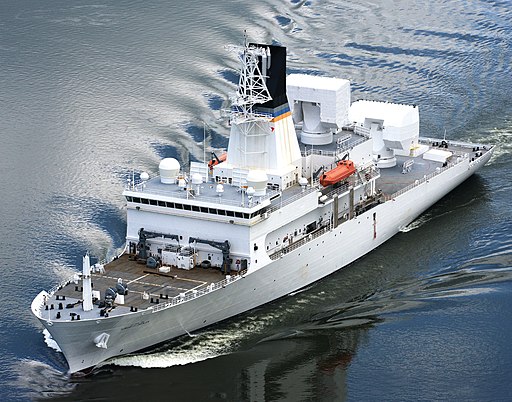
USNS Howard O. Lorenzen is a missile-range instrumentation ship of the U.S. Navy, built to provide high-end radar and tracking capabilities for missile launches, space tracking, and treaty-verification tasks. Operated under the aegis of the Military Sealift Command (MSC), it serves as a non-combatant, specialized support vessel, embedding advanced radar instrumentation rather than heavy weapons. Its conception, construction, and deployment reflect a strategic shift toward dedicated instrumentation platforms — vessels optimized to collect telemetry, radar, and tracking data from ballistic missile launches or space-launch events globally.
Construction of the vessel was contracted to VT Halter Marine in Pascagoula, Mississippi. The keel was laid in August 2008; after completion and trials, the ship was accepted by the U.S. Navy in January 2012 and achieved operational status a few years later. With the retirement of the older generation of instrumentation ships, Howard O. Lorenzen stands as a central node in U.S. missile-range and space-domain awareness capabilities.
What distinguishes Howard O. Lorenzen is its integration of a next-generation radar suite, the so-called “Cobra Judy Replacement” (CJR), renamed as the “Cobra King” system once installed — a dual-band active electronically scanned array (AESA) radar combining high-resolution tracking (X-band) with broad-area search (S-band). This gives the ship the ability to monitor missile trajectories, record re-entry events, gather telemetry, and support treaty verification and missile-defense testing with real-time data relayed to shore stations or defense agencies. The vessel thus merges naval architecture with leading-edge sensor technology — a floating observatory for ballistic missile and space-launch phenomena.
Technical Specifications — Dimensions, Propulsion & Crew
Howard O. Lorenzen measures 534 feet in length (approximately 163 meters) and has a beam of 89 feet (≈ 27 meters). Its draft lies in the range of about 21 to 22 feet (≈ 6.4–6.7 meters), giving it a hull form suited for ocean-going stability while bearing heavy superstructures and radar domes. Fully loaded, the ship displaces about 12,642 long tons (≈ 12,845 metric tons), reflecting both its structural mass and the added weight of radar arrays, power plants, and support equipment.
Propulsion is via a diesel-electric system: four MaK 12 M 32 C diesel-electric propulsion (DEP) engines — each rated at roughly 5.5 megawatts — drive the ship, delivering a maximum speed of about 20 knots. For redundancy and auxiliary power, the vessel also carries a Caterpillar C32 diesel generator for emergency power needs. This propulsion arrangement emphasizes reliability, endurance, and relatively low acoustic and vibrational noise — important for supporting sensitive instrumentation and long deployments.
The complement aboard Howard O. Lorenzen comprises about 88 personnel: civilian mariners (contract mariners under MSC) plus embarked mission-specialist technicians, often from U.S. government agencies such as the Air Force. This hybrid crew structure reflects the ship’s non-combatant, mission-support character. There is no heavy armament — as the vessel is not designed for combat operations — but rather the focus is on radar, telemetry, data collection, communications, and maintenance of specialized systems.
Radar & Sensor Suite — “Cobra King” and Instrumentation Capabilities
At the heart of Howard O. Lorenzen’s mission capability lies the radar and instrumentation suite — the “Cobra King,” the successor to the legacy radar system operated on older instrumentation ships. The Cobra King integrates dual-band phased-array radars: an X-band active electronically scanned array (AESA) and an S-band array, both working in concert to deliver comprehensive detection, tracking, and high-resolution imaging capabilities. The S-band array provides broad-area, volume-search detection — useful for discovering launches or missile objects over large zones — while the X-band array offers fine-resolution tracking and discrimination, able to resolve re-entry vehicles, warheads, boosters, or other sub-components during a test or launch event. The radar arrays themselves are massive, each assembly weighing on the order of hundreds of thousands of pounds, due to the size and structural reinforcement needed for reliable sea-state operations.
These radars enable Howard O. Lorenzen to perform long-range tracking and data gathering on ballistic missile launches, space launches, re-entry events, and other high-speed or high-altitude trajectories. The ship can capture telemetry, radar cross-section data, trajectory paths, and re-entry behavior, providing data essential for missile defense testing, weapons evaluation, treaty compliance verification, and strategic intelligence. Data collected aboard can be processed on board or relayed via secure satellite or communication links to land-based analysis centers — ensuring near real-time intelligence and assessment.
Complementing the radar arrays, the vessel’s deck and onboard systems support necessary infrastructure: structural reinforcements to bear the radar weight, power generation and distribution systems (to feed high-demand radar electronics), environmental control (for cooling and stable operation of electronics), telemetry antennas and sensor suites for signal interception, and data-processing labs. The design integrates the instrumentation mission deeply into the ship’s architecture — from hull stability through to power distribution — making Howard O. Lorenzen a specialized yet capable ocean-going sensor platform rather than a generic auxiliary vessel.
Mission Profile and Operational Role
The primary role of Howard O. Lorenzen is to support missile-range instrumentation — that is, to monitor missile tests, space launches, and ballistic missile events worldwide. When missile tests or space launches occur, particularly over remote ocean areas, the ship can be dispatched to a predetermined tracking station and positioned to collect radar, telemetry, and tracking data. This capability is essential for the U.S. government’s missile-defense programs, for verification of arms-control treaty compliance, and for scientific or technical assessment of missile or launch system performance.
Because of its advanced radar and sensor payload, the vessel replaces older instrumentation ships (such as its predecessor) and provides a more capable, flexible, and modern platform for 21st-century missile tracking and space-domain awareness. Its mobility allows the U.S. services to project sensor coverage to whatever sea regions are relevant — whether across the Pacific, Atlantic, Indian Ocean, or elsewhere — avoiding reliance on fixed ground sites or foreign territory.
In practice, Howard O. Lorenzen is managed under MSC but missions are often sponsored by the U.S. Air Force (or agencies associated with missile defense or space-domain awareness). Its operational deployments involve coordination between civilian mariners, mission technicians, radar specialists, and analysts. The ship’s data output supports real-time or near-real-time reporting, test evaluation, treaty monitoring, and intelligence collection — making it a critical, though not always visible, part of strategic defense and weapons-test infrastructure.
Design & Construction History
The contract for T-AGM-25 was awarded in 2006; keel was laid in August 2008 at VT Halter Marine. The ship was christened in mid-2010 and launched later that year. After completion of outfitting, integration of the radar systems, and extensive testing, it was delivered to the U.S. Navy in January 2012. Final contract trials — covering propulsion, habitability, systems operations, navigation, and safety — concluded in late 2013, after which the vessel achieved operational readiness under the “Cobra Judy Replacement” program.
The ship was intended to replace the older instrumentation ship (which had served for decades under various radar systems) and serve for roughly 30 years — ensuring that the United States retains mobile, sea-based radar instrumentation capacity well into the 21st century. Its design is based on a commercial-style hull modified to support heavy radar superstructures, large power generation capacity, and mission-specific systems — a compromise between cost-effective shipbuilding practices and the heavy demands of modern radar instrumentation.
The decision to build a new missile-range instrumentation ship reflected evolving strategic requirements: increased missile and space-launch activity worldwide, need for mobility to track launches in remote oceans, and replacement of aging legacy vessels whose radar and electronic systems were becoming outdated. In this context, Howard O. Lorenzen represents a modern, purpose-built sensor ship designed to meet contemporary defense and strategic monitoring needs.
Limitations, Operational Considerations, and Strategic Value
Because Howard O. Lorenzen is not a combatant, it relies on its civilian-mariner crew for ship operations and embarked technical staff for mission tasks. Therefore, while it excels at radar tracking and telemetry gathering, it lacks self-defense weaponry — in contested environments, protection must be provided by other naval assets. Its speed (20 knots) is adequate for repositioning but not suited for high-speed deployment or evasion; the design emphasizes stability, power, and instrumentation rather than agility.
Moreover, the heavy radar superstructure, large power demands, and specialized equipment require robust maintenance and logistic support. Deployments are likely planned carefully, with significant pre-deployment preparation, satellite communication support, and mission-specific coordination between multiple agencies. Because of its specialization, the ship cannot easily perform other auxiliary roles such as replenishment, amphibious support, or escort duties.
Nonetheless, the strategic value of Howard O. Lorenzen is high. In an era of proliferating missile technologies, frequent space launches, and increasing need for global surveillance, a mobile sea-based radar platform offers unique flexibility. It allows the U.S. to gather telemetry and tracking data from remote launch sites or over international waters, monitor compliance with international treaties, support missile-defense testing, and maintain space-domain awareness without dependence on foreign ground sites. As such, the ship is a core asset in the U.S. military’s instrumentation and strategic-surveillance architecture.
Conclusion
USNS Howard O. Lorenzen (T-AGM-25) stands out as a highly specialized, technically advanced missile-range instrumentation ship — combining modern diesel-electric propulsion, robust naval architecture, and cutting-edge radar and sensor systems to deliver global launch-tracking capability. Its role transcends conventional naval support: it is a sea-based observatory, a moving radar station, and a critical node in missile-defense, treaty-verification, and space-domain awareness networks.
.jpg)