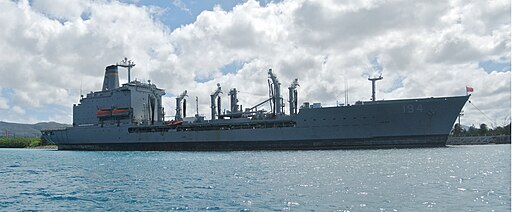
USNS John Ericsson (T-AO-194) was a United States Navy fleet replenishment oiler operated by the Military Sealift Command, designed to provide sustained logistical support to naval forces operating far from home ports. As a non-commissioned auxiliary vessel crewed primarily by civilian mariners, the ship embodied the modern U.S. Navy’s emphasis on underway replenishment as a force multiplier. By allowing carrier strike groups, amphibious forces, and independent surface combatants to remain at sea for extended periods, John Ericsson played a critical but often understated role in maintaining global maritime presence, deterrence, and rapid response capability.
Ship Class and Design Philosophy
John Ericsson belonged to the Henry J. Kaiser-class of replenishment oilers, a class developed during the Cold War to replace aging World War II–era oilers and to meet the demands of modern, fuel-intensive naval operations. The class emphasized efficiency, reliability, and compatibility with high-tempo fleet operations. These ships were designed from the outset to support connected replenishment at sea, featuring multiple fueling stations on both port and starboard sides, as well as robust cargo handling systems. The overall design balanced commercial tanker practices with naval requirements, resulting in a platform that was economical to operate while still meeting military standards for survivability and interoperability.
Construction and Physical Characteristics
USNS John Ericsson was constructed to large tanker dimensions, reflecting its primary mission of bulk fuel transport and delivery. The ship measured approximately 677 feet in length, with a beam of about 98 feet and a full-load displacement exceeding 40,000 tons. The hull form was optimized for stability during replenishment operations, where maintaining steady station alongside receiving ships is critical. Internally, the vessel was divided into numerous fuel tanks and machinery spaces, with careful compartmentalization to enhance safety and damage control. The superstructure was positioned forward, providing clear aft deck space for replenishment rigs and cargo handling equipment.
Propulsion and Performance
The propulsion system of John Ericsson consisted of a diesel-powered plant driving a single shaft, delivering sufficient horsepower to achieve a sustained speed of around 20 knots. While not intended to match the top speeds of combatants, this performance allowed the oiler to keep pace with carrier strike groups during transits and routine operations. The diesel machinery was selected for fuel efficiency, endurance, and ease of maintenance, aligning with the ship’s long-duration deployment profile. Maneuverability was enhanced through bow thrusters and responsive steering systems, which were particularly important during close-quarters replenishment evolutions.
Cargo Capacity and Replenishment Capabilities
The primary mission of USNS John Ericsson was the transportation and delivery of naval fuels, including marine diesel fuel and aviation fuel used by carrier air wings. The ship carried well over 150,000 barrels of fuel, distributed across segregated tanks to allow simultaneous delivery of different fuel types. Replenishment systems included multiple connected replenishment stations capable of transferring fuel at high flow rates while underway. In addition to liquid cargo, the ship had limited capacity for dry stores and packaged cargo, enabling it to support a broader range of logistical needs during deployments. These capabilities allowed the vessel to service several ships in succession without returning to port.
Crew Composition and Habitability
Unlike commissioned warships, John Ericsson was operated by a mixed crew structure. The majority of personnel were civilian mariners employed by the Military Sealift Command, responsible for navigation, engineering, and ship handling. A smaller Navy detachment provided expertise in communications, replenishment coordination, and mission-specific tasks. This arrangement reduced operating costs while maintaining professional standards. Habitability spaces were designed for extended deployments, with private or semi-private berthing, dedicated mess facilities, and recreational areas. While not luxurious, accommodations reflected the expectation that the crew would spend long periods at sea in support of fleet operations.
Defensive Systems and Survivability
As an auxiliary vessel, USNS John Ericsson was not intended to engage in combat, but it incorporated limited defensive measures and survivability features. Structural design emphasized redundancy in critical systems, fire suppression, and damage control. During periods of heightened threat, the ship could be fitted with close-in defensive weapons and crew-served armament for self-protection against asymmetric threats. The vessel relied primarily on escorting combatants and situational awareness provided by the fleet for protection, consistent with its logistical support role.
Operational Service and Deployment History
Throughout its service life, John Ericsson supported U.S. Navy operations across multiple theaters, including the Pacific and Middle Eastern regions. The ship participated in sustained logistical efforts during major operations and routine forward deployments, often operating continuously for months at a time. Its ability to deliver fuel reliably under a wide range of sea states made it a dependable asset to fleet commanders. Though rarely in the public eye, the ship’s operational tempo reflected the constant demand for underway replenishment in modern naval warfare.
Deactivation and Legacy
After decades of service, USNS John Ericsson was eventually deactivated as newer replenishment platforms entered service and fleet logistics requirements evolved. The ship’s career exemplified the importance of auxiliary vessels in enabling naval power projection. While combat ships often receive the most attention, oilers like John Ericsson form the logistical backbone that allows fleets to operate globally and persistently. The vessel’s legacy lies in its quiet efficiency and the countless missions it supported, underscoring the essential role of maritime logistics in modern naval strategy.
