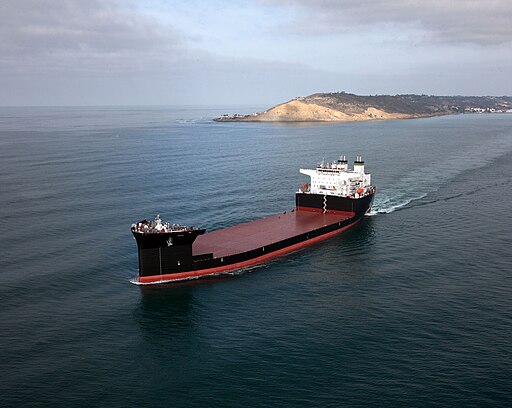
USNS John Glenn (T-ESD-2) is an expeditionary sea base–related auxiliary vessel operated by the United States Navy under the Military Sealift Command. Conceived to support distributed maritime operations, the ship provides a flexible, mobile sea platform capable of enabling logistics, equipment transfer, and maritime staging without reliance on fixed port infrastructure. Named after astronaut and U.S. Senator John Glenn, the vessel reflects a broader naval shift toward modularity, adaptability, and forward presence. Its primary mission centers on serving as a floating pier and transfer hub, particularly for large-scale equipment movements between sealift ships and shore when ports are austere, damaged, or politically inaccessible.
Expeditionary Sea Base Concept and Design Philosophy
USNS John Glenn belongs to the Expeditionary Transfer Dock subclass within the broader expeditionary sea base family. The design philosophy emphasizes a semi-submersible hull and expansive mission deck that together allow the ship to interface directly with landing craft, lighterage, and roll-on/roll-off sealift vessels. Rather than functioning as a combatant, the ship acts as an enabling platform, extending the operational reach of amphibious and logistics forces. Its architecture is derived from commercial offshore engineering concepts, particularly heavy-lift and mobile offshore base designs, adapted to meet naval standards for survivability, command-and-control integration, and sustained operations.
Construction and General Characteristics
USNS John Glenn was constructed using commercial shipbuilding practices to control costs while maintaining the robustness required for military service. The vessel measures approximately 784 feet in length, with a beam of around 164 feet, making it one of the widest ships in the U.S. Navy’s auxiliary inventory. Full-load displacement exceeds 90,000 tons, reflecting the massive structural strength required to support heavy vehicle transfers and simultaneous operations. The hull is built with reinforced decks and ballast systems that allow controlled submersion of the mission deck, enabling efficient alignment with other vessels during transfer operations.
Propulsion and Power Generation
The propulsion system of USNS John Glenn is diesel-electric in configuration, optimized for endurance, station-keeping, and fuel efficiency rather than high speed. The ship achieves a maximum speed of roughly 15 knots, which is sufficient for strategic repositioning and operational maneuvering. Power generation capacity is substantial, supporting not only propulsion but also extensive hotel services, cargo handling equipment, ballast pumps, and command-and-control systems. The electrical plant provides the redundancy necessary for continuous operations, particularly during complex ballasting evolutions where precise control is critical to safety and mission success.
Ballast and Semi-Submersible Capabilities
A defining technical feature of USNS John Glenn is its advanced ballast system. The ship can deliberately lower its mission deck close to the waterline by taking on seawater into dedicated ballast tanks. This capability allows landing craft air cushion, landing craft utility, and other surface connectors to move seamlessly between the sea and the deck. Ballasting operations are carefully managed through automated control systems that monitor hull stresses, trim, and stability in real time. This semi-submersible function transforms the vessel into a stable offshore transfer point, even in moderate sea states.
Mission Deck and Cargo Handling Systems
The mission deck of USNS John Glenn spans tens of thousands of square feet and is engineered to handle extremely heavy loads, including main battle tanks, armored vehicles, and large logistics packages. The deck is outfitted with tie-down points, reinforced lanes, and integrated mooring fixtures to secure equipment during transfers. Cargo handling is supported by cranes, ramps, and vehicle maneuvering areas designed for continuous flow operations. This layout enables the ship to function as a logistics bridge, transferring equipment from large sealift ships to smaller connectors that can move ashore where ports are unavailable.
Aviation Facilities and Support Functions
Although not primarily an aviation platform, USNS John Glenn includes flight deck facilities capable of supporting rotary-wing aircraft. These aviation capabilities enhance the ship’s flexibility by enabling personnel movement, light cargo transfer, medical evacuation, and command liaison. The flight deck is designed to accommodate medium-lift helicopters and includes basic support infrastructure such as fueling points and landing aids. This aviation element complements the surface connector mission, ensuring the ship can support a broad spectrum of expeditionary tasks.
Crew Composition and Command Structure
The ship is operated by a civilian mariner crew under the Military Sealift Command, responsible for navigation, engineering, deck operations, and maintenance. A smaller contingent of U.S. Navy personnel embarks to manage mission-specific systems, communications, and coordination with supported forces. This hybrid crewing model reduces operational costs while retaining the specialized expertise required for complex naval logistics missions. Living quarters, medical spaces, and support facilities are designed for long-duration deployments, recognizing that expeditionary operations often require sustained presence far from established bases.
Survivability and Defensive Considerations
USNS John Glenn is not designed for frontline combat but incorporates survivability features appropriate to its support role. The hull and internal systems emphasize redundancy, damage control, and fire suppression. The ship can be equipped with crew-served defensive weapons and electronic countermeasures as needed, depending on the threat environment. In operational practice, the vessel relies on situational awareness, escorting combatants, and standoff positioning to mitigate risk while conducting its mission.
Operational Employment and Strategic Value
In service, USNS John Glenn supports amphibious task forces, Army and Marine Corps logistics movements, and joint operations requiring large-scale equipment transfer. The ship’s ability to act as a mobile seaport significantly enhances operational flexibility, particularly in regions with limited infrastructure or contested access. By decoupling logistics from fixed ports, the vessel contributes directly to the resilience and adaptability of U.S. power projection. Its presence allows commanders to sustain forces ashore while minimizing dependence on vulnerable or politically sensitive facilities.
Legacy and Future Relevance
USNS John Glenn represents a modern evolution in naval logistics, blending commercial engineering practices with expeditionary military requirements. As global operations increasingly emphasize distributed forces and contested environments, the ship’s capabilities remain highly relevant. Its technical design demonstrates how non-combatant vessels can have strategic impact by enabling mobility, sustainment, and operational freedom. In this role, John Glenn stands as a cornerstone of contemporary expeditionary logistics and a model for future auxiliary ship development.
_underway_in_January_2014.jpg)