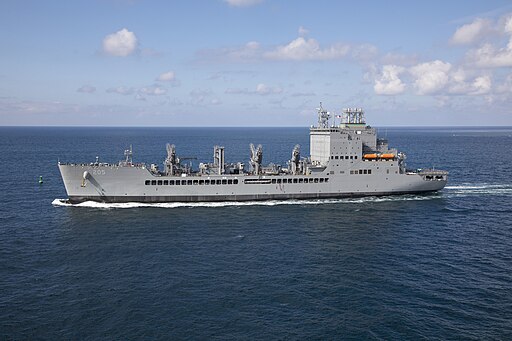
USNS John Lewis (T-AO-205) is the lead ship of the John Lewis-class fleet replenishment oilers, representing a major modernization of the United States Navy’s underway replenishment capability. Operated by the Military Sealift Command and crewed primarily by civilian mariners, the ship is designed to sustain carrier strike groups, amphibious forces, and independent surface combatants across vast oceanic distances. As the namesake of its class, John Lewis sets the technical and operational standard for a new generation of auxiliary vessels focused on survivability, efficiency, environmental compliance, and seamless integration with modern naval task forces.
John Lewis-Class Design Philosophy
The John Lewis-class was developed to replace aging Henry J. Kaiser-class oilers while addressing contemporary operational challenges, including contested maritime environments and increased fuel demands from advanced warships. The design philosophy centers on enhanced survivability, reduced crew workload through automation, and improved compatibility with modern replenishment systems. Unlike earlier oilers that were optimized primarily for benign environments, the John Lewis-class incorporates naval architectural features intended to reduce signatures, improve redundancy, and support sustained operations closer to potential threat areas. The class also reflects stricter environmental and safety regulations, aligning naval logistics with modern maritime standards.
Construction and Hull Characteristics
USNS John Lewis was constructed using modular shipbuilding techniques that combine commercial shipyard efficiency with naval-specific requirements. The vessel measures approximately 742 feet in length, with a beam of about 106 feet, and displaces roughly 49,000 tons at full load. The hull form is designed for improved hydrodynamic efficiency, contributing to reduced fuel consumption during transit and replenishment operations. Structural reinforcement is concentrated along the cargo deck and replenishment stations to withstand repeated high-load transfer operations. The forward superstructure configuration improves visibility and maximizes usable deck space aft for cargo and fueling equipment.
Propulsion and Power Systems
The ship is powered by a diesel propulsion plant driving a single shaft, selected for reliability, fuel efficiency, and ease of maintenance over extended deployments. Maximum speed is approximately 20 knots, allowing John Lewis to operate effectively alongside fast carrier strike groups. Electrical power generation is significantly upgraded compared to previous classes, supporting advanced automation, cargo handling systems, and command-and-control equipment. Redundant generators and power distribution networks ensure continued operation even in the event of system failures, a key survivability and mission assurance feature.
Fuel Capacity and Cargo Specifications
USNS John Lewis is optimized for the transport and delivery of large quantities of fuel essential to modern naval operations. The ship carries over 150,000 barrels of fuel, including marine diesel fuel and aviation fuel used by carrier-based aircraft. Fuel is stored in segregated tanks that allow multiple fuel types to be transferred simultaneously without contamination. The internal piping and pumping systems are designed for high flow rates, enabling rapid replenishment of multiple ships during a single evolution. In addition to liquid cargo, the vessel includes limited capacity for dry stores, enhancing its flexibility as a logistics platform.
Underway Replenishment Capabilities
Underway replenishment is the core mission of USNS John Lewis, and the ship is equipped with state-of-the-art connected replenishment systems. Multiple fueling stations are located along both port and starboard sides, allowing simultaneous servicing of two receiving ships. Advanced tensioned rigs, automated hose handling equipment, and improved control interfaces reduce crew workload and increase safety during replenishment operations. The ship is designed to conduct replenishment at sustained speeds and in higher sea states than older oilers, improving operational availability and responsiveness.
Automation and Crew Efficiency
One of the defining technical advancements of USNS John Lewis is its high degree of automation. Integrated bridge systems, automated engine controls, and digital cargo management significantly reduce the number of personnel required to operate the ship effectively. The typical crew consists of approximately 125 civilian mariners, supported by a small Navy detachment responsible for mission coordination and communications. Habitability spaces are modernized, featuring improved accommodations, fitness areas, and medical facilities designed to support long deployments while maintaining crew morale and effectiveness.
Survivability and Defensive Design Features
Although classified as a non-combatant auxiliary, USNS John Lewis incorporates enhanced survivability features reflecting its potential operation in contested environments. The hull and internal layout emphasize compartmentalization, fire suppression, and damage control redundancy. Signature reduction measures, including improved exhaust treatment and reduced radar cross-section features, are incorporated into the superstructure design. While the ship does not carry offensive weaponry as standard, it can be equipped with crew-served defensive systems and small-caliber weapons when required, relying primarily on fleet escorts and situational awareness for protection.
Environmental and Regulatory Compliance
The John Lewis-class was designed to meet or exceed modern environmental standards, marking a significant improvement over previous generations of oilers. USNS John Lewis incorporates double-hull construction to reduce the risk of fuel spills, advanced waste management systems, and emissions controls compliant with international maritime regulations. These features not only reduce environmental impact but also enhance the ship’s ability to operate globally without restriction, an increasingly important consideration for sustained naval logistics.
Operational Role and Fleet Integration
In operational service, USNS John Lewis functions as a critical enabler of distributed maritime operations. By providing reliable fuel delivery far from fixed bases, the ship allows naval forces to remain forward-deployed and operationally unpredictable. Its systems are fully integrated with modern fleet command, control, and logistics planning networks, enabling precise scheduling and execution of replenishment missions. The vessel’s flexibility allows it to support not only carrier strike groups but also surface action groups, amphibious forces, and joint or allied naval operations.
Strategic Importance and Future Outlook
As the lead ship of its class, USNS John Lewis represents a foundational element of the U.S. Navy’s future logistics force. The ship’s design balances efficiency, survivability, and environmental responsibility while addressing the growing demands of modern naval warfare. Its introduction signals a renewed emphasis on resilient and capable auxiliary vessels as essential components of combat power. Over its service life, John Lewis is expected to play a central role in sustaining global naval operations, reinforcing the principle that effective logistics are inseparable from maritime dominance.
_underway_at_sea,_in_2022_(220728-N-N2201-001).JPG)