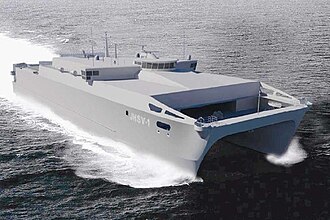
USNS Lansing (T-EPF-16): The Next Generation of High-Speed Expeditionary Mobility
Modern military operations increasingly depend on the ability to move people, equipment, and supplies quickly across vast maritime regions. In an era where global security challenges can emerge with little warning, traditional large-scale naval platforms are only part of the solution. The United States Navy and Military Sealift Command require highly flexible vessels capable of rapidly transporting forces, supporting humanitarian missions, and operating in areas where speed and accessibility are essential. One of the newest ships designed to fulfill these requirements is USNS Lansing (T-EPF-16), a Spearhead-class Expeditionary Fast Transport vessel that represents the future of rapid maritime mobility.
Built to provide high-speed transportation for personnel, vehicles, equipment, and supplies, USNS Lansing is part of a new generation of naval support vessels designed around flexibility rather than traditional combat roles. Unlike destroyers, submarines, or aircraft carriers, Expeditionary Fast Transport ships are not intended to engage enemy forces directly. Instead, their value comes from their ability to move forces quickly, support joint military operations, respond to disasters, and provide logistical access to regions where traditional transportation methods may be limited.
As the sixteenth ship of the Spearhead class, USNS Lansing benefits from years of operational experience gained from earlier vessels in the program. Its aluminum catamaran design, shallow draft, high speed, and large mission bay provide commanders with a unique capability that complements the Navy’s larger combat ships and expeditionary forces.
The Role of Expeditionary Fast Transport Ships
A New Approach to Maritime Mobility
The Expeditionary Fast Transport (EPF) program was developed to address a challenge faced by modern military planners: how to move large numbers of personnel and equipment quickly between locations without relying entirely on traditional ports, airfields, or slower sealift vessels. EPF ships provide a bridge between strategic transportation and tactical operations by combining the speed of a fast ship with the capacity of a logistics platform.
USNS Lansing is designed to transport troops, vehicles, supplies, and specialized equipment at speeds far greater than conventional transport ships. This capability allows commanders to reposition forces rapidly, support exercises with allies, and respond to emergencies across wide geographic areas.
The ship’s shallow draft also allows it to access ports, coastal areas, and island locations that may be unavailable to larger vessels. This flexibility is particularly valuable in regions such as the Indo-Pacific, where thousands of islands and dispersed operating locations create significant logistical challenges.
Supporting Joint Military Operations
Although operated by the U.S. Navy’s Military Sealift Command rather than as a commissioned warship, USNS Lansing contributes directly to military readiness. The vessel can support the U.S. Army, Marine Corps, Navy, Air Force, and other government agencies by transporting personnel and equipment wherever needed.
Possible missions include:
- Rapid movement of troops and vehicles.
- Support for amphibious operations.
- Humanitarian assistance following natural disasters.
- Medical support and evacuation missions.
- Transportation during military exercises.
- Logistics support for distributed operations.
This versatility allows EPF ships to perform missions that would otherwise require significantly larger and more expensive platforms.
Naming USNS Lansing
USNS Lansing continues the Navy’s tradition of naming Expeditionary Fast Transport ships after American communities. The vessel honors the city of Lansing, Michigan, the state capital and a community with a long connection to American industry, government, and public service.
Naming military vessels after cities and communities creates a direct relationship between the ship and the people it represents. Throughout construction and future service, USNS Lansing will serve as a maritime ambassador for the city and state whose name it carries.
The ship’s name also reflects the broader role of the EPF program: connecting communities, supporting national objectives, and providing practical capabilities that benefit both military and humanitarian missions.
Construction and Development
Built by Austal USA
USNS Lansing is being constructed by Austal USA in Mobile, Alabama, one of the world’s leading builders of aluminum-hulled high-speed vessels. Austal developed extensive expertise in lightweight aluminum ship construction through both commercial and military projects, making it a key partner in the U.S. Navy’s effort to expand fast maritime transportation capabilities.
The construction of an EPF requires advanced engineering techniques because aluminum vessels must combine low weight with exceptional structural strength. The ship’s catamaran hull design provides stability, reduces resistance through the water, and allows the vessel to achieve high speeds while carrying substantial payloads.
Thousands of workers contribute to the construction process, including engineers, welders, designers, electricians, and systems specialists. Modern naval shipbuilding involves extensive testing and quality control to ensure that every system performs reliably under demanding operational conditions.
The Spearhead-Class Evolution
USNS Lansing belongs to the Spearhead class, which has evolved continuously since the first ship entered service. Lessons learned from earlier vessels have contributed to improvements in maintenance, mission flexibility, onboard systems, and operational performance.
The class demonstrates how the Navy has moved toward more adaptable support platforms capable of meeting a wide range of requirements. Instead of designing a ship for only one mission, EPFs are built with flexible spaces that can be configured for different operational needs.
High-Speed Catamaran Design
Speed and Efficiency
One of the defining characteristics of USNS Lansing is its exceptional speed. The ship can travel at approximately 35 to 40 knots, allowing it to cover large distances much faster than traditional transport vessels.
This speed provides several advantages. Military forces can be moved quickly during crises, supplies can reach remote locations sooner, and commanders gain greater flexibility when planning operations. In humanitarian situations, where time can determine whether lives are saved, rapid transportation can be especially valuable.
The catamaran hull contributes significantly to the ship’s performance. By using two parallel hulls, the design reduces water resistance while improving stability compared with many conventional single-hull ships.
Shallow Draft Operations
Another major advantage of the EPF design is its shallow draft. Unlike large amphibious ships or conventional cargo vessels that require deep-water ports, USNS Lansing can operate closer to shore and access smaller ports.
This capability is particularly useful in areas with limited infrastructure. Following a natural disaster, for example, damaged ports may prevent large ships from delivering supplies. An EPF can often reach locations that larger vessels cannot, making it a valuable humanitarian tool.
Mission Capabilities
Transportation of Personnel and Equipment
The primary mission of USNS Lansing is rapid transport. The vessel’s large mission bay can carry military vehicles, cargo, containers, and equipment required to support deployed forces.
The ship can transport hundreds of personnel while providing accommodations and support facilities for extended missions. Its vehicle deck is designed to accommodate a variety of military vehicles and equipment, making it useful for expeditionary operations where speed and flexibility are essential.
Humanitarian Assistance and Disaster Response
Beyond military operations, USNS Lansing can support humanitarian missions around the world. Natural disasters such as hurricanes, earthquakes, and tsunamis often damage transportation infrastructure, creating urgent demand for supplies, medical assistance, and evacuation capabilities.
An EPF can rapidly deliver emergency equipment, medical teams, engineers, and relief supplies. Its ability to operate independently and reach shallow coastal areas makes it an important asset during disaster response efforts.
Medical Support
The Expeditionary Fast Transport design also allows ships of the class to support medical missions. Flexible internal spaces can be adapted for casualty treatment, patient movement, and emergency response requirements.
During humanitarian crises or military operations, rapid medical evacuation can significantly improve outcomes for injured personnel and civilians.
Technology and Ship Systems
Propulsion and Performance
USNS Lansing is powered by a diesel propulsion system driving waterjets, allowing the vessel to achieve high speeds while maintaining maneuverability. Waterjet propulsion is particularly effective for shallow-water operations because it reduces the need for exposed propellers.
The propulsion system provides the combination of speed, efficiency, and reliability required for expeditionary missions.
Advanced Navigation and Communication
Although not a combat vessel, USNS Lansing incorporates modern navigation, communication, and command systems. These technologies allow the ship to operate effectively within larger naval task forces and coordinate with military and civilian organizations during missions.
Reliable communications are especially important for humanitarian operations, where multiple agencies may need to coordinate activities quickly.
Life and Operations Aboard USNS Lansing
As a Military Sealift Command vessel, USNS Lansing will primarily be operated by civilian mariners under the command of the Navy’s sealift organization. These crews provide the professional maritime expertise required to operate and maintain the vessel during deployments.
Depending on the mission, military personnel, government specialists, or mission teams may also embark aboard the ship. This mixed operational model allows the vessel to remain flexible while supporting a wide variety of missions.
Life aboard an EPF requires adaptability. Unlike traditional warships with permanent combat roles, these vessels may perform completely different missions from one deployment to another. The crew must be prepared to support transportation operations, humanitarian activities, exercises, and emergency responses.
Strategic Importance in the Indo-Pacific Era
The importance of fast, flexible transportation has increased significantly as military planning focuses more heavily on distributed operations. In regions such as the Indo-Pacific, distances are enormous, and access to traditional bases may be limited.
USNS Lansing provides commanders with additional options by enabling rapid movement between dispersed locations. Its speed and shallow-water capability make it particularly useful for operations involving islands, coastal areas, and remote regions.
Rather than replacing larger combat ships, EPFs complement them by solving one of the most basic challenges of military operations: moving people and equipment where they are needed.
The Future of Expeditionary Mobility
USNS Lansing represents a broader shift toward flexible naval capabilities. Future conflicts and crises will require forces that can move quickly, operate in diverse environments, and support both military and humanitarian objectives.
The Expeditionary Fast Transport program demonstrates that naval power depends not only on weapons but also on logistics, mobility, and the ability to sustain operations over distance. Ships like USNS Lansing ensure that American forces can respond rapidly wherever challenges emerge.
Conclusion
USNS Lansing (T-EPF-16) represents an important evolution in maritime transportation and expeditionary support. While it does not carry the weapons systems of a destroyer or the aviation power of an aircraft carrier, its contribution to naval operations is equally significant. Speed, flexibility, and accessibility make it a valuable platform for moving forces, delivering aid, and supporting missions around the world.
As the newest generation of Expeditionary Fast Transport ships continues entering service, vessels like USNS Lansing will play an increasingly important role in modern military operations. Whether transporting troops during exercises, delivering relief after disasters, supporting coastal missions, or strengthening partnerships with allies, the ship embodies the changing nature of naval power in the twenty-first century.
Technical Specifications
| Specification | Details |
|---|---|
| Ship Name | USNS Lansing (T-EPF-16) |
| Class | Spearhead-class Expeditionary Fast Transport |
| Hull Number | T-EPF-16 |
| Operator | Military Sealift Command (MSC) |
| Builder | Austal USA, Mobile, Alabama |
| Ship Type | High-speed transport catamaran |
| Status | Under construction |
| Length | 338 ft (103 m) |
| Beam | 93 ft (28.5 m) |
| Draft | Approximately 12 ft (3.8 m) |
| Full-Load Displacement | Approximately 2,400–2,500 tons |
| Propulsion | 4 × diesel engines driving waterjets |
| Maximum Speed | Approximately 35–40 knots |
| Range | Approximately 1,200 nautical miles at high speed |
| Crew | Approximately 41 civilian mariners |
| Military Personnel Capacity | Up to approximately 300 personnel |
| Vehicle Deck Capacity | Large mission bay for vehicles, cargo, and equipment |
| Cargo Capacity | Approximately 600 short tons |
| Flight Deck | Aviation-capable landing area for helicopters |
| Primary Missions | Rapid transport, logistics support, humanitarian assistance, disaster relief, expeditionary operations |
| Hull Design | Aluminum twin-hull catamaran |
| Service Life | Designed for decades of expeditionary support operations |
