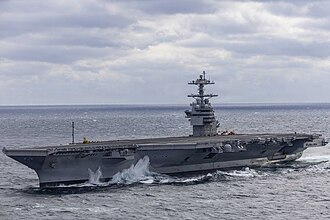
USS John F. Kennedy (CVN-79): The Future of American Naval Aviation Power
Aircraft carriers have long represented the ability of a nation to project power across the world’s oceans, combining aviation, logistics, command capabilities, and naval diplomacy into a single mobile platform. Among the newest and most advanced warships being built for the United States Navy is USS John F. Kennedy (CVN-79), the second Gerald R. Ford-class nuclear-powered aircraft carrier. Named in honor of the 35th President of the United States, the ship continues a historic naval tradition while introducing a new era of carrier technology designed to support American maritime operations throughout the twenty-first century.
As global security challenges become increasingly complex, aircraft carriers remain central to the Navy’s ability to respond rapidly to crises, reassure allies, protect sea lanes, and maintain freedom of navigation. USS John F. Kennedy represents the next stage in carrier development, incorporating advanced technologies that improve aircraft launch and recovery, reduce manpower requirements, increase operational efficiency, and provide greater flexibility compared with previous generations of carriers. Although its massive size is impressive, the true importance of CVN-79 lies in its ability to serve as the centerpiece of a carrier strike group capable of conducting sustained operations anywhere in the world.
Honoring President John F. Kennedy
USS John F. Kennedy carries the name of one of America’s most recognizable leaders and continues a proud tradition of naval vessels named after President John Fitzgerald Kennedy. Before entering politics, Kennedy served as a U.S. Navy officer during World War II, where he commanded the patrol torpedo boat PT-109 in the Pacific Theater. After the boat was sunk by a Japanese destroyer in 1943, Kennedy demonstrated extraordinary leadership by helping his surviving crew members reach safety. His wartime service became one of the defining moments of his early life and shaped his lifelong connection with the Navy.
As president from 1961 to 1963, Kennedy placed significant emphasis on national defense, naval readiness, and space exploration. His administration oversaw major developments in U.S. military strategy during the Cold War, including the strengthening of conventional and nuclear forces. His famous commitment to national service and his emphasis on technological innovation remain closely associated with American leadership.
The first USS John F. Kennedy (CV-67), a conventionally powered aircraft carrier commissioned in 1968, served the Navy for nearly four decades before retiring in 2007. The new CVN-79 continues this legacy with a far more advanced design, combining Kennedy’s connection to naval service with the capabilities required for modern maritime operations.
The Gerald R. Ford-Class Revolution
USS John F. Kennedy belongs to the Gerald R. Ford class, the newest generation of U.S. Navy aircraft carriers. Designed to replace the aging Nimitz-class carriers, the Ford class incorporates major technological improvements intended to increase sortie generation, reduce operating costs, improve survivability, and prepare naval aviation for future challenges.
The first ship of the class, USS Gerald R. Ford (CVN-78), introduced numerous innovations that fundamentally changed carrier operations. USS John F. Kennedy benefits from lessons learned during the construction and early operational experience of CVN-78, allowing the Navy to refine production methods and improve system integration.
Unlike previous carriers that relied on decades-old technologies gradually upgraded over time, the Ford class was designed from the beginning around advanced systems. These include the Electromagnetic Aircraft Launch System (EMALS), Advanced Arresting Gear (AAG), upgraded radar systems, improved electrical generation capacity, and redesigned internal arrangements that enhance efficiency.
Construction at Newport News Shipbuilding
Building America’s Newest Aircraft Carrier
USS John F. Kennedy is being constructed by Huntington Ingalls Industries’ Newport News Shipbuilding in Virginia, the only shipyard in the United States capable of designing and building nuclear-powered aircraft carriers. The facility has produced every American nuclear aircraft carrier since USS Enterprise (CVN-65), making it one of the world’s most experienced naval shipbuilding organizations.
Construction of a carrier is among the largest industrial projects undertaken by the United States. Thousands of workers contribute to the process, including engineers, welders, electricians, designers, nuclear specialists, and technicians responsible for integrating millions of individual components into a functioning warship.
The carrier is built using modular construction techniques, where large sections of the ship are fabricated separately before being assembled together. This approach improves efficiency while maintaining the precision required for a nuclear-powered vessel expected to operate for more than half a century.
Progress Toward Service
USS John F. Kennedy was christened in December 2019, with members of the Kennedy family participating in the traditional ceremony. The ship’s construction has continued through extensive outfitting, testing, and system installation. Before entering active service, the carrier must complete a series of trials evaluating propulsion, aviation systems, combat capabilities, navigation equipment, and overall performance.
Once commissioned, CVN-79 will join the operational fleet and begin decades of service as one of the most powerful naval aviation platforms in the world.
Advanced Technology and Innovation
Electromagnetic Aircraft Launch System (EMALS)
One of the most significant technological improvements aboard USS John F. Kennedy is the Electromagnetic Aircraft Launch System. Unlike traditional steam catapults used on Nimitz-class carriers, EMALS uses electromagnetic energy to launch aircraft from the flight deck.
This technology provides several advantages, including smoother acceleration, reduced stress on aircraft structures, improved reliability, and the ability to launch a wider range of aircraft. EMALS can accommodate everything from lightweight unmanned aircraft to heavily loaded fighter jets, giving future carrier air wings greater operational flexibility.
The system also reduces the need for extensive steam infrastructure, freeing internal space for other uses and improving overall efficiency.
Advanced Arresting Gear
Working alongside EMALS is the Advanced Arresting Gear system, which replaces older hydraulic arresting equipment used on previous carriers. AAG uses advanced energy absorption technology to recover aircraft safely while reducing maintenance requirements.
Together, EMALS and AAG represent a major transformation in carrier aviation operations, improving launch and recovery cycles while preparing the Navy for future generations of aircraft.
Nuclear Power and Global Reach
USS John F. Kennedy is powered by two Bechtel A1B nuclear reactors, providing enormous electrical generation capacity and propulsion power. Nuclear propulsion allows the carrier to operate for decades without refueling, giving it exceptional endurance compared with conventionally powered vessels.
The ship’s nuclear reactors provide electricity not only for propulsion but also for advanced systems such as radar, weapons, aircraft support equipment, and future technologies requiring substantial electrical power. This increased electrical capacity was a key design requirement for the Ford class because future naval warfare will depend heavily on sensors, networks, directed-energy weapons, and advanced computing systems.
A nuclear-powered aircraft carrier can remain at sea for extended periods, limited primarily by food supplies, maintenance requirements, and crew endurance rather than fuel availability. This capability enables the Navy to respond quickly to crises without relying on nearby ports or foreign bases.
The Carrier Air Wing
The true combat power of USS John F. Kennedy comes from the aircraft it carries. As the centerpiece of a carrier strike group, the ship will operate a modern carrier air wing consisting of multiple aircraft types designed for different missions.
The air wing is expected to include:
- F/A-18E/F Super Hornet fighters for air superiority and strike missions.
- EA-18G Growler aircraft for electronic warfare and suppression of enemy air defenses.
- E-2D Advanced Hawkeye aircraft for airborne early warning and battlefield management.
- MH-60R and MH-60S Seahawk helicopters for anti-submarine warfare, search and rescue, logistics, and maritime security.
- Unmanned aircraft systems as future technology becomes integrated into carrier operations.
This combination allows the carrier strike group to conduct offensive and defensive missions across enormous distances while maintaining flexibility in uncertain environments.
The Carrier Strike Group Concept
USS John F. Kennedy will rarely operate alone. Instead, it will serve as the centerpiece of a carrier strike group consisting of guided-missile cruisers, destroyers, submarines, supply ships, and aircraft.
Each component contributes unique capabilities. Destroyers provide air and missile defense, submarines conduct covert surveillance and anti-submarine warfare, logistics ships maintain supplies, and the carrier provides unmatched aviation capability.
This integrated approach allows the Navy to create a powerful and flexible force capable of responding to conventional conflicts, regional crises, humanitarian disasters, and deterrence missions.
Life Aboard a Nuclear Aircraft Carrier
Operating a ship the size of USS John F. Kennedy requires a crew of thousands of sailors who maintain every aspect of the vessel around the clock. The carrier functions as a small floating city, containing medical facilities, dining areas, repair shops, command centers, aviation maintenance spaces, and living quarters.
Approximately 2,600 sailors operate the ship itself, while an additional 2,500 personnel may serve as part of the embarked carrier air wing. Maintaining such a complex platform requires constant coordination between engineering teams, aviation personnel, weapons specialists, communications operators, and support crews.
Life aboard an aircraft carrier is demanding, with long deployments and continuous operations, but it also creates a unique sense of teamwork. Every sailor contributes to the carrier’s ability to launch aircraft, defend itself, and sustain global operations.
Strategic Importance in Modern Naval Warfare
Despite advances in missile technology, cyber warfare, and unmanned systems, aircraft carriers remain among the most visible symbols of national power. Their ability to deliver airpower without requiring access to foreign bases makes them valuable tools of diplomacy and deterrence.
USS John F. Kennedy will be especially important in regions where access to land bases may be limited or contested. Its mobility allows commanders to reposition airpower rapidly, respond to emerging threats, and support allies during times of crisis.
The carrier’s advanced technology also ensures that it can continue adapting as warfare evolves. Increased electrical capacity, improved aviation systems, and digital infrastructure provide a foundation for future upgrades throughout its expected service life.
A Carrier Built for the Future
USS John F. Kennedy represents more than another aircraft carrier entering the Navy’s fleet. It represents the transition toward a new generation of naval warfare built around efficiency, technology, and adaptability. While the ship honors a president whose life was defined by leadership and service, its capabilities are focused firmly on the challenges of the future.
For decades to come, CVN-79 will serve as a mobile symbol of American naval strength, supporting military operations, protecting international commerce, and demonstrating the ability of the United States to operate anywhere on the world’s oceans.
Conclusion
USS John F. Kennedy (CVN-79) stands at the intersection of history and innovation. Named after a president who understood the importance of naval power and who personally experienced the dangers of maritime conflict, the carrier continues a legacy built on courage, technology, and service.
As the second Gerald R. Ford-class aircraft carrier, CVN-79 introduces advanced systems that will redefine carrier operations for the twenty-first century. From electromagnetic aircraft launches and improved arresting systems to nuclear propulsion and a next-generation air wing, the ship represents the future of American naval aviation.
When USS John F. Kennedy joins the fleet, it will not simply be another warship. It will be a global aviation base, a diplomatic instrument, and a powerful reminder of the enduring role of sea power in protecting national interests.
Technical Specifications
| Specification | Details |
|---|---|
| Ship Name | USS John F. Kennedy (CVN-79) |
| Class | Gerald R. Ford-class aircraft carrier |
| Hull Number | CVN-79 |
| Builder | Huntington Ingalls Industries – Newport News Shipbuilding |
| Named For | President John F. Kennedy |
| Keel Laid | August 22, 2015 |
| Christened | December 7, 2019 |
| Status | Under construction / testing phase |
| Length | Approximately 1,092 ft (333 m) |
| Beam (Flight Deck) | Approximately 256 ft (78 m) |
| Displacement | Approximately 100,000+ tons full load |
| Propulsion | 2 × Bechtel A1B nuclear reactors, 4 shafts |
| Speed | 30+ knots |
| Range | Unlimited by fuel; decades of nuclear endurance |
| Crew | Approximately 2,600 ship’s company |
| Air Wing Personnel | Approximately 2,500 |
| Aircraft Capacity | Approximately 75+ aircraft |
| Aircraft Launch System | Electromagnetic Aircraft Launch System (EMALS) |
| Aircraft Recovery System | Advanced Arresting Gear (AAG) |
| Radar Systems | Dual-band radar system including AN/SPY-3 and AN/SPY-4 technology |
| Armament | RIM-7/RIM-162 missiles, RIM-116 Rolling Airframe Missile, Phalanx CIWS |
| Aircraft Types | F/A-18E/F, EA-18G, E-2D, MH-60 helicopters, future unmanned aircraft |
| Expected Service Life | Approximately 50 years |
| Primary Missions | Naval aviation, power projection, air defense, strike warfare, deterrence, humanitarian assistance |
_Underway_on_Sea_Trial.jpg)