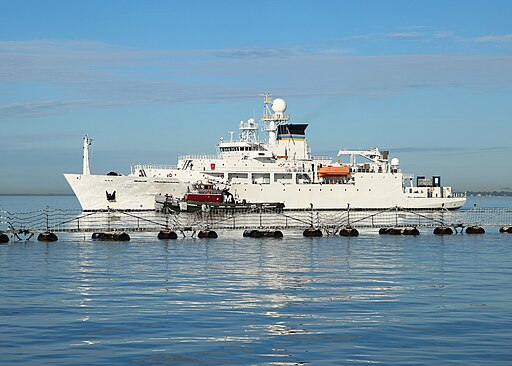
USNS Marie Tharp (T-AGS-66) is an advanced oceanographic survey ship operated by the United States Navy’s Military Sealift Command and crewed by civilian mariners. The vessel is named after Marie Tharp, a pioneering geologist and oceanographic cartographer whose work fundamentally changed scientific understanding of seafloor spreading and plate tectonics. As part of the Pathfinder-class (also referred to as the T-AGS 60 class), the ship was designed to support high-resolution hydrographic, geophysical, and acoustic surveys in both deep-ocean and littoral environments. Its mission profile emphasizes scientific precision, quiet operation, endurance, and the ability to deploy and recover a wide range of sophisticated towed and autonomous systems.
Design Philosophy and Hull Characteristics
USNS Marie Tharp was designed with a focus on acoustic quieting and operational stability, both of which are essential for accurate oceanographic data collection. The hull form minimizes flow noise and vibration that could interfere with sonar and sensor performance, while extensive machinery isolation and damping systems further reduce radiated noise. The ship’s displacement, beam, and draft are optimized to allow global deployment while still providing excellent station-keeping characteristics in challenging sea states. A large working deck aft supports towing operations and over-the-side deployments, while internal spaces are arranged to balance laboratory capacity, crew habitability, and machinery access.
Propulsion and Power Generation
The propulsion system of USNS Marie Tharp is diesel-electric, a configuration chosen to enhance fuel efficiency, reduce acoustic signatures, and provide flexible power management. Multiple diesel generators supply electricity to electric propulsion motors driving a single controllable-pitch propeller. This arrangement allows precise speed control at very low speeds, which is critical during survey operations. The ship is also equipped with bow thrusters to improve maneuverability during close-quarters operations and dynamic positioning. Electrical power generation capacity is sufficient not only for propulsion but also for the extensive scientific equipment, data processing systems, and hotel services required during long-duration missions.
Scientific and Survey Capabilities
The core mission of USNS Marie Tharp is oceanographic surveying, and the vessel is equipped with an extensive suite of sensors and deployment systems to support this role. The ship can operate multibeam and single-beam echo sounders, sub-bottom profilers, side-scan sonar, and magnetometers to map seafloor topography and subsurface features with high accuracy. Towing winches and handling systems are designed for deep-water operations, allowing the deployment of long towed arrays and instrument packages at significant depths. The vessel also supports autonomous and remotely operated vehicles, expanding its ability to collect data in areas that are difficult or hazardous for surface ships.
Laboratories, Data Processing, and Communications
USNS Marie Tharp includes multiple dedicated laboratories for hydrographic, geophysical, and acoustic data analysis. These spaces are equipped with advanced computing systems that allow near-real-time processing, visualization, and quality control of collected data. Secure and non-secure communications systems enable the transmission of survey results to shore-based commands and scientific partners, while also supporting coordination with other naval and research assets. The integration of shipboard networks ensures that sensor inputs, navigation data, and environmental measurements are synchronized, providing a comprehensive and reliable data set for both operational and scientific use.
Crew, Habitability, and Endurance
The ship is operated by a mixed team of civilian mariners and embarked mission personnel, including Navy survey specialists and scientists. Habitability standards reflect the vessel’s long deployment cycles, with comfortable berthing, dedicated workspaces, and recreational facilities designed to support crew effectiveness over extended periods at sea. Endurance is measured in months rather than weeks, supported by substantial fuel capacity, provisions storage, and maintenance facilities. This endurance allows USNS Marie Tharp to operate globally without frequent port calls, a key requirement for sustained survey campaigns in remote regions.
Technical Specifications
USNS Marie Tharp (T-AGS-66) has a full-load displacement of approximately 5,100 tons, an overall length of about 329 feet, a beam of roughly 57 feet, and a draft of approximately 19 feet. The diesel-electric propulsion system provides a maximum speed of around 15 knots, with significantly lower speeds used during survey operations to optimize data quality. The ship’s range exceeds 12,000 nautical miles at economical cruising speed. Crew complement typically includes around 35 civilian mariners, with additional accommodations for mission specialists.
Operational Role and Strategic Importance
Within the broader context of U.S. naval operations, USNS Marie Tharp plays a critical role in providing accurate and up-to-date knowledge of the maritime environment. The data collected by the ship supports submarine and surface ship navigation, undersea warfare planning, cable route assessment, and environmental awareness. Beyond strictly military applications, the vessel also contributes to scientific understanding of ocean processes and seafloor geology, reflecting the dual-use nature of modern oceanographic platforms. Through its advanced capabilities and specialized design, USNS Marie Tharp represents a key asset in maintaining maritime superiority and expanding knowledge of the world’s oceans.
_pulls_into_Naval_Station_Norfolk_on_2_November_(2017171102-N-OH262-867).JPG)