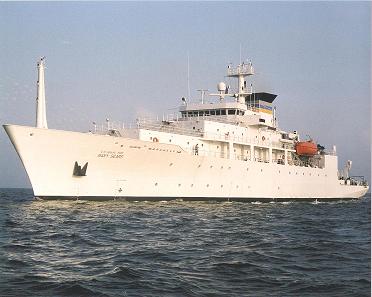
USNS Mary Sears (T-AGS 65) is a modern oceanographic survey ship operated by the United States Navy’s Military Sealift Command and crewed primarily by civilian mariners. The vessel is named in honor of Mary Sears, a distinguished oceanographer whose work during World War II laid foundational principles for naval oceanography and undersea warfare support. As a unit of the Pathfinder-class oceanographic survey ships, the vessel was designed to provide the U.S. Navy with precise, reliable, and persistent knowledge of the undersea environment. Its missions focus on collecting high-resolution hydrographic, geophysical, and acoustic data that are essential for naval operations, strategic planning, and scientific research across the world’s oceans.
Design Concept and Hull Architecture
The design of USNS Mary Sears reflects a balance between endurance, stability, and acoustic discretion. The hull form emphasizes reduced hydrodynamic noise and vibration, which is critical for the performance of sensitive sonar and survey equipment. Structural elements and machinery foundations are isolated to limit noise transmission into the water, while the ship’s overall proportions provide excellent seakeeping in open-ocean conditions. A large stern working deck and robust over-the-side handling arrangements allow the ship to deploy heavy and complex sensor arrays. Internally, the layout supports a seamless flow between operations spaces, laboratories, and equipment rooms, ensuring that data collection and analysis can proceed continuously during extended missions.
Propulsion, Maneuverability, and Power Systems
USNS Mary Sears employs a diesel-electric propulsion system selected for its efficiency, reliability, and acoustic advantages. Multiple ship service diesel generators produce electrical power that is distributed to propulsion motors driving a single controllable-pitch propeller. This configuration enables precise control of speed and torque, allowing the vessel to maintain extremely slow and steady speeds during survey operations without sacrificing efficiency. Bow thrusters enhance low-speed maneuverability and support station-keeping when operating near sensitive areas or during equipment deployment and recovery. The ship’s electrical generation capacity is designed to support propulsion, hotel services, and the substantial power demands of scientific sensors and onboard data-processing systems simultaneously.
Survey, Mapping, and Oceanographic Capabilities
The primary mission of USNS Mary Sears is detailed oceanographic surveying, and the ship is equipped with a comprehensive suite of sensors and handling systems to fulfill this role. It supports multibeam echo sounders for high-resolution bathymetric mapping, sub-bottom profilers for sediment and geological analysis, side-scan sonar for object detection, and magnetometers for geophysical surveys. Specialized winches, cranes, and A-frames allow the deployment of deep-towed sensor arrays and instrument packages to significant depths. The ship is also capable of supporting autonomous underwater vehicles and remotely operated systems, greatly expanding its reach and flexibility in complex or deep-water survey environments.
Laboratories, Data Integration, and Communications
USNS Mary Sears includes multiple dedicated laboratories configured for hydrographic, acoustic, and geophysical analysis. These laboratories are equipped with advanced computing infrastructure that enables near-real-time processing, visualization, and verification of collected data. Integrated navigation and positioning systems ensure precise correlation between sensor measurements and geographic location. Secure and non-secure communications systems allow data to be transmitted ashore or shared with other naval and research assets, supporting both operational decision-making and long-term scientific analysis. The ship’s internal networks are designed for high reliability and redundancy, reflecting the critical nature of the information it gathers.
Crew Composition, Habitability, and Endurance
The vessel is operated by a core crew of civilian mariners, with additional embarked Navy personnel and scientific specialists depending on mission requirements. Habitability standards are tailored for long deployments, providing comfortable berthing, workspaces, and recreational facilities that support crew health and performance over extended periods at sea. Logistics systems, including fuel storage, provisions capacity, and maintenance support, allow USNS Mary Sears to remain on station for months at a time without resupply. This endurance is essential for sustained survey operations in remote regions far from established ports.
Technical Specifications
USNS Mary Sears (T-AGS 65) has a full-load displacement of approximately 5,100 tons. The ship measures about 329 feet in length, with a beam of roughly 57 feet and a draft of approximately 19 feet. Its diesel-electric propulsion system provides a maximum speed of around 15 knots, while survey operations are typically conducted at significantly lower speeds to maximize data quality. The vessel has an operational range exceeding 12,000 nautical miles at economical speed. The standard crew consists of roughly 35 civilian mariners, with accommodations for additional mission personnel and specialists.
Operational Significance and Strategic Value
USNS Mary Sears plays a vital role in maintaining the U.S. Navy’s understanding of the undersea environment, which is a critical component of modern naval warfare and maritime security. The data it collects directly supports submarine navigation, antisubmarine warfare planning, undersea infrastructure assessment, and environmental intelligence. At the same time, the ship’s capabilities contribute to broader scientific knowledge of oceanography and marine geology. Through its advanced design, quiet operation, and sophisticated survey systems, USNS Mary Sears stands as a key asset in both national defense and the ongoing exploration of the global ocean.
