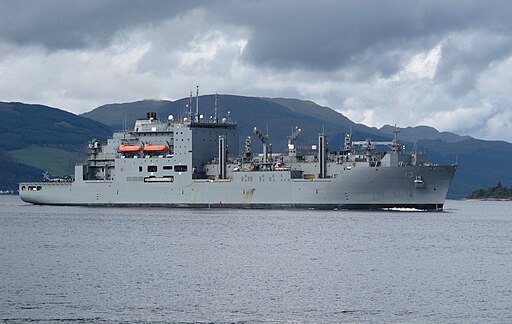
USNS Medgar Evers (T-AKE-13) is a Lewis and Clark-class dry cargo and ammunition ship operated by the United States Navy’s Military Sealift Command. The vessel is named in honor of Medgar Wiley Evers, a prominent civil rights leader and U.S. Army veteran whose legacy represents service, sacrifice, and commitment to national ideals. As part of the Navy’s modern combat logistics force, USNS Medgar Evers was designed to deliver sustained at-sea resupply to deployed naval forces, ensuring that carrier strike groups, amphibious task forces, and surface action groups can remain operational far from friendly ports for extended periods.
Ship Design and Structural Characteristics
The design of USNS Medgar Evers emphasizes cargo capacity, stability, and safety during underway replenishment operations. The hull is large and strongly built, providing the structural strength needed to carry thousands of tons of ammunition, dry stores, and refrigerated supplies while operating in open-ocean environments. Internal spaces are carefully segregated to meet stringent safety requirements for ammunition stowage, with environmental controls that protect sensitive materials. The ship’s superstructure and deck layout are optimized to support efficient cargo flow from storage areas to transfer stations, reducing turnaround time during replenishment evolutions. Its size and hull form also contribute to excellent seakeeping performance, which is critical when conducting alongside operations in varying sea states.
Propulsion, Maneuverability, and Power Generation
USNS Medgar Evers is powered by a conventional diesel propulsion system designed for endurance, reliability, and sustained fleet operations. Multiple medium-speed diesel engines drive a single propeller through a reduction gear, providing the ship with the power necessary to maintain formation with fast-moving naval task groups. This propulsion arrangement allows for consistent cruising speeds while also offering precise control during replenishment operations that require close coordination with receiving ships. Electrical power is generated by several ship service diesel generators, which supply energy for cargo handling equipment, navigation and communication systems, environmental controls, and hotel services. Redundant machinery and power distribution systems enhance operational resilience and reduce the risk of mission interruption.
Cargo Storage and Replenishment Capabilities
The primary mission of USNS Medgar Evers is to deliver a wide variety of supplies at sea, and its cargo systems reflect this role. The ship can carry thousands of tons of dry provisions, spare parts, repair materials, and ordnance, all stored in purpose-built holds. Advanced cargo elevators, automated handling systems, and heavy-lift cranes enable rapid transfer of supplies from internal storage to replenishment stations. The vessel is equipped with multiple connected replenishment rigs on both port and starboard sides, allowing it to resupply more than one ship simultaneously. In addition to alongside replenishment, the ship supports vertical replenishment using helicopters, providing flexibility when sea conditions or tactical situations prevent close-quarters operations.
Aviation Facilities and Vertical Replenishment
USNS Medgar Evers includes a flight deck and aviation support infrastructure to enable helicopter operations in support of logistics missions. While the ship does not maintain a permanently assigned air detachment, it is fully capable of hosting Navy and allied helicopters for vertical replenishment. Aviation fuel storage, refueling systems, and deck handling equipment are designed to support sustained flight operations. Vertical replenishment allows the rapid delivery of high-priority or sensitive cargo and enables resupply of ships that cannot conduct alongside replenishment, significantly enhancing the overall effectiveness of fleet logistics.
Crew, Automation, and Habitability
The ship is operated by a combination of civilian mariners and a small military detachment, reflecting the Military Sealift Command’s operational model. A high level of automation in engineering, navigation, and cargo handling systems allows USNS Medgar Evers to operate with a relatively small crew for its size. Habitability standards are modern, with comfortable berthing, dining facilities, medical spaces, and recreational areas designed to support crew health and morale during long deployments. These features are essential, as logistics ships often remain at sea for months at a time, supporting continuous fleet operations across vast distances.
Technical Specifications
USNS Medgar Evers (T-AKE-13) has a full-load displacement of approximately 41,000 tons. The ship measures about 689 feet in length, with a beam of approximately 106 feet and a draft of roughly 30 feet. Its propulsion system enables sustained speeds of around 20 knots, allowing it to keep pace with carrier strike groups and other fast-moving naval formations. The vessel has an operational range exceeding 14,000 nautical miles at economical cruising speed. Cargo capacity includes several thousand tons of ammunition and dry stores, along with extensive refrigerated and frozen storage. The typical crew complement consists of approximately 120 to 130 civilian mariners, with accommodations for additional mission or military personnel as required.
Operational Importance and Strategic Contribution
USNS Medgar Evers plays a vital role in maintaining the endurance and combat effectiveness of U.S. naval forces worldwide. By providing reliable and timely at-sea resupply, the ship enables combatant vessels to remain on station, respond quickly to emerging threats, and sustain high-tempo operations without reliance on shore-based logistics. Its combination of large cargo capacity, efficient replenishment systems, and global reach makes it an indispensable component of the Navy’s combat logistics force. In modern maritime strategy, where sustained presence and rapid response are essential, USNS Medgar Evers represents a critical enabler of naval power projection and operational flexibility.
