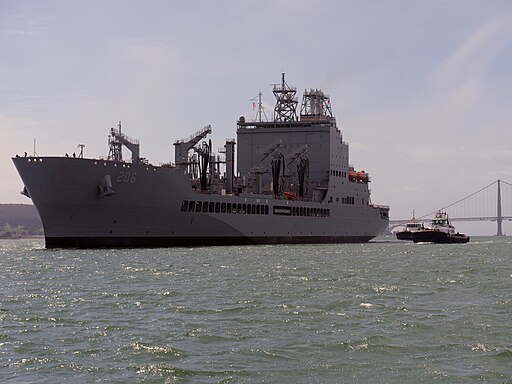
The USNS Oscar V. Peterson (T-AO-206) is a modern fleet replenishment oiler of the United States Navy — specifically part of the new generation of oilers built to support naval groups with fuel and supplies while underway. As a “fleet oiler,” its mission is logistical: to carry large volumes of fuel (both for ships and for aircraft), plus dry stores and refrigerated supplies, then transfer them at sea to combatants and support vessels. In essence, it acts as a mobile supply base, enabling long-range naval deployments without the need to return to port.
Originally launched under the name USNS Harvey Milk (T-AO-206), the vessel entered service in 2023. In 2025 it was renamed USNS Oscar V. Peterson to honor a Medal of Honor recipient from World War II. As the second ship of its class, it represents a key component of the Navy’s efforts to modernize its underway replenishment fleet.
Built with modern naval architecture, robust cargo-handling systems, and wide operational capability, Oscar V. Peterson blends commercial-ship design efficiency with military logistics requirements. Its specs reflect a focus on capacity, endurance, flexibility, and readiness to support carrier strike groups, amphibious formations, or surface combatants across extended deployments.
Technical Specifications — Overview
- Hull classification / pennant number: T-AO-206.
- Ship type / class: Fleet replenishment oiler of the John Lewis‑class.
- Length overall: 746 feet (227.4 meters).
- Beam (width): 106 ft 5 in (≈ 32.4 meters).
- Maximum draft (fully loaded): 33.5 feet (≈ 10.2 meters).
- Displacement (full load): approximately 49,850 metric tons.
- Complement / Crew: primarily civilian mariners under Military Sealift Command (MSC) — about 99 to 125 personnel depending on role and configuration.
- Propulsion system: twin-shaft, medium-speed diesel engines with PTO/PTI geared drives.
- Top speed: about 20 knots (≈ 37 km/h).
- Cargo capacity: the ship carries large volumes of petroleum products, as well as dry and refrigerated stores for underway replenishment.
Design, Propulsion and Cargo Capacity
The hull of Oscar V. Peterson is designed along the guidelines established for the John Lewis-class oilers, which rely on commercial-ship design principles adapted for naval logistics use. The hull uses robust steel framing and is laid out to accommodate large fuel tanks, multiple cargo storage holds, and replenishment rigs. This design emphasizes economic fuel carriage, structural integrity, and stability — even under partially loaded conditions. The cargo tanks are subdivided into multiple compartments, which helps limit free surface effect (sloshing) when partially loaded, thereby maintaining stability and seaworthiness.
For propulsion, the ship uses a twin-shaft system driven by medium-speed diesel engines fitted with PTO/PTI — power take-off / power take-in — enabling efficient power transfer and flexibility. This configuration supports sustained cruising and also provides necessary power for replenishment operations (pumps, cargo-handling systems, and other auxiliaries) without compromising fuel economy. The gearing and shaft arrangement ensures reliability and manageable maintenance demands, critical for a vessel that may remain at sea for extended periods.
On the cargo side, Oscar V. Peterson is optimized to deliver a blend of petroleum and supply logistics. It can carry a substantial volume of fuel — including diesel for ships (e.g., F-76), aviation fuel (for aircraft embarked on carriers), and lubricants — enabling it to support both surface ships and air wings. Additionally, the vessel offers dry cargo and refrigerated storage capacity, ensuring that food, spare parts, and other supplies can be delivered during underway replenishment. The design supports simultaneous delivery of fuel and stores, maximizing replenishment efficiency for a carrier strike group or amphibious task force.
Replenishment Capabilities & At-Sea Logistics
A central feature of Oscar V. Peterson is its under-way replenishment (UNREP) capability — the ability to resupply other ships at sea without returning to port. The vessel is fitted with multiple refueling stations (on both port and starboard, and often an astern rig) to supply fuel via hoses. These rigs are engineered to allow safe fuel transfer while underway, even in rough seas. The ship’s pumping and hose-handling systems are robust, enabling volume fuel flow rates sufficient to maintain a carrier strike group’s tempo.
In addition to fuel, the ship supports delivery of dry goods and refrigerated supplies. Through replenishment-at-sea procedures (RAS) and vertical replenishment (VERTREP) via helicopters — using its helicopter deck — Oscar V. Peterson can transfer not only fuel but also food, spare parts, mail, and other stores. This dual capability (fuel + stores) is critical for sustaining operations over long deployments, especially in remote or contested areas where port visits may be infrequent or risky.
The combination of cargo capacity and replenishment flexibility means that Oscar V. Peterson plays a critical logistical role: it allows naval task forces to remain on station longer, increase their operational range, and maintain readiness without frequent port calls. This endurance and flexibility make the ship a backbone asset for the Navy’s global operations, particularly in areas far from home ports or during extended missions.
Crew, Operation, and Service Profile
Unlike commissioned warships (which carry “USS” designations), Oscar V. Peterson operates under the Military Sealift Command as a non-commissioned vessel — denoted by the prefix “USNS.” Its crew is primarily civilian mariners (CIVMARS), supplemented by small Navy detachments responsible for communications, command liaison, and coordination during replenishment operations. This hybrid crew model reflects the logistical, support-oriented nature of the oiler’s mission.
Crew accommodations aboard are more akin to commercial merchant ships than combatants: cabins (or stateroom-style berthing), mess facilities, recreation areas, and storage for personal gear. This arrangement helps create a sustainable living environment for long deployments — sometimes several weeks or months at sea — reducing fatigue and supporting continuous operations. Onboard systems include electric generators, pumps, power supply for cargo systems, environmental systems (HVAC), navigation, communications, and safety gear — all designed to support both routine transit and UNREP tasks.
Since being delivered to the Navy on July 11, 2023, Oscar V. Peterson has become part of the Navy’s Combat Logistics Force. Its operational profile involves replenishment of carrier strike groups, amphibious ready groups, and surface combatant squadrons. Because the John Lewis-class was conceived as a replacement for older replenishment oilers, its entry into service increases the fleet’s endurance, efficiency, and readiness. As the second ship of its class, it helps solidify the backbone of the U.S. Navy’s afloat logistics capability.
Historical and Naming Background
The vessel now known as Oscar V. Peterson was originally launched as USNS Harvey Milk (T-AO-206). Its keel was laid down on September 3, 2020, at the shipyard of General Dynamics NASSCO in San Diego, California. The ship was launched on November 6, 2021, and after successful builder’s and acceptance trials, it was delivered to the Navy on July 11, 2023. (navsource.net)
However, on 27 June 2025, the Secretary of the Navy announced the ship would be renamed to reflect a new namesake: Oscar V. Peterson — a U.S. Navy chief petty officer who was posthumously awarded the Medal of Honor for extraordinary heroism during the Battle of the Coral Sea in World War II. The renaming aligned with a broader decision to honor U.S. Navy heritage and valor rather than previous naming conventions.
Thus, USNS Oscar V. Peterson carries both the modern technical legacy of 21st-century naval logistics and a symbolic legacy tied to Navy history and sacrifice. As part of the John Lewis-class, its design and operational role reflect evolving strategic needs: endurance, global reach, and the ability to sustain fleet operations far from home ports.
Strategic Role and Importance
In modern naval operations, the ability to remain deployed — to stay at sea and maintain readiness without returning to port — is vital. Forces such as carrier strike groups, amphibious ready groups, or destroyer squadrons rely heavily on an uninterrupted supply of fuel, fresh water, food, spare parts, and aviation fuel to support air wings. A replenishment oiler like Oscar V. Peterson is thus indispensable: it transforms logistics from a fixed-port concern into a mobile at-sea capability.
By carrying both ship fuels and aviation fuels, plus dry and refrigerated stores, Oscar V. Peterson supports a broad array of vessels and missions. It enables carrier-based air operations, surface ship endurance, expeditionary deployments, and emergency response — including humanitarian assistance or disaster relief if needed. Its flexibility and capacity ensure the fleet can project power, maintain presence, or respond to crises with minimal dependence on local port infrastructure.
Moreover, the introduction of the John Lewis-class — and Oscar V. Peterson in particular — represents a modernization of the Navy’s logistics fleet. Compared to older oilers, these newer ships offer improved capacity, updated engineering, more efficient cargo handling, and longer service life. In a global security landscape where maritime operations often span oceans and last months, such logistics assets are central to sustaining naval power and readiness.
Conclusion
USNS Oscar V. Peterson (T-AO-206) stands at the intersection of modern naval engineering, logistics strategy, and historical legacy. As a John Lewis-class fleet replenishment oiler, it brings critical capabilities: large fuel and supply capacity, robust underway replenishment systems, efficient propulsion, and endurance for long deployments. Its hybrid-crewed, MSC-operated model allows the U.S. Navy to sustain extended operations while optimizing personnel and resources.
The ship’s renaming in 2025 pays homage to a Navy hero, linking the vessel’s technical mission to a deeper tradition of courage and service. In doing so, Oscar V. Peterson embodies both the pragmatic demands of maritime logistics and the intangible values that underlie naval service.
_underway_in_San_Francisco_Bay,_California_(USA),_28_March_2024_(240328-N-IM823-1076).JPG)