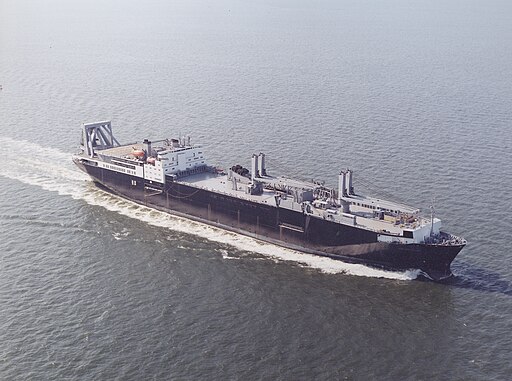
USNS GySgt Fred W. Stockham (T-AK-3017) was a surge sealift cargo ship operated by the United States Navy’s Military Sealift Command, named in honor of Gunnery Sergeant Fred W. Stockham, a Marine who posthumously received the Medal of Honor during World War I. The vessel embodied the modern philosophy of strategic prepositioning and rapid logistics deployment, serving as a key component in ensuring that U.S. forces could be supplied across global theaters with minimal delay. Designed to transport large quantities of rolling stock, containerized cargo, and heavy military equipment, the ship functioned as a floating warehouse and delivery platform capable of sustaining distant operations and reinforcing expeditionary forces without reliance on fixed basing infrastructure.
Hull Configuration and Structural Characteristics
The ship was constructed with a robust steel hull engineered for high-volume payload capacity and transoceanic endurance. Measuring approximately 950 feet in length with a beam surpassing 100 feet, the vessel was designed with a deep cargo profile and reinforced internal framing to support heavy tactical vehicles, armored assets, and bulk military supplies. Its displacement exceeded 60,000 tons at full load, reflecting a structure optimized for sustained operational stability rather than speed. The hull form prioritized seaworthiness and resistance to fatigue over prolonged missions, with longitudinal bulkheads and compartmentalization enhancing damage control survivability. Draft typically ranged between 30 and 35 feet depending on cargo load, making it well-suited for major commercial ports and strategic logistics hubs worldwide.
Propulsion Plant and Performance Parameters
USNS GySgt Fred W. Stockham utilized a conventional steam turbine propulsion system, driving a single propeller through reduction gearing. This configuration delivered a service speed of approximately 20 knots, suitable for integration into convoys and global logistics networks. The ship’s fuel capacity and machinery layout supported extended operational ranges exceeding 10,000 nautical miles without refueling, enabling fully autonomous transoceanic operations. While it was not designed for high-speed maneuvering, its propulsion system emphasized mechanical reliability, fuel economy, and consistent operational output across long distances, which were critical in sustaining military supply chains.
Cargo Systems and Load Handling Capabilities
The vessel was configured with multiple expansive cargo holds capable of accommodating a combination of containerized goods and breakbulk freight. Internal decks were engineered to support heavy tracked vehicles, artillery systems, and large logistics modules, with reinforced surfaces rated for significant axle loads. Integrated cargo handling gear included heavy-duty cranes and internal transfer systems that allowed autonomous loading and unloading operations even in ports lacking modern infrastructure. Roll-on/roll-off capability enabled rapid embarkation of vehicles through stern or side access points, reducing turnaround time between missions and increasing logistical responsiveness in operational theaters.
Crew Support and Habitability Systems
Crew accommodations were designed to support both civilian mariners and embarked military personnel under long-duration deployments. Living spaces featured climate-controlled quarters, galley facilities, medical stations, and operations rooms configured to ensure sustained performance in global climates. While not designed for troop transport on the scale of amphibious ships, the vessel could accommodate support teams and operational specialists necessary for mission execution. Habitability standards aimed at supporting extended deployments while maintaining operational readiness and crew morale.
Command Infrastructure and Navigational Systems
Navigation and command systems aboard GySgt Fred W. Stockham incorporated commercial and military-grade radar, GPS navigation arrays, electronic charting systems, and automated helm controls. The bridge was configured to ensure optimal situational awareness during port approaches and open-ocean transits. Communication systems allowed coordination with naval task forces, port authorities, and global logistics command centers, reinforcing the vessel’s integration within the wider Defense Transportation System. Redundant power and control systems ensured uninterrupted operations even during system maintenance or partial mechanical failure.
Strategic Role and Operational Legacy
Throughout its service life, USNS GySgt Fred W. Stockham played a vital role in reinforcing American military logistics during peacetime and conflict environments. Its operational presence ensured rapid deployment capabilities, strategic mobility, and sustained battlefield resupply for forces positioned far from domestic bases. As a surge sealift platform, it stood as a critical enabler of power projection, carrying the logistical backbone necessary for modern military operations. The ship’s design and operational record reflect the significance of robust maritime logistics in sustaining global military reach, cementing its legacy as an essential component of U.S. strategic transport infrastructure.
