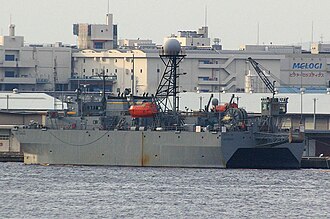
USNS Victorious (T‑AGOS‑19): Engineering, Mission, and Maritime Purpose
When discussing the backbone of modern undersea surveillance capabilities within the U.S. Navy, few ships encapsulate the marriage between advanced engineering and specialized mission design like the USNS Victorious (T‑AGOS‑19). Far different from traditional surface combatants or cargo carriers, Victorious is an ocean surveillance ship — a vessel conceived not to wield guns or launch aircraft, but rather to serve as a highly stable platform for acoustical detection systems critical to naval anti‑submarine warfare (ASW) and strategic maritime awareness. Built during the final decade of the Cold War and still active in the 2020s, Victorious stands as a testament to purpose‑built naval architecture that balances stability, endurance, and sensor integration.
Origins of the Victorious Design
The Victorious‑class program emerged from a U.S. Navy requirement in the 1980s to enhance long‑range submarine surveillance capability. The overarching goal was to field ships capable of towing highly sensitive arrays of hydrophones across deep ocean expanses, lowering them to optimal depths and enabling passive acoustical detection of quiet submarines well beyond the horizon of traditional sonar. To accomplish this, naval planners adopted a relatively unconventional hull form for a military vessel: the Small Waterplane Area Twin Hull (SWATH) design.
Unlike traditional monohull vessels, SWATH ships consist of two slender submerged hulls linked to the superstructure by narrow struts. This configuration minimizes the area on the sea surface that reacts to wave action, dramatically reducing vertical motion compared to conventional ships of similar displacement. For acoustic surveillance vessels like Victorious, such stability at slow speeds and in moderate to heavy seas is not merely a comfort feature — it is mission critical, because towing long, sensitive towed array systems demands exceedingly low ship motion to prevent sensor noise and array distortion.
Construction and Delivery
The keel for USNS Victorious was laid down on April 12, 1988, at McDermott Shipyards in Morgan City, Louisiana — a facility chosen for its broad experience with specialized marine construction. This shipyard undertook fabrication and assembly of the elaborate SWATH hull structure, integrating diesel‑electric propulsion systems and extensive mission equipment foundations. After two years of construction and outfitting, Victorious was launched in May 1990 and subsequently delivered to the U.S. Navy on August 13, 1991, officially entering service under the Military Sealift Command (MSC) as part of its Special Missions Program.
Assigned to MSC, Victorious is crewed predominantly by civilian mariners, with a complement sized to efficiently operate the vessel’s propulsion systems, logistics, and mission equipment support functions without compromising operational readiness.
Mission Focus: Ocean Surveillance and Acoustic Detection
At the center of Victorious’s mission package is the Surveillance Towed Array Sensor System (SURTASS) — a long, passive acoustic array that, when deployed, trails slowly behind the ship at depths optimized for ambient noise reception. SURTASS arrays leverage passive detection principles, listening for the faint acoustic signatures of submarines and other undersea contacts over extended ranges. Unlike active sonar, which emits pulses and listens for echoes, SURTASS is entirely passive, allowing for covert monitoring while minimizing the ship’s own acoustic footprint.
Deploying and towing such arrays requires not only robust winch and cable handling systems, but also a hull platform that generates minimal self‑noise and maintains steady course and speed. The SWATH hull’s exceptional motion damping is ideally matched to this role, enabling Victorious to spend extended periods — often in excess of 60 days on station — methodically towing hydrophone arrays along pre‑designated tracks.
Propulsion: Diesel‑Electric Integration
Under the hull, Victorious’s drive system is a diesel‑electric propulsion plant comprising multiple diesel generators coupled with electric motors that drive twin shafts. This configuration provides several advantages for an ocean surveillance vessel:
- Electric drive systems generate relatively low mechanical vibration compared with direct‑drive mechanical propulsion systems, reducing interference with sensitive acoustical sensors.
- Power produced by the diesel generators can be flexibly apportioned between propulsion and mission systems without complex mechanical reconfiguration.
- The twin shaft setup offers redundancy and maneuverability during array deployment operations.
Across various sources, Victorious’s installed shaft horsepower is often noted at approximately 1,600 hp, sufficient to propel the hull at a maximum cruise speed of just under 10 knots. When towing a SURTASS array, practical operational speeds reduce to approximately 3 knots to accommodate the drag and ensure optimal acoustic performance.
Operational Theater and Maritime Deployments
While defined by its mission rather than geographic stationing, Victorious has been observed operating in diverse seas across the Pacific and beyond. Typical operations involve long transits to acoustically significant regions — such as deep water basins where submarine traffic or strategic patrol routes are likely — where Victorious can conduct methodical sweeps.
One notable operational flashpoint occurred in 2009 when Victorious encountered harassing approaches by Chinese patrol vessels and an aircraft in the Yellow Sea during operations conducted in international waters. On one occasion, a Chinese maritime patrol vessel illuminated Victorious with high–intensity spotlights at close range, and on other occasions, multiple close fly‑bys were executed by a Chinese Y‑12 aircraft at low altitude. On subsequent patrols, Chinese vessels made repeated approaches, at times forcing Victorious to temporarily stop to avoid collision. These incidents underscored both the sensitive geopolitical implications of ocean surveillance missions and the challenging interoperability landscape encountered by U.S. Navy assets conducting lawful operations in contested environments.
Crew and Life Onboard
Operationally, USNS Victorious typically carries a small civilian crew under MSC authority — generally 19 civilian mariners and a handful of additional support personnel. In certain missions, technical operators may augment the complement, especially when advanced array handling or specialized mission data processing is required. The minimalist crew size reflects both the automated nature of much of the ship’s systems and the requirement for efficient logistics on extended station periods.
Life aboard a surveillance ship differs markedly from life on a combatant. Speed is modest, accommodations are designed for extended endurance rather than rapid maneuver, and daily routines prioritize array deployment cycles, acoustic data monitoring, and maintenance of equipment. The ship’s stability at sea, afforded by the SWATH hull, translates into a living environment where seasickness is minimized even in rough conditions — a critical quality for crew endurance on lengthy deployments.
Technical Evolution and Modernization Challenges
Though the core architecture of Victorious dates to the late 1980s and early 1990s, the enduring utility of ocean surveillance has driven incremental modernization in sensors, communications, and data integration. Over the life of the platform, advances in digital signal processing, enhanced fiber optic towed arrays, and satellite communications have continually expanded the vessel’s effectiveness without fundamentally altering its hull form or propulsion plant.
Moreover, the larger strategic environment for ocean surveillance has evolved. As potential undersea adversaries deploy quieter submarines with improved stealth coatings and propulsion systems, passive acoustics remain a cornerstone of undersea detection. Ships like Victorious thus provide not only near‑term operational capability but also critical feedback on array performance and environmental acoustics that inform future system development.
SWATH Hull: Innovation Meets Naval Purpose
Victorious’s SWATH hull form deserves special attention, as it represents one of the relatively few instances in U.S. naval architecture where this technology was adopted at scale. By minimizing the area of the vessel’s waterplane — the cross‑section of the hull at the surface — a SWATH hull dramatically reduces heave, pitch, and roll induced by wave action.
This low response to wave motion is not only beneficial for crew comfort; more importantly, it enhances the fidelity of towed sensors by reducing the variable forces acting on the tow cable and array. Early sea trials, conducted through the early 1990s, validated that Victorious could maintain a stable operational platform even in sea states that would severely compromise similar missions on conventional hulls.
Legacy and Continued Service
After more than three decades in service, USNS Victorious has accrued an operational legacy that bridges late‑Cold War acoustical strategies to 21st‑century undersea awareness missions. While the pace of global naval development has accelerated, the basic tenets of passive surveillance remain rooted in physics: sound travels far in the ocean, and understanding what lies beneath the waves requires platforms capable of listening with precision.
Victorious and her sister ships in the class occupy a strategic niche in that broader surveillance architecture, working in concert with satellites, fixed undersea arrays, acoustic gliders, and unmanned vehicles to build a comprehensive maritime picture. Their contributions may not feature headline maneuvers or kinetic action, yet they form an indispensable layer of persistence in the naval intelligence mosaic. (navysite.de)
Technical Parameters of USNS Victorious (T‑AGOS‑19)
| Parameter | Specification |
|---|---|
| Hull Form | SWATH (Small Waterplane Area Twin Hull) |
| Class/Type | Victorious‑class Ocean Surveillance Ship |
| Builder | McDermott Shipyards, Morgan City, Louisiana |
| Keel Laid | April 12, 1988 |
| Launched | May 3, 1990 |
| Delivered/Commissioned | August 13, 1991 |
| Displacement (Light) | ~3,100 tons |
| Displacement (Full Load) | ~3,384 tons |
| Length Overall | ~235 ft (~72 m) |
| Beam | ~94 ft (~29 m) |
| Draft (Max) | ~25 ft (~7.6 m) |
| Propulsion | Diesel‑electric, 2 shafts |
| Installed Shaft Horsepower | ~1,600 hp |
| Maximum Speed | ~9.6–10 knots (approx.) |
| Operational Tow Speed | ~3 knots (with SURTASS) |
| Complement | ~19 civilian mariners + mission personnel |
| Mission System | SURTASS passive sonar array |
| Call Sign | NVIC |
| Flag | United States of America |
| Homeport | (Variable, Pacific and Atlantic deployments) |
