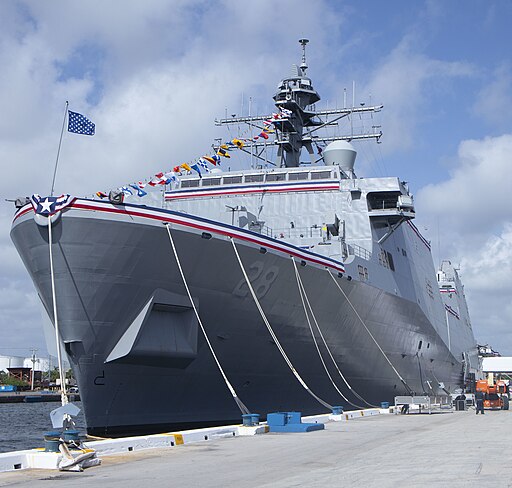
USS Fort Lauderdale (LPD-28)
USS Fort Lauderdale (LPD-28): A Modern Amphibious Transport Dock Ship
The USS Fort Lauderdale (LPD-28) is a San Antonio-class amphibious transport dock ship that represents a significant advancement in the U.S. Navy’s fleet capabilities. Commissioned on July 30, 2022, this cutting-edge vessel is named in honor of the city of Fort Lauderdale, Florida, a community with strong ties to the military and maritime industry. As part of the San Antonio-class, the USS Fort Lauderdale plays a critical role in the Navy’s mission to support expeditionary warfare, disaster relief, and humanitarian operations.
Development and Construction
The USS Fort Lauderdale was built by Huntington Ingalls Industries (HII) at its Ingalls Shipbuilding facility in Pascagoula, Mississippi. Construction began in 2017, and the keel was laid on October 13, 2017, signifying the start of its physical assembly. The ship was christened on August 21, 2021, in a ceremony attended by distinguished guests, including the ship’s sponsor, Meredith Berger, who served as the Assistant Secretary of the Navy for Energy, Installations, and Environment.
The ship incorporates technological improvements developed from lessons learned in the construction and operation of earlier San Antonio-class vessels. These advancements include upgraded command-and-control systems, enhanced survivability features, and improved habitability for the crew and embarked personnel.
Design and Specifications
The San Antonio-class ships, including the USS Fort Lauderdale, are designed to transport and deploy Marines, their equipment, and vehicles for a wide range of missions. The LPD-28 features the following key specifications:
- Length: 684 feet (208 meters)
- Beam: 105 feet (32 meters)
- Draft: 23 feet (7 meters)
- Displacement: Approximately 25,000 tons (full load)
- Speed: Over 22 knots
- Crew: Around 400 personnel, including officers and enlisted sailors
- Embarked Forces: Can accommodate up to 800 Marines
The ship boasts a well deck for launching and recovering amphibious craft and vehicles, such as Landing Craft Air Cushion (LCAC) and conventional landing craft. It also features a flight deck capable of supporting a variety of aircraft, including the MV-22B Osprey tiltrotor and CH-53E Super Stallion helicopters, making it versatile in amphibious assault operations.
Mission Capabilities
The USS Fort Lauderdale is purpose-built for a range of operational scenarios:
- Amphibious Operations: The primary mission of the ship is to support the transport and landing of troops, vehicles, and supplies. The well deck and flight deck make it a vital component in amphibious assault missions, allowing rapid deployment of forces onto hostile shores.
- Humanitarian Assistance and Disaster Relief (HADR): The ship’s ability to carry large amounts of supplies and equipment, combined with medical facilities onboard, makes it an excellent platform for providing aid in the aftermath of natural disasters.
- Command and Control: Equipped with state-of-the-art communications and sensor systems, the USS Fort Lauderdale can serve as a mobile command center for joint operations. Its advanced network infrastructure enables seamless coordination between naval, air, and ground forces.
- Anti-Terrorism and Security Operations: The ship’s defensive capabilities include the Mk 46 Mod 2 Gun Weapon System, .50-caliber machine guns, and advanced radar systems. These features ensure its survivability in high-threat environments.
- Special Operations: The ship is capable of supporting special operations missions, providing a launch and recovery platform for small boats and covert teams.
Key Features and Upgrades
1. Steel Beach and Habitability Enhancements
The USS Fort Lauderdale was designed with a focus on improving the quality of life for sailors and Marines onboard. Spacious berthing areas, recreational spaces, and improved climate control systems contribute to better morale and operational efficiency.
2. Optimized Command Systems
LPD-28 incorporates cutting-edge C4ISR (Command, Control, Communications, Computers, Intelligence, Surveillance, and Reconnaissance) systems, which enhance situational awareness and enable real-time data sharing across the fleet.
3. Survivability
The ship is equipped with advanced defensive measures, such as Electronic Countermeasures (ECM) and reinforced structural components, to withstand missile and small-arms fire.
4. Fuel Efficiency
Efforts were made during construction to improve the ship’s fuel efficiency, reducing operational costs and environmental impact over its lifetime.
Operational History and Strategic Importance
While the USS Fort Lauderdale is still in its early years of service, its commissioning marked a milestone in the Navy’s ongoing effort to modernize its amphibious fleet. As part of the U.S. Navy’s 10th Fleet, the ship contributes to ensuring maritime dominance, particularly in contested environments where rapid and flexible response capabilities are crucial.
The LPD-28 is expected to operate globally, supporting missions in the Indo-Pacific, Mediterranean, and other regions where amphibious capabilities are required. The ship’s ability to project power, sustain operations, and provide humanitarian assistance aligns with the Navy’s strategic goals of maintaining freedom of navigation and supporting allies.
Community Connection
The naming of the USS Fort Lauderdale pays tribute to the strong ties between the Navy and the city. Fort Lauderdale has long been a hub for naval activity, particularly during World War II, when it served as a training center for naval aviators. The community continues to honor its naval heritage through events and partnerships, such as Fleet Week and the annual Air Show.
The ship’s commissioning ceremony in 2022 was a proud moment for the city, highlighting the enduring relationship between Fort Lauderdale and the U.S. Navy. Local leaders and residents alike celebrated the vessel’s addition to the fleet, underscoring the pride the community takes in its role in supporting the armed forces.
Conclusion
The USS Fort Lauderdale (LPD-28) stands as a testament to the innovation, dedication, and strategic foresight of the U.S. Navy and its shipbuilding partners. Designed to meet the challenges of modern warfare and humanitarian missions, this San Antonio-class ship exemplifies versatility and capability. As it continues its service, the USS Fort Lauderdale will undoubtedly play a vital role in safeguarding U.S. interests, supporting allies, and providing assistance wherever it is needed.
_currently_moored_at_Port_Everglades,_Fort_Lauderdale_before_her_commissioning_ceremony.jpg)