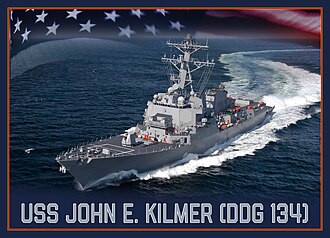
USS John E. Kilmer (DDG-134): A Future Flight III Destroyer Honoring Valor and Strengthening America’s Naval Power
The United States Navy has a long-standing tradition of naming its warships after individuals whose courage, leadership, and dedication to the nation have left an enduring mark on American history. These names transform modern warships into living memorials, reminding every sailor who serves aboard them that they are carrying forward the legacy of extraordinary people. One of the newest destroyers to continue this tradition is USS John E. Kilmer (DDG-134), a Flight III Arleigh Burke-class guided-missile destroyer named in honor of Sergeant Major John E. Kilmer, a decorated United States Marine whose heroism during the Vietnam War earned him the Navy Cross. Although the ship is still in the early stages of its construction and has yet to begin operational service, it already represents the future of American surface warfare. Equipped with cutting-edge radar technology, sophisticated missile defense systems, and the flexibility to perform virtually every major naval mission, USS John E. Kilmer is expected to become one of the most capable multi-mission combatants in the U.S. Navy for decades to come.
Modern destroyers are no longer simply escorts for larger warships. They have evolved into highly sophisticated combat platforms capable of independently defending entire naval task forces, intercepting ballistic missiles, striking targets hundreds of miles inland, tracking hostile submarines, supporting humanitarian operations, and integrating seamlessly into multinational military networks. USS John E. Kilmer will join the fleet during a period of rapidly changing maritime security challenges, where advanced technology, information dominance, and operational flexibility have become just as important as traditional naval firepower.
The Marine Behind the Ship’s Name
USS John E. Kilmer honors Sergeant Major John Edward Kilmer, one of the most respected enlisted Marines of the Vietnam War. Born in Highland Park, Michigan, Kilmer joined the United States Marine Corps in 1962 and quickly established himself as an exceptional leader. During the Vietnam War he repeatedly demonstrated remarkable courage under enemy fire while leading Marines in difficult combat situations.
His most famous actions occurred in July 1965 during Operation Starlite, the first major offensive conducted by U.S. Marines in Vietnam. While serving as a platoon sergeant, Kilmer exposed himself to intense enemy fire on multiple occasions to organize his Marines, evacuate wounded personnel, and direct attacks against well-defended enemy positions. His fearless leadership and complete disregard for personal safety inspired those around him and contributed directly to the success of the mission. For these extraordinary actions he was awarded the Navy Cross, the United States Navy and Marine Corps’ second-highest decoration for valor.
Kilmer continued serving in the Marine Corps for many years, eventually attaining the rank of Sergeant Major. Throughout his career he became known not only for battlefield courage but also for exceptional leadership, professionalism, and dedication to mentoring younger Marines. Naming DDG-134 in his honor ensures that future generations of sailors will carry forward the legacy of a Marine whose service exemplified courage, commitment, and selfless leadership.
The Evolution of the Arleigh Burke Class
USS John E. Kilmer belongs to the Arleigh Burke class, a destroyer design that has become the backbone of the United States Navy’s surface fleet. Since the commissioning of the lead ship, USS Arleigh Burke (DDG-51), in 1991, the class has proven remarkably adaptable, evolving through multiple production flights while continuously incorporating new technologies and capabilities.
Unlike specialized warships that focus on only one mission area, Arleigh Burke-class destroyers are true multi-role combatants. They defend carrier strike groups against aircraft and missiles, conduct ballistic missile defense missions, hunt submarines, engage hostile surface ships, launch precision land-attack missiles, escort commercial shipping, enforce maritime security, participate in disaster relief operations, and integrate with allied naval forces around the world.
The decision to continue producing Flight III destroyers demonstrates the Navy’s confidence in the platform. Rather than replacing the class entirely, engineers have refined and modernized the design to address emerging threats while preserving the reliability, survivability, and operational flexibility that have made the Arleigh Burke class one of the most successful destroyer programs in naval history.
Construction and Development
Built at Bath Iron Works
USS John E. Kilmer is being built by General Dynamics Bath Iron Works in Bath, Maine, one of the nation’s premier naval shipyards. For well over a century, Bath Iron Works has constructed some of America’s finest surface combatants, earning its reputation as the “Bath Built is Best Built” shipyard through generations of craftsmanship and engineering excellence.
Constructing a modern guided-missile destroyer is an extraordinarily complex undertaking. Millions of individual components must be fabricated, tested, installed, and integrated into a fully operational combat system. Thousands of engineers, naval architects, electricians, welders, pipefitters, software specialists, and quality assurance personnel contribute their expertise throughout the construction process.
Modern modular shipbuilding techniques allow large sections of the vessel to be assembled independently before being joined together in dry dock. This approach improves construction efficiency while maintaining the exacting standards required for a frontline warship expected to remain in service for several decades.
Preparing for Fleet Service
Following structural completion, USS John E. Kilmer will undergo extensive outfitting as propulsion systems, radar arrays, communications equipment, weapons, sensors, navigation systems, and combat software are installed and tested. Dock trials and sea trials will verify that every system functions as designed before the Navy formally accepts the ship and places it into active service.
Once commissioned, the destroyer will begin an operational career expected to span nearly four decades.
Flight III: The Most Advanced Burke Yet
AN/SPY-6(V)1 Air and Missile Defense Radar
The defining feature of Flight III destroyers is the revolutionary AN/SPY-6(V)1 Air and Missile Defense Radar, one of the most capable naval radar systems ever developed. Built using modular gallium nitride technology, SPY-6 provides dramatically greater sensitivity, reliability, and detection range than previous generations of naval radar.
The system can simultaneously detect, track, and discriminate hundreds of airborne targets, including conventional aircraft, stealth platforms, cruise missiles, ballistic missiles, and increasingly sophisticated hypersonic threats. Its improved sensitivity enables commanders to identify smaller and more distant targets while providing more accurate tracking information for missile engagements.
Aegis Baseline 10 Combat System
Working alongside SPY-6 is the Aegis Baseline 10 Combat System, integrating radar, electronic warfare sensors, communications, weapons, and decision-support software into a unified combat management architecture. Advanced computing systems process enormous volumes of sensor data in real time, enabling rapid engagement decisions while coordinating defensive operations with nearby ships, aircraft, and allied forces.
This high degree of automation significantly enhances situational awareness and allows the destroyer to respond effectively to complex multi-directional attacks.
Weapons and Firepower
Mk 41 Vertical Launch System
USS John E. Kilmer carries a 96-cell Mk 41 Vertical Launch System (VLS), providing exceptional flexibility by allowing multiple missile types to be loaded according to mission requirements. Depending on deployment objectives, the destroyer can carry Standard Missile variants for fleet air defense and ballistic missile interception, Tomahawk cruise missiles for long-range precision strikes, Vertical Launch ASROC anti-submarine weapons, and Evolved Sea Sparrow Missiles for close-range defense.
This modular missile architecture allows commanders to adapt the ship’s offensive and defensive capabilities without structural modifications, making the destroyer suitable for a wide variety of operational environments.
Naval Gun and Close-In Protection
Complementing the missile battery is the Mk 45 Mod 4 5-inch naval gun, capable of providing naval surface fire support, engaging hostile ships, and defending against selected aerial threats. Its versatility continues to make it an important weapon despite the increasing prominence of missile systems.
For last-ditch defense against incoming anti-ship missiles, the destroyer employs the Phalanx Close-In Weapon System (CIWS), supported by sophisticated electronic warfare equipment, decoys, and countermeasure launchers that help defeat incoming threats before impact.
Anti-Submarine Warfare Excellence
Submarines remain among the most dangerous threats facing modern naval forces, making anti-submarine warfare a core mission for every Arleigh Burke-class destroyer. USS John E. Kilmer combines advanced hull-mounted sonar, a sophisticated towed sonar array, acoustic processing systems, and embarked MH-60R Seahawk helicopters to detect, classify, and engage hostile submarines across large ocean areas.
The embarked helicopters dramatically extend the ship’s surveillance capability through the use of dipping sonar, sonobuoys, torpedoes, and advanced maritime sensors. Working together with submarines, maritime patrol aircraft, and allied naval forces, the destroyer forms part of a comprehensive undersea warfare network.
Ballistic Missile Defense
One of the most strategically significant missions assigned to Flight III destroyers is ballistic missile defense. USS John E. Kilmer will integrate into the Navy’s global missile defense architecture, helping protect carrier strike groups, allied territories, deployed military forces, and critical infrastructure against short-, medium-, and intermediate-range ballistic missile attacks.
The combination of SPY-6 radar and advanced Standard Missile interceptors provides greatly enhanced tracking accuracy and engagement capability against increasingly sophisticated missile threats. As missile technology continues to evolve worldwide, this defensive role will remain one of the destroyer’s highest priorities.
Network-Centric Warfare
Modern naval warfare depends not only on individual ships but also on their ability to exchange information rapidly across joint and allied networks. USS John E. Kilmer will serve as an important node within this connected battlespace, sharing radar tracks, intelligence, targeting information, and command data with aircraft, submarines, satellites, carrier strike groups, and allied navies.
This network-centric approach enables distributed maritime operations, allowing widely separated forces to coordinate their actions while maintaining operational flexibility across enormous ocean regions.
Life on Board
Operating one of the Navy’s most sophisticated warships requires a crew of approximately 330 highly trained officers and enlisted sailors. Every member contributes to maintaining propulsion systems, combat equipment, communications, electrical distribution, navigation, aviation support, logistics, and damage control.
Life aboard a destroyer demands professionalism, technical expertise, and endurance. Sailors stand continuous watches, conduct preventive maintenance, participate in realistic training exercises, and remain prepared to respond immediately to emergencies or combat situations. The teamwork developed through these shared experiences creates the strong unit cohesion that has long characterized the surface fleet.
Strategic Importance for the Future Fleet
The maritime security environment continues to become more complex as nations invest in advanced missiles, submarines, electronic warfare systems, cyber capabilities, and unmanned platforms. Flight III destroyers like USS John E. Kilmer are specifically designed to operate successfully within this challenging environment by combining powerful sensors, integrated command systems, flexible weapons, and exceptional survivability.
Whether escorting aircraft carriers in the Indo-Pacific, participating in NATO operations in the Atlantic, conducting missile defense patrols, enforcing freedom of navigation, or providing humanitarian assistance after natural disasters, the destroyer will serve as one of the Navy’s most versatile and heavily utilized surface combatants.
Conclusion
USS John E. Kilmer (DDG-134) represents both a tribute to extraordinary Marine Corps heroism and a major investment in the future of American naval power. Named after Sergeant Major John E. Kilmer, whose courage during the Vietnam War earned one of the nation’s highest military decorations, the destroyer carries forward a legacy of leadership, sacrifice, and unwavering commitment to duty.
At the same time, its Flight III design places it among the most technologically advanced surface combatants ever constructed. Featuring the powerful SPY-6 radar, the Aegis Baseline 10 Combat System, a versatile 96-cell Vertical Launch System, advanced anti-submarine capabilities, and integrated network warfare technologies, USS John E. Kilmer is well prepared to meet the challenges of twenty-first-century maritime operations. As it enters service in the years ahead, it will stand as both a memorial to an American hero and a cornerstone of the U.S. Navy’s future surface fleet.
Technical Specifications
| Specification | Details |
|---|---|
| Ship Name | USS John E. Kilmer (DDG-134) |
| Class | Arleigh Burke-class guided-missile destroyer |
| Flight | Flight III |
| Hull Number | DDG-134 |
| Builder | General Dynamics Bath Iron Works, Bath, Maine |
| Status | Under construction |
| Ordered | Fiscal Year 2024 procurement |
| Length | 509.5 ft (155.3 m) |
| Beam | 66 ft (20.1 m) |
| Draft | Approximately 31 ft (9.4 m) |
| Full-Load Displacement | Approximately 9,700–9,900 tons |
| Propulsion | 4 × General Electric LM2500 gas turbines, 2 shafts |
| Power Output | Approximately 100,000 shp (75 MW) |
| Maximum Speed | More than 30 knots (56 km/h) |
| Range | Approximately 4,400 nautical miles at 20 knots |
| Crew | Approximately 330 officers and enlisted personnel |
| Radar | AN/SPY-6(V)1 Air and Missile Defense Radar |
| Combat System | Aegis Baseline 10 |
| Vertical Launch System | 96-cell Mk 41 VLS |
| Main Gun | 1 × 5-inch (127 mm) Mk 45 Mod 4 |
| Close-In Defense | Phalanx CIWS, electronic warfare suite, decoys |
| Aviation Facilities | Flight deck and hangar for 2 × MH-60R Seahawk helicopters |
| Primary Missions | Air defense, ballistic missile defense, anti-submarine warfare, anti-surface warfare, land attack, maritime security, escort operations |
| Expected Service Life | Approximately 35–40 years |
_artist_depiction.jpg)