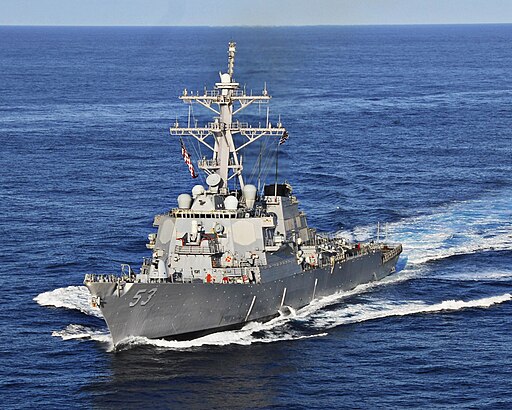
USS John Paul Jones (DDG-53)
USS John Paul Jones (DDG-53): A Vanguard of Naval Power and Precision
The USS John Paul Jones (DDG-53) is a guided missile destroyer of the Arleigh Burke-class, one of the most advanced and powerful surface combatants in the United States Navy. Named after John Paul Jones, a Revolutionary War naval commander often regarded as the “Father of the American Navy,” the ship honors a legacy of bold leadership and combat excellence.
Commissioned on December 18, 1993, and built by Bath Iron Works in Maine, the USS John Paul Jones was the third ship in the Arleigh Burke class and the first of the Flight I variant to receive a series of upgrades that would shape the future of Aegis-equipped warships. With its multi-mission capability, it excels in anti-air warfare (AAW), anti-submarine warfare (ASW), anti-surface warfare (ASuW), and strike operations.
Strategic Role and Capabilities
The USS John Paul Jones plays a critical role in the Navy’s global mission of sea control, power projection, and defense of the fleet. It is particularly noted for being among the first destroyers modified for Ballistic Missile Defense (BMD) and has served as a testbed and frontline operator of the Aegis BMD system, capable of detecting and intercepting short to intermediate-range ballistic missiles.
The ship is also a prominent part of Carrier Strike Groups (CSGs), providing high-end escort and integrated firepower capabilities that ensure fleet survivability and dominance in high-threat environments.
General Characteristics
- Class and Type: Arleigh Burke-class guided missile destroyer (Flight I)
- Hull Number: DDG-53
- Builder: Bath Iron Works, Bath, Maine
- Commissioned: December 18, 1993
- Homeport: Naval Base San Diego, California
Dimensions and Displacement:
- Length: 505 feet (154 meters)
- Beam: 66 feet (20 meters)
- Draft: 31 feet (9.4 meters)
- Displacement: Approx. 8,900 tons (full load)
These dimensions grant the ship a relatively small radar profile while still maintaining robust structural integrity and capacity for advanced systems and weapons.
Propulsion and Performance
The USS John Paul Jones employs a gas turbine propulsion system, enabling high speeds and rapid acceleration, critical for both strike and defensive maneuvering.
Propulsion System:
- Engines: 4 × General Electric LM2500-30 gas turbines
- Total Power: 100,000 shaft horsepower (75 MW)
- Propulsion: 2 shafts with controllable pitch propellers
Performance Metrics:
- Speed: In excess of 30 knots
- Range: 4,400 nautical miles at 20 knots
The combination of speed, range, and power allows DDG-53 to respond rapidly to emerging threats and reposition across wide theaters of operation.
Sensors, Radar, and Combat Systems
At the heart of the ship’s operational superiority is the Aegis Combat System, a state-of-the-art suite that integrates radar, sensors, and fire control systems to manage threats in real-time.
Key Sensor and Combat Systems:
- AN/SPY-1D(V) phased-array radar – provides 360-degree coverage for air and missile threats
- Aegis Baseline 9C – integrates BMD and anti-air capabilities
- AN/SQQ-89(V)15 – integrated sonar suite for ASW (including hull-mounted sonar and towed array)
- AN/SQS-53C sonar – active/passive sonar for underwater detection
- Mk 116 fire control system
- Electronic Warfare: AN/SLQ-32(V)3 system with radar jamming and deception capabilities
Ballistic Missile Defense:
- Equipped with SM-3 and SM-6 missiles for exo-atmospheric missile intercepts
- Full integration with Aegis Ballistic Missile Defense System
- Linked to C2BMC (Command and Control, Battle Management, and Communications) systems
USS John Paul Jones was one of the first to conduct live intercept tests using the SM-6, marking a significant evolution in naval air and missile defense.
Weapons and Armament
The ship’s extensive weapons array allows it to conduct multi-domain operations simultaneously. It can engage aircraft, missiles, ships, submarines, and land targets with precision.
Vertical Launch System (VLS):
- Mk 41 VLS with 90 cells (29 forward, 61 aft)
- Capable of launching:
- RIM-66 Standard Missiles (SM-2)
- RIM-174 Standard Extended Range Active Missile (SM-6)
- RIM-161 Standard Missile 3 (SM-3) for BMD
- Tomahawk Land Attack Missiles (TLAM)
- RUM-139 VL-ASROC for anti-submarine warfare
Gun Systems:
- 1 × 5-inch/54 caliber (127 mm) Mk 45 gun – for shore bombardment and surface targets
- 2 × Mk 38 25 mm autocannons
- 4 × .50 caliber (12.7 mm) machine guns
Close-In Defense:
- 2 × Phalanx CIWS (Close-In Weapon Systems) – last-resort missile defense
- Chaff and decoy launchers for missile countermeasures
Torpedo Tubes:
- 2 × Mk 32 triple-tube launchers for Mk 46/Mk 54 lightweight torpedoes
These armaments provide an exceptionally flexible offensive and defensive capability across all warfare domains.
Aviation Facilities
Although not a full aviation platform like cruisers or amphibious ships, the USS John Paul Jones includes a helicopter flight deck but does not have a hangar.
- Flight deck supports operations of:
- SH-60B Seahawk or MH-60R/S helicopters
- Supports vertical replenishment and ASW missions via embarked helicopters
Crew and Accommodations
- Crew Complement: Approximately 300 personnel (23 officers, 38 chief petty officers, and 240 enlisted)
- Accommodations include:
- Enlisted and officer berthing compartments
- Medical and dental facilities
- Gym and recreation areas
- Advanced galley and dining facilities for long deployments
Habitability and ergonomics were improved over previous destroyer classes, making Arleigh Burke-class ships like the John Paul Jones more livable on extended deployments.
Operational History
Since its commissioning, the USS John Paul Jones has had a distinguished operational history. It has participated in:
- Operation Southern Watch and Operation Iraqi Freedom
- Ballistic Missile Defense testing, including SM-3 intercepts
- Pacific Rim (RIMPAC) exercises
- Forward deployments with Carrier Strike Group 1 and Pacific deterrence operations
In 2014, it became the Navy’s primary missile defense test ship, taking over from the USS Lake Erie, highlighting its pivotal role in advancing future missile defense technologies.
Legacy of John Paul Jones
John Paul Jones, the ship’s namesake, is famous for his audacious naval tactics during the American Revolutionary War. His immortal quote, “I have not yet begun to fight!,” symbolizes unwavering resolve, which the destroyer strives to uphold in every mission. The USS John Paul Jones continues to honor his legacy by being at the forefront of naval innovation and combat readiness.
Conclusion
The USS John Paul Jones (DDG-53) is more than just a warship—it’s a floating fortress, a missile defense shield, and a symbol of American maritime strength. With its blend of powerful armament, advanced sensors, and multi-role versatility, DDG-53 remains one of the most formidable destroyers in the world.
As naval warfare continues to evolve, the USS John Paul Jones stands ready to defend, deter, and, if necessary, dominate—true to the spirit of its namesake and the proud tradition of the United States Navy.
