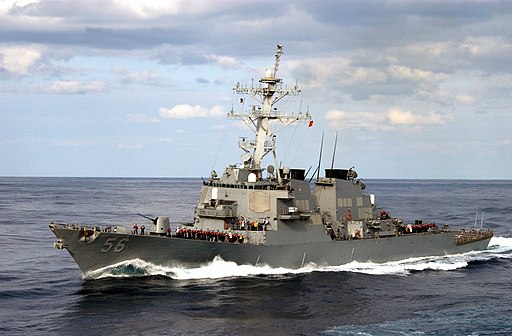
USS John S. McCain (DDG-56)
USS John S. McCain (DDG-56): Resolute Defender of the Indo-Pacific
The USS John S. McCain (DDG-56) is an Arleigh Burke-class guided missile destroyer, a formidable warship designed to perform multi-mission operations that span the full spectrum of naval warfare. As one of the premier surface combatants of the United States Navy, DDG-56 combines lethal firepower, advanced sensors, and flexible capabilities to protect the U.S. and its allies across the globe.
Named in honor of Admiral John S. McCain Sr. and Admiral John S. McCain Jr., and later rededicated to include Senator John S. McCain III, the ship serves as a living tribute to a distinguished naval lineage. It is permanently forward-deployed to Yokosuka, Japan, as part of the U.S. Seventh Fleet, where it plays a crucial role in maintaining a free and open Indo-Pacific.
Origins and Commissioning
The USS John S. McCain was built by Bath Iron Works in Maine and was commissioned on July 2, 1994. As a Flight I variant of the Arleigh Burke class, the ship was among the earliest destroyers to feature the revolutionary Aegis Combat System, integrating radar, weapons, and control systems into a single powerful platform.
Designed for anti-air warfare (AAW), anti-submarine warfare (ASW), anti-surface warfare (ASuW), and strike warfare, DDG-56 has evolved with successive upgrades to maintain its edge against emerging threats in the region.
General Characteristics
- Class and Type: Arleigh Burke-class guided missile destroyer (Flight I)
- Hull Number: DDG-56
- Homeport: Fleet Activities Yokosuka, Japan
- Builder: Bath Iron Works, Bath, Maine
- Commissioned: July 2, 1994
Dimensions and Displacement:
- Length: 505 feet (154 meters)
- Beam: 66 feet (20 meters)
- Draft: 31 feet (9.4 meters)
- Displacement: 8,900 tons (full load)
These design parameters give the ship excellent seaworthiness, survivability, and adaptability across a broad range of missions.
Propulsion and Performance
The USS John S. McCain features a gas turbine propulsion system that gives it the speed and range to operate rapidly across vast distances, especially in the wide expanse of the Pacific Ocean.
Propulsion System:
- Engines: 4 × General Electric LM2500-30 gas turbines
- Total Power: 100,000 shaft horsepower
- Propulsion: 2 shafts, controllable pitch propellers
Performance:
- Maximum Speed: 30+ knots
- Range: 4,400 nautical miles at 20 knots
This performance enables the ship to escort carrier strike groups, conduct independent operations, and respond to contingencies with agility.
Sensors, Radar, and Combat Systems
Central to DDG-56’s effectiveness is the Aegis Combat System, a battle management suite that integrates sensors, weapons, and decision-making tools into a unified network for rapid threat response.
Sensor and Combat System Suite:
- Radar: AN/SPY-1D phased array radar
- Sonar: AN/SQS-53C hull-mounted sonar, AN/SQR-19 TACTAS (towed array sonar)
- Electronic Warfare: AN/SLQ-32(V)3 EW suite
- Fire Control: Mk 99 Fire Control System
- Combat System: Aegis Baseline 9 with Cooperative Engagement Capability (CEC)
This configuration allows the ship to track and engage dozens of targets simultaneously, across air, surface, and sub-surface domains.
Ballistic Missile Defense (BMD) Role
The USS John S. McCain has been upgraded to participate in the Navy’s Ballistic Missile Defense mission. Equipped with the Aegis BMD system, it can:
- Detect and track ballistic missiles
- Launch SM-3 and SM-6 interceptors
- Integrate with global BMD architecture via satellite uplinks
This capability enhances deterrence and defense against missile threats to U.S. forces and regional allies, particularly in East Asia.
Weapons and Armament
The ship’s firepower is built around its Mk 41 Vertical Launching System (VLS) and a host of other modern weaponry.
Vertical Launch System:
- Total Cells: 90 (29 forward, 61 aft)
- Capable of launching:
- RIM-66 SM-2 and SM-6 surface-to-air missiles
- Tomahawk Land Attack Missiles (TLAM)
- RUM-139 VL-ASROC anti-submarine rockets
- SM-3 interceptors for BMD
Surface and Close-In Weapons:
- Guns:
- 1 × Mk 45 5-inch/54 caliber naval gun
- 2 × Mk 38 25 mm chain guns
- CIWS:
- 2 × Phalanx Close-In Weapon Systems (Block 1B)
- Machine Guns:
- Multiple .50-caliber mounts for force protection
Anti-Submarine Warfare:
- Torpedo Tubes:
- 2 × Mk 32 triple launchers for Mk 46 or Mk 54 torpedoes
This comprehensive armament suite ensures that the USS John S. McCain is combat-capable in a variety of threat environments, from littoral zones to open ocean.
Aviation Facilities
While the ship has no enclosed hangar, it is equipped with a flight deck that supports limited helicopter operations.
- Flight Deck Capabilities:
- Supports MH-60R Seahawk helicopters
- Allows for vertical replenishment (VERTREP), medevac, and ASW operations
Helicopter support extends the ship’s surveillance, targeting, and submarine-hunting capabilities.
Crew and Habitability
- Crew Complement: Approximately 300 officers and enlisted personnel
- Accommodations:
- Modern berthing compartments
- Dining and recreation areas
- Onboard medical and dental facilities
The Arleigh Burke-class ships, including DDG-56, are designed for long-range deployments, with habitability in mind to support high-tempo operations over extended periods.
Operational History and Engagements
The USS John S. McCain has had a distinguished operational career, often serving at the forefront of U.S. naval diplomacy and presence missions.
Key Operations and Deployments:
- Ballistic Missile Defense patrols in the Western Pacific
- Freedom of Navigation Operations (FONOPs) in the South China Sea and Taiwan Strait
- Participation in RIMPAC and Joint Naval Exercises with allies such as Japan, South Korea, and Australia
- Disaster relief missions and non-combatant evacuations
- Anti-piracy patrols in Southeast Asian waters
Notable Events:
- In 2017, the ship suffered a tragic collision with the tanker Alnic MC near Singapore, resulting in the deaths of 10 sailors. Following extensive repairs and upgrades, the ship returned to active duty in 2020, reaffirming its resilience and continued mission readiness.
Legacy and Dedication
Originally named for two prominent admirals, in 2018, the ship was rededicated to also honor Senator John S. McCain III, a Vietnam War veteran, prisoner of war, and long-time U.S. Senator and advocate for the military. The rededication reflects the ship’s embodiment of courage, sacrifice, and leadership.
Conclusion
The USS John S. McCain (DDG-56) stands as a powerful testament to American naval strength and commitment to regional security in the Indo-Pacific. Its ability to engage in missile defense, escort missions, sea control, and crisis response makes it an indispensable asset in modern warfare.
As tensions rise and global challenges increase, the USS John S. McCain remains at the tip of the spear—deterring aggression, defending allies, and honoring the legacy of a storied naval family through its service.
